What's going on in Mr. Solarz' Class?
What's going on in Mr. Solarz's Class?
  • Parents (Newsletter)
    • Our Online Photo Album >
      • 2018-2019 Photo Album
      • 2017-2018 Photo Album
      • 2016-2017 Daily Photo Journal
      • 2016-2017 Daily Photo Journal - Album 2
      • 2015-2016 Daily Photo Journal
      • 2015-2016 Yearbook
      • 2014-2015 Daily Photo Journal
    • Our YouTube Channels >
      • 2018-2019 YouTube Channel
      • 2017-2018 YouTube Channel
      • 2016-2017 YouTube Channel
      • 2015-2016 YouTube Channel
      • 2014-2015 YouTube Channel
      • 2013-2014 YouTube Channel
      • 2012-2013 YouTube Channel
      • YouTube videos over the years
      • Learn Like a PIRATE videos
    • Calendar
    • Our Weekly Schedule
    • FAQ about our classroom
    • Curriculum Night Presentation
  • Educators
    • Danielson Framework >
      • Domain 1 - Planning & Preparation
      • Domain 2 - Classroom Environment
      • Domain 3 - Instruction
      • Domain 4 - Professional Responsibilities
      • Professional ePortfolio
      • Instructional Coach Evidence
      • Experience Logs
    • FAQ about our Classroom
    • Workshops
    • Our Classroom Library is for Sale
  • Curriculum
    • Science Units >
      • 5th Grade >
        • Human Body Unit >
          • Human Body Links
        • Ecosystems >
          • Ecosystems - Legends of Learning
        • Watery Earth >
          • Watery Earth Links
        • Earth in Space
        • Investigating Matter
      • 4th Grade >
        • Energy >
          • Energy Unit Notes
          • Energy Debates
          • Energy Debate Organizers
        • Our Geosphere
        • Waves
      • Science Fair
      • STEM Investigations!
      • Try Engineering Together
    • Social Studies Units >
      • 5th Grade >
        • Revolutionary War >
          • Liberty's Kids Videos
          • Revolutionary War Hero Project >
            • RWHP Directions
        • U.S. Constitution & Government >
          • Mini Lessons
          • Colonize Mars! >
            • Claiming Mars for Ourselves >
              • 2017-2018 Creating our Country on Mars
              • 2016-2017 Mars Decisions
              • 2015-2016 Claiming Mars for Ourselves
              • 2014-2015 Claiming Mars for Ourselves 2015
            • Solutions to Problems on Mars >
              • 2017-2018 Our Solutions to Problems on Mars
              • 2016-2017 Problems & Solutions
              • 2015-2016 Our Solutions to Problems
              • 2014-2015 Our Solutions to Problems
            • 2014-2015 "Mission: Mars" Video Discussions 2015
          • Project Citizen
        • Westward Expansion >
          • Oregon Trail Simulation
          • Oregon Trail Readings
          • Reflection Rotation >
            • 2017-2018 Reflections >
              • ThingLink Photo Stories
              • Green Screen Tableaux Vivants
              • Fictional Travel Blog
              • Canva Concept Cards
              • YouTube Newscasts
              • Google Slide Show
              • Daily Travel Blog
              • Act-It-Outs
            • 2016-2017 Reflections
            • 2015-2016 Reflections >
              • Voki Reflections >
                • Voki Blog
            • 2014-2015 Reflections >
              • Act-It-Outs
              • Timeline Spreadsheet
              • Newscasts
              • ThingLink >
                • ThingLink Images
                • Sign up for ThingLink
              • Google Slideshow
              • Fictional Travel Log
              • Daily Travel Log
              • Tableaux Vivants
              • Photo Stories
      • 4th Grade >
        • Geography
        • Explorers
        • Native Americans
        • Colonization
        • State of Sustainability
      • Presidential Election Simulation - 2012 >
        • Presidential Election Simulation - 2016
      • Current Events
    • Reading >
      • 5th Grade Units >
        • Literature Circles >
          • Literature Circles >
            • Video Discussions
          • Literature Circles >
            • Video Discussions
            • Activities
        • Schoolwide Launch
        • Schoolwide Fiction
        • Schoolwide Non-Fiction
        • Schoolwide Ecosystems
        • Schoolwide Poetry
        • Wonder >
          • Wonder
        • The Phantom Tollbooth >
          • Phantom Tollbooth Assignments
      • 4th Grade Units >
        • Schoolwide Launch
        • Schoolwide Fiction
        • Schoolwide Non-Fiction
        • Schoolwide Poetry
        • Schoolwide Energy
    • Writing, Spelling & Grammar >
      • Writing >
        • Writing City
        • WEX
        • WriteAbout
        • Reflection Writing
        • JoonBugz
      • Spelling >
        • Words Their Way
      • Grammar >
        • Grammar
    • Math >
      • Money Island
      • Math in Focus
    • Miscellaneous >
      • Activities >
        • Short-Term Projects
        • Challenges!
        • Special Events
        • Projects & Mini Lessons
        • Bonus Activities
        • Miscellaneous >
          • Honor Badges
          • Growing a Growth Mindset
      • Imagination Club >
        • Schedule
        • Daily Ritual
        • Mini-Lessons
        • Photo Journal
        • Student Creations Round 1
      • Mystery Skype
      • Entrepreneurship Unit >
        • Entrepreneurship - Creating Our Own Businesses!
      • Self-Reflection
      • KinderPals
  • Student ePortfolios
    • 2018-2019 ePortfolios >
      • Students 1-7 >
        • 1 - Isabel
        • 2 - Alexis
        • 3 - Oscar
        • 4 - Adrian
        • 5 - Edy
        • 6 - Matthew
        • 7 - Molly
      • Students 8-14 >
        • 8 - Joey
        • 9 - Jeremiah
        • 10 - Emmalina
        • 11 - Sama
        • 12 - Hazel
        • 13 - Nick
        • 14 - Filip
      • Students 15-21 >
        • 15 - Nellie
        • 16 - Landon
        • 17 - Molly
        • 18 - Harrison
        • 19 - Kali
        • 20 - Inti
        • 21 - Ryan
        • 22 - Pavel
      • Blog Assignments
    • 2017-2018 ePortfolios >
      • Students 1-9 >
        • Elle
        • Daniel
        • Tommy
        • Alyssa
        • Gavin
        • Milosz
        • Mikey F
        • Caitlin
        • Brynna
      • Students 10-17 >
        • Kya
        • Olivia
        • Ian
        • Colin
        • Owen
        • Gianna
        • Isabella
        • Carmen P
      • Students 18-25 >
        • Lucy
        • Caleb
        • Mikey S
        • Wes
        • Martin
        • Will
        • Shaun
        • Carmen W
      • Blog Assignments
    • 2016-2017 ePortfolios >
      • Students 1-8 >
        • Hailie
        • Jody
        • Madison
        • Dylan
        • Calvin
        • Connor
        • Louisa
        • Harvey
      • Students 9-16 >
        • Anna
        • Jack
        • Ben
        • Elijah
        • Catelyn
        • Cole
        • Abby
        • Ashley
      • Students 17-23 >
        • Charles
        • Michelle
        • Charlie
        • Daniel
        • Sam
        • Chingoon
        • Kyren
      • Blog Assignments
    • 2015-2016 ePortfolios >
      • Students 1-9 >
        • TJ
        • JJ
        • Bridget
        • Alex
        • Mason
        • Ryan
        • Lucas
        • Shreya
        • Logan
      • Students 10-18 >
        • Charlotte
        • Addie
        • Aidan
        • Andrew
        • Jeremy
        • Rachel
        • Russell
        • Addy
        • Cassidy
      • Students 19-26 >
        • Audrey
        • Regan
        • Giuliana
        • Brady
        • Stephen
        • Matthew
        • Ben
        • Tyler
        • Thomas
      • Blog Assignments
    • 2014-2015 ePortfolios >
      • Students 1-7 >
        • 1 - Michael
        • 2 - Charlie
        • 3 - Nicole
        • 4 - Stacy
        • 5 - Bela
        • 6 - Kendall
        • 7 - Demetri
      • Students 8-14 >
        • 8 - Emily
        • 9 - Nicky
        • 10 - Hanna
        • 11 - Payton
        • 12 - Hasanain
        • 13 - Tucker
        • 14 - Chris
      • Students 15-21 >
        • 15 - Madi
        • 16 - Aidan
        • 17 - Luke
        • 18 - Kaela
        • 19 - Ryan
        • 20 - Alison
        • 21 - Lucas
      • Blog Assignments
  • Passion Time
    • Passion Time Resources >
      • ALL Passion Time Resources
      • Step-By-Step Directions
      • Submit Your Essential Question
      • Our Trello Page
      • Our Passion Projects over the years
      • Our Trello Board
      • SAMPLE Blog Post Format
      • YouTube Upload Page
      • Mini-Lessons
    • 2018-2019 Projects >
      • Round 1
      • Round 2
      • Round 3
      • Round 4
    • 2017-2018 Projects >
      • Round 1
      • Round 2
      • Round 3
      • Round 4
      • Round 5
    • 2016-2017 Projects >
      • Submit Your Essential Question
      • Mini-Lessons
      • Round 1
      • Round 2
      • Round 3
      • Round-4
      • Round 5
      • Round 6
    • 2015-2016 Projects >
      • Round 1
      • Round 2
      • Round 3
      • Round 4
    • 2014-2015 Projects >
      • Round 1
      • Round 2
      • Round 3
      • Round 4
      • Round 5
      • Round 6
  • Student-Led Classroom Info
    • Our Learning Experiences
    • 21st Century Skills
    • Whole Class Goals
    • Individual Goals
    • Classroom Jobs
    • Collaborative Responsibilities
    • Rituals & Routines
    • Uses of "Give Me Five"
    • Student-Led Mini-Lessons
    • Lit Circle Signposts
    • Mystery Skype Jobs

Lesson 9 - Finding Bodies of Water on Maps

5/8/2015

1 Comment

 
Picture
Sign in to Science Companion Prime.

Using our United States map, find at least two examples of each of the bodies of water listed on the Science Companion workbook.
Complete the following page in your Science Notebook on Science Companion Prime.  Take screen shots of your answers and post them on a blog entry entitled, "Watery Earth Lesson 9 - Finding Bodies of Water on Maps."

Using our Illinois map, answer the following questions in your Science Notebook
& put screen shots of your answers in the blog entry from above:
  1. Do you see any bodies of surface water in your state that you couldn't find on the United States map? If so, list them below.
  2. Did you find any bodies of surface water on the United States map that you can't find in your state? If so, list them below.
  3. List the names of three bodies of water in your state. Next to the name, identify the type of body of water (river, lake, marsh, ocean, reservoir, etc.).

Using our Arlington Heights map, answer the following questions in your Science Notebook & put screen shots of your answers in the blog entry from above:
  1. Do you see any bodies of surface water in your local area that you couldn't find on your state map or the United States map? If so, list them below:
  2. Did you find any bodies of surface water on your state map or on the United States map that you can't find in your local area? If so, list them below:
  3. List the names of three bodies of water in your local area. Next to the name, identify the type of body of water (river, lake, marsh, ocean, reservoir, etc.).

Reflection Questions:
  • What bodies of surface water did you find while examining the three maps?
  • Were there any types of surface water on the Arlington Heights map that you weren’t able to find on the Illinois map? If so, why?
  • Were there any types of surface water on the Illinois map that you couldn’t find on the United States map? If so, why?
  • What are some names of the bodies of water in Illinois and Arlington Heights? What bodies of water did you identify?

1 Comment

Lesson 8 - Bodies of Water

5/2/2015

0 Comments

 
Here is an alphabetical list of some of the bodies of surface water found in the world.  Using sticks, sign up for a body of water to research and find examples of in the world.

Create a ThingLink image of a map that has a few examples of your assigned body of water on it.  Place links to photos, videos, and informational websites wherever their bodies of water are. 

Finish, by creating a short video (a few minutes maybe) explaining what you know and what you learned about your body of water.  Make sure if you read anything, that you rephrase it in your own words after you read it. 

Although mine is not perfect (above), listen to it as an example.  Use QuickTime Screen Recorder so that you can show visuals while you speak (a screencast). 

Create a blog entry entitled, "Lesson 8 - Bodies of Water: _________."  (Insert the name of your body of water.) Embed your ThingLink image in your blog post and then post it.  We will answer reflection questions after we listen to each others' blog entries and after we do a map activity.


Read the SRB chapter for this lesson & make any necessary adjustments based on what you read.
0 Comments

Lesson 7 - The Water Cycle

4/29/2015

0 Comments

 
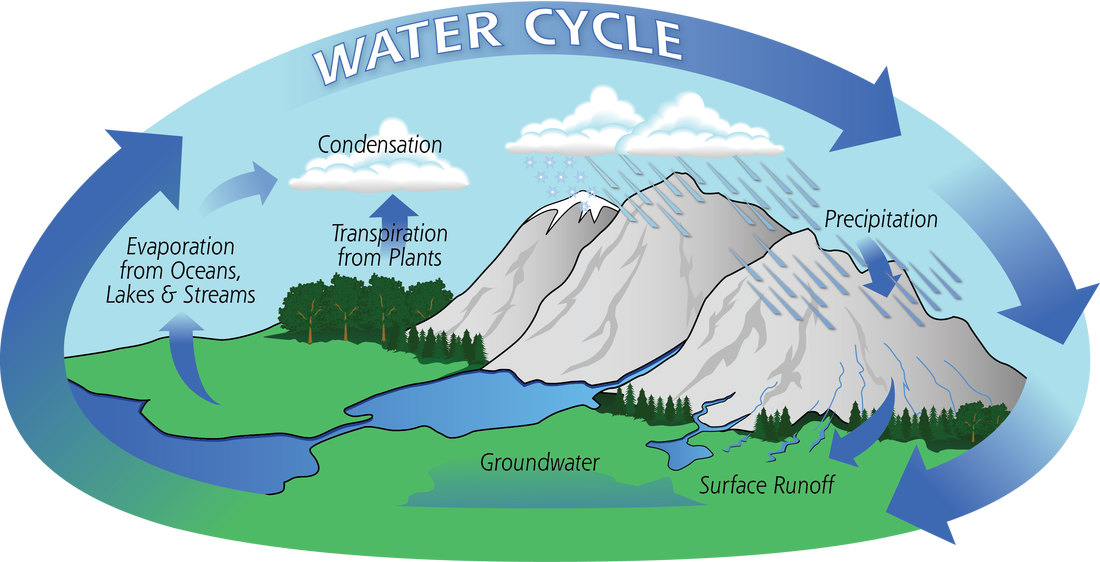
Explain what you think happens to a drop of water after it falls as rain.  See if you can create a story about this raindrop that ends with it falling to the ground again as rain!  Here are some hints to help you draft your story:
  • What have you seen raindrops do outside?
  • In your story, does the raindrop fall on a surface or somewhere else?
  • What happens to your raindrop in the first few minutes after it falls?
  • As an organizer, you can create a simple drawing with arrows that shows what your water drop will do in your story.
  • You need the following parts of the cycle to be in your story (explained): evaporation, condensation, precipitation, and some form of water collection (accumulation or infiltration, etc.).  (You can use other forms of the words if you'd prefer.)
Picture
0 Comments

Lesson 6 - Drops of Water on Different Surfaces

4/26/2015

0 Comments

 
Create a new blog post entitled, "Watery Earth Lesson 6 - Drops of Water on Different Surfaces"

Raindrop Lab:

  • Get various materials to represent things that rain can fall on.
  • Get an eyedropper and a cup of water, but don't start testing yet!
  • Drag in an "Embed Code" element.  Later, we will paste the embed code from our ThingLink.  (See the example on the right.)
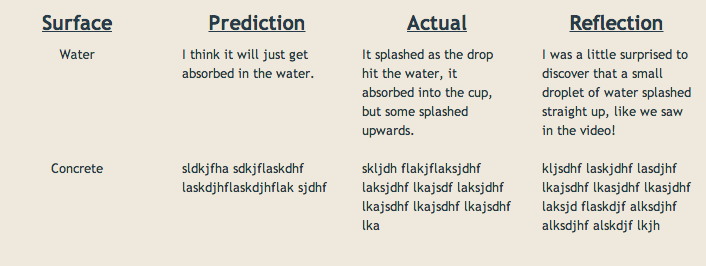
  • Set up a 4-Column Chart on your blog entry.  Look at the sample to the right for guidance.  Set up your titles and text the same way.
  • Choose all of the surfaces that you plan to test and create the drawing that you will use.
Picture
  • Make all of the predictions (use very descriptive language like we practiced with the apple).
  • Record videos of water dropping on each surface and what happens shortly after. Here is what that looked like last year.
  • Upload each video to YouTube.
  • Record what actually happened in your chart. Then, write a reflection sentence for each surface.
  • ThingLink them to a drawing that we create, take a picture of, and add tags to.
  • If it rains, we can also try to see this happening outside. Here are some pictures from last year.
Reflection Questions:
  1. Which materials surprised you the most? Why? 
  2. Which materials do you still wonder about? How do you think water will respond to that material?
0 Comments

Lesson 5 - How _______ Use Water

4/5/2015

0 Comments

 
Finally, find out how important water is to various scientists.  Of course, they use water like you and I do, but they also rely on water as part of their daily routine at work.  How do the following scientists use water at work?  What role does water play for each scientist?
  • Zoologists
  • Chemists
  • Geologists
  • Meteorologists
  • Botanists

Create a blog entry entitled, "Watery Earth Lesson 5 - How ________ Use Water" (using the Type of Scientist in the blank).

Write about how one type of scientist uses water at work.  Do this in paragraph form (Expository style).  Here is an example.
0 Comments

Lesson 4 - How _______ Use Water

4/5/2015

0 Comments

 
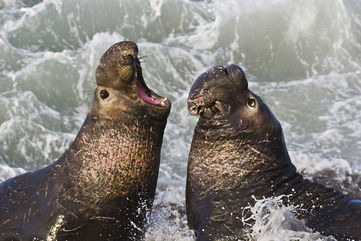
Picturehttp://a-z-animals.com/animals/elephant-seal/
Discuss how plants and animals need and use water.  Use what you already know and what you learned from the SRB reading from Session 2.

Assign each student an organism to research by having them sign up on our Google Spreadsheet (pull sticks). 

Create a blog entry entitled, "Watery Earth Lesson 2.3 - How _______ Use Water."  Put your organism's name in the blank. 

Using the bulleted lists from Water Earth Lesson 2's blog post to:
  1. Write a paragraph or more that describes how your organism needs and uses water.  Write in expository style writing (just like our Human Body Research Paper).  A sample blog post is below the Read More Break...
  2. Include at least one photo from Google Images that shows your organism.  (Link to the source & type in a caption.)

Below
your paragraph, create a 3-column chart with the following titles:
"Humans,"  "________" (Your Organism's Name in the blank), and "Both."

List at least three ways your organism uses or needs water that is different from humans in the proper columns.

List at least three ways your organism and humans use or need water similarly in the "Both" column.


Insert a "Title" element above the columns entitled, "How Humans and __________ Use and Need Water."

As a final reflection, answer the following questions under your 3-Column Chart:

   1.   Why is water considered a "Natural Resource?"
   2.   How is water essential (required) to our survival and the survival of all living things?


Read More
0 Comments

Lesson 3 - Natural Resources

4/5/2015

0 Comments

 
Picture
As a class, discuss the differences between Man-Made Resources and Natural Resources.

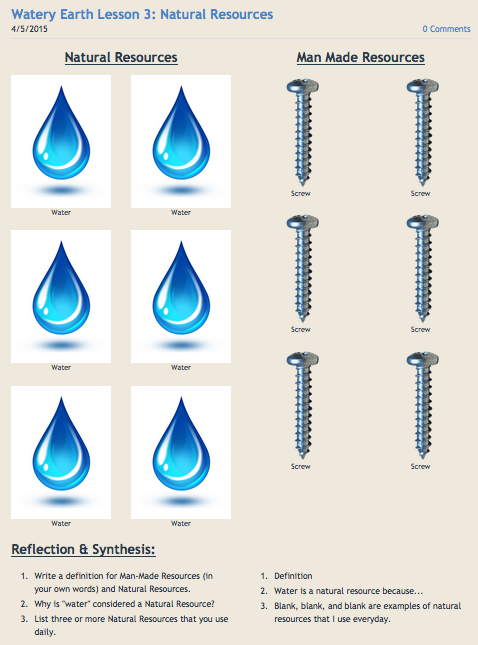
Create a blog entry entitled, "Watery Earth Lesson 3: Natural Resources." 

Create a 2-Column Chart with the titles: "Man-Made Resources" and "Natural Resources." 
  1. In each column, insert another 2-Column Chart.  (See the sample post on the right for a visual.)
  2. Find at least six photographs from Google Images that fit each category and drag them into each column.  Make sure that you have the same number of images on both sides when you are done.  You cannot search for "Natural Resources" or "Man-Made Resources" on Google; you must search for the items you want to put on each side individually.
  3. Link the photo back to its source (to give credit).  Do NOT turn on Lightbox.
  4. Type a caption that describes the picture.

At the bottom of your blog post:
  1. Write a definition for Man-Made Resources (in your own words) and Natural Resources.
  2. Why is "water" considered a Natural Resource?
  3. List three or more Natural Resources that you use daily.

Read the rest of the chapter in the SRB:
  • Click here to go to Science Companion's Sign-In Screen.
  • Click here to read the SRB pages 28-36.

0 Comments

Lesson 2 - How We Use Water

4/5/2015

0 Comments

 
Picture
Create a blog entry entitled, "Watery Earth Lesson 2: How We Use Water."  Using bullets, list all the ways you use water for:
  • Drinking and Eating
  • Keeping Clean
  • Caring for Pets
  • Playing
  • Other

Publish your post and then look through other students' posts.  When you have read at least four other students' posts, answer these two questions at the end of your post above:
  1. What seem to be the most commons uses of water (list at least three)?
  2. What are the most unusual uses of water (list at least three)?

Afterwards, read SRB pages 21-27.  Click here, sign in, then click here.  Stop reading at the word "Humans."

0 Comments

Lesson 1 - The Wonder of Water

4/1/2015

0 Comments

 
Picture
Share a personal story that you have had with water by making a blog entry on your ePortfolio & entitle it, "Watery Earth Lesson 1: My Water Story."  If you need help coming up with ideas, use this organizer to help brainstorm ideas: Water Stories. You will need to sign in with your Science Companion Prime information.  

When you are done, read others' stories and post positive comments for them to read.

Read the SRB Section entitled, "The Wonder of Water."  You will need to sign in with your Science Companion Prime information.
0 Comments

    Author

    Write something about yourself. No need to be fancy, just an overview.

    Archives

    May 2015
    April 2015

    Categories

    All

    RSS Feed

Powered by Create your own unique website with customizable templates.