What's going on in Mr. Solarz' Class?
What's going on in Mr. Solarz's Class?
  • Parents (Newsletter)
    • Our Online Photo Album >
      • 2018-2019 Photo Album
      • 2017-2018 Photo Album
      • 2016-2017 Daily Photo Journal
      • 2016-2017 Daily Photo Journal - Album 2
      • 2015-2016 Daily Photo Journal
      • 2015-2016 Yearbook
      • 2014-2015 Daily Photo Journal
    • Our YouTube Channels >
      • 2018-2019 YouTube Channel
      • 2017-2018 YouTube Channel
      • 2016-2017 YouTube Channel
      • 2015-2016 YouTube Channel
      • 2014-2015 YouTube Channel
      • 2013-2014 YouTube Channel
      • 2012-2013 YouTube Channel
      • YouTube videos over the years
      • Learn Like a PIRATE videos
    • Calendar
    • Our Weekly Schedule
    • FAQ about our classroom
    • Curriculum Night Presentation
  • Educators
    • Danielson Framework >
      • Domain 1 - Planning & Preparation
      • Domain 2 - Classroom Environment
      • Domain 3 - Instruction
      • Domain 4 - Professional Responsibilities
      • Professional ePortfolio
      • Instructional Coach Evidence
      • Experience Logs
    • FAQ about our Classroom
    • Workshops
    • Our Classroom Library is for Sale
  • Curriculum
    • Science Units >
      • 5th Grade >
        • Human Body Unit >
          • Human Body Links
        • Ecosystems >
          • Ecosystems - Legends of Learning
        • Watery Earth >
          • Watery Earth Links
        • Earth in Space
        • Investigating Matter
      • 4th Grade >
        • Energy >
          • Energy Unit Notes
          • Energy Debates
          • Energy Debate Organizers
        • Our Geosphere
        • Waves
      • Science Fair
      • STEM Investigations!
      • Try Engineering Together
    • Social Studies Units >
      • 5th Grade >
        • Revolutionary War >
          • Liberty's Kids Videos
          • Revolutionary War Hero Project >
            • RWHP Directions
        • U.S. Constitution & Government >
          • Mini Lessons
          • Colonize Mars! >
            • Claiming Mars for Ourselves >
              • 2017-2018 Creating our Country on Mars
              • 2016-2017 Mars Decisions
              • 2015-2016 Claiming Mars for Ourselves
              • 2014-2015 Claiming Mars for Ourselves 2015
            • Solutions to Problems on Mars >
              • 2017-2018 Our Solutions to Problems on Mars
              • 2016-2017 Problems & Solutions
              • 2015-2016 Our Solutions to Problems
              • 2014-2015 Our Solutions to Problems
            • 2014-2015 "Mission: Mars" Video Discussions 2015
          • Project Citizen
        • Westward Expansion >
          • Oregon Trail Simulation
          • Oregon Trail Readings
          • Reflection Rotation >
            • 2017-2018 Reflections >
              • ThingLink Photo Stories
              • Green Screen Tableaux Vivants
              • Fictional Travel Blog
              • Canva Concept Cards
              • YouTube Newscasts
              • Google Slide Show
              • Daily Travel Blog
              • Act-It-Outs
            • 2016-2017 Reflections
            • 2015-2016 Reflections >
              • Voki Reflections >
                • Voki Blog
            • 2014-2015 Reflections >
              • Act-It-Outs
              • Timeline Spreadsheet
              • Newscasts
              • ThingLink >
                • ThingLink Images
                • Sign up for ThingLink
              • Google Slideshow
              • Fictional Travel Log
              • Daily Travel Log
              • Tableaux Vivants
              • Photo Stories
      • 4th Grade >
        • Geography
        • Explorers
        • Native Americans
        • Colonization
        • State of Sustainability
      • Presidential Election Simulation - 2012 >
        • Presidential Election Simulation - 2016
      • Current Events
    • Reading >
      • 5th Grade Units >
        • Literature Circles >
          • Literature Circles >
            • Video Discussions
          • Literature Circles >
            • Video Discussions
            • Activities
        • Schoolwide Launch
        • Schoolwide Fiction
        • Schoolwide Non-Fiction
        • Schoolwide Ecosystems
        • Schoolwide Poetry
        • Wonder >
          • Wonder
        • The Phantom Tollbooth >
          • Phantom Tollbooth Assignments
      • 4th Grade Units >
        • Schoolwide Launch
        • Schoolwide Fiction
        • Schoolwide Non-Fiction
        • Schoolwide Poetry
        • Schoolwide Energy
    • Writing, Spelling & Grammar >
      • Writing >
        • Writing City
        • WEX
        • WriteAbout
        • Reflection Writing
        • JoonBugz
      • Spelling >
        • Words Their Way
      • Grammar >
        • Grammar
    • Math >
      • Money Island
      • Math in Focus
    • Miscellaneous >
      • Activities >
        • Short-Term Projects
        • Challenges!
        • Special Events
        • Projects & Mini Lessons
        • Bonus Activities
        • Miscellaneous >
          • Honor Badges
          • Growing a Growth Mindset
      • Imagination Club >
        • Schedule
        • Daily Ritual
        • Mini-Lessons
        • Photo Journal
        • Student Creations Round 1
      • Mystery Skype
      • Entrepreneurship Unit >
        • Entrepreneurship - Creating Our Own Businesses!
      • Self-Reflection
      • KinderPals
  • Student ePortfolios
    • 2018-2019 ePortfolios >
      • Students 1-7 >
        • 1 - Isabel
        • 2 - Alexis
        • 3 - Oscar
        • 4 - Adrian
        • 5 - Edy
        • 6 - Matthew
        • 7 - Molly
      • Students 8-14 >
        • 8 - Joey
        • 9 - Jeremiah
        • 10 - Emmalina
        • 11 - Sama
        • 12 - Hazel
        • 13 - Nick
        • 14 - Filip
      • Students 15-21 >
        • 15 - Nellie
        • 16 - Landon
        • 17 - Molly
        • 18 - Harrison
        • 19 - Kali
        • 20 - Inti
        • 21 - Ryan
        • 22 - Pavel
      • Blog Assignments
    • 2017-2018 ePortfolios >
      • Students 1-9 >
        • Elle
        • Daniel
        • Tommy
        • Alyssa
        • Gavin
        • Milosz
        • Mikey F
        • Caitlin
        • Brynna
      • Students 10-17 >
        • Kya
        • Olivia
        • Ian
        • Colin
        • Owen
        • Gianna
        • Isabella
        • Carmen P
      • Students 18-25 >
        • Lucy
        • Caleb
        • Mikey S
        • Wes
        • Martin
        • Will
        • Shaun
        • Carmen W
      • Blog Assignments
    • 2016-2017 ePortfolios >
      • Students 1-8 >
        • Hailie
        • Jody
        • Madison
        • Dylan
        • Calvin
        • Connor
        • Louisa
        • Harvey
      • Students 9-16 >
        • Anna
        • Jack
        • Ben
        • Elijah
        • Catelyn
        • Cole
        • Abby
        • Ashley
      • Students 17-23 >
        • Charles
        • Michelle
        • Charlie
        • Daniel
        • Sam
        • Chingoon
        • Kyren
      • Blog Assignments
    • 2015-2016 ePortfolios >
      • Students 1-9 >
        • TJ
        • JJ
        • Bridget
        • Alex
        • Mason
        • Ryan
        • Lucas
        • Shreya
        • Logan
      • Students 10-18 >
        • Charlotte
        • Addie
        • Aidan
        • Andrew
        • Jeremy
        • Rachel
        • Russell
        • Addy
        • Cassidy
      • Students 19-26 >
        • Audrey
        • Regan
        • Giuliana
        • Brady
        • Stephen
        • Matthew
        • Ben
        • Tyler
        • Thomas
      • Blog Assignments
    • 2014-2015 ePortfolios >
      • Students 1-7 >
        • 1 - Michael
        • 2 - Charlie
        • 3 - Nicole
        • 4 - Stacy
        • 5 - Bela
        • 6 - Kendall
        • 7 - Demetri
      • Students 8-14 >
        • 8 - Emily
        • 9 - Nicky
        • 10 - Hanna
        • 11 - Payton
        • 12 - Hasanain
        • 13 - Tucker
        • 14 - Chris
      • Students 15-21 >
        • 15 - Madi
        • 16 - Aidan
        • 17 - Luke
        • 18 - Kaela
        • 19 - Ryan
        • 20 - Alison
        • 21 - Lucas
      • Blog Assignments
  • Passion Time
    • Passion Time Resources >
      • ALL Passion Time Resources
      • Step-By-Step Directions
      • Submit Your Essential Question
      • Our Trello Page
      • Our Passion Projects over the years
      • Our Trello Board
      • SAMPLE Blog Post Format
      • YouTube Upload Page
      • Mini-Lessons
    • 2018-2019 Projects >
      • Round 1
      • Round 2
      • Round 3
      • Round 4
    • 2017-2018 Projects >
      • Round 1
      • Round 2
      • Round 3
      • Round 4
      • Round 5
    • 2016-2017 Projects >
      • Submit Your Essential Question
      • Mini-Lessons
      • Round 1
      • Round 2
      • Round 3
      • Round-4
      • Round 5
      • Round 6
    • 2015-2016 Projects >
      • Round 1
      • Round 2
      • Round 3
      • Round 4
    • 2014-2015 Projects >
      • Round 1
      • Round 2
      • Round 3
      • Round 4
      • Round 5
      • Round 6
  • Student-Led Classroom Info
    • Our Learning Experiences
    • 21st Century Skills
    • Whole Class Goals
    • Individual Goals
    • Classroom Jobs
    • Collaborative Responsibilities
    • Rituals & Routines
    • Uses of "Give Me Five"
    • Student-Led Mini-Lessons
    • Lit Circle Signposts
    • Mystery Skype Jobs

Kinderpals Reflection

5/22/2018

0 Comments

 
Reflect on the 7-8 times we worked with our KinderPals this year.
  1. What is the KinderPals Program?
  2. In what ways do you think the program benefits the kindergartners? Try to explain several with support.
  3. Why is the KinderPals program beneficial to 5th graders? Believe it or not, you should be getting something out of the program as well!
  4. What challenges did you experience in KinderPals this year?
  5. What improvements could be made to the program for next year?
  6. Do you think the kindergartners enjoyed the stories from Peekapak? Why do you think that? Do you have any evidence to support your answer?

Answers:
  1. The KinderPals program is a program that helps younger students learn about different essential virtues but, instead of teachers teaching the students older students teach them. For example I have a KinderPal that is in kindergarten and I am in fifth grade.
  2. I think it helps them learn about the different virtues that are needed in life. For example we are now doing honesty as the virtues for this time.
0 Comments

Testing Plant Growth

5/14/2018

0 Comments


Independent Variable ​

  • Plant seeds in different kinds of soil (e.g. potting soil, perlite, sand, etc.)
​

Dependent Variables ​

  • Measure the height of each plant at certain checkpoints.

Evidence

  • We can record our data using measurements (in cm).

Reflection/Synthesis:

Answer the following questions in your blog post. Remember to have at least one follow-up sentence for each question, when possible.
  1. Name your Control Variables (What will stay the same for each of the three cups)?
  2. Name the Independent Variable (What is it that is different for each of the three cups)?
  3. Name your Dependent Variable (What is it that you are testing & recording data on?)
  4. What data are you collecting to serve as Evidence to show how plants grow in organic material versus inorganic planting material?
  5. Why is everyone starting with the same three cups? Why do we need to test so many plants?
  6. What sprouts first in a seed: the stem or the root?
  7. How do you know? How do the pictures below help explain your answer for #6?
  8. Why do you think it goes in that order?

Answers:

  1. The kind of plant will stay the same.
  2. There are different types of materials we planted them in.
  3. We are measuring how long it is.
  4. We are measuring the plants we did that in class today but I had to go so I did not get to measure my plant.
  5. It is so we are sure of our answer.
  6. The root sprouts first. It looks for water and nutrients.

  7. This is a seed that was in water it's roots went in the direction it needed to to find water and nutrients.
  8. It goes in this order because you can slowly see it pushing out of the shell and you can also see growth changes.
Picture
Picture
Picture
Picture
0 Comments

Plants As Producers

5/3/2018

0 Comments

 
​Reflection/Synthesis:
Answer the following questions in your blog post. Remember to have at least one follow-up sentence for each question, when possible.
  1. Plants need energy and matter to grow. Where do plants get their ENERGY?
  2. Where do plants get their MATTER?
  3. Where do plants get their FOOD (be careful - this is a trick question)?
  4. Why are plants called Producers?
  5. What would happen if plants didn't have a way to get energy?
  6. What would happen to animals if there were no plants to eat?
  7. What are some of the LIVING components of a plant "system"? (A plant "system" is everything that a plant needs to survive and everything it produces.)
  8. What are some of the NON-LIVING components of a plant "system"?
  9. In what ways do the components of the system interact?
  10. What matter is transported in and out of the plant system?
Answers:
  1. Plants get there energy from the sun. They transform this into glucose.
  2. They get this from photosynthesis.
  3. They get this from nutrients in the ground and water.
  4. They are called this because they produce food.
  5. Every animal would go extinct because herbivores mostly get eaten by carnivores and herbivores would die out.
  6. They would all die.
  7. One of the living things are pollinators for example bees.
  8. Some of the non-living components are water and soil.
  9. They take stuff of the flower for example pollinators.
  10. Glucose is transported.
​
​
0 Comments

Players in an Ecosystem

4/23/2018

0 Comments

 
Picture
Picture
Picture
Reflect & Synthesize:
Answer the following questions in your blog post. Remember to have at least one follow-up sentence for each question, when possible.
  1. Choose one of your Food Chains that you created and explain how it works.
  2. Can a Food Web be considered a "system"? Why or why not?
  3. What happens if a plant or animal all of a sudden disappears from the food web?
  4. Using this food chain, "sunlight to apple to worm to bird to cat," How do organisms in this food chain get the matter they need for body repair and growth?
  5. Using the same food chain in #4, How do organisms in that food chain get the energy they need for body warmth and motion?
  6. What do you think happens to the matter that is NOT used by the organisms in a food chain or food web? Is it wasted or does something else happen?
Answers:
  1. A pill bug eats a rotting log and the pill bug gets eaten by Daddy Longlegs. Daddy Longlegs gets eaten by the robin. They all eat something (Except for the log) to survive.
  2. Yes because it repeats. Also it is very important.
  3. The entire food web dies because everything relies on that animal. For example a flower would die if there were no bees and then the skunk that eats the bees dies because there are no bees and so on.
  4. The worm gets the matter from the apple and that is the same for all the other ones.
  5. The worm gets the glucose that the apple and the other animals eat that and so on.
  6. Matter does not disappear it changes form. If the matter is a animal it will rot.
0 Comments

Food - Matter & Energy

4/16/2018

0 Comments

 
Picture
Picture
On the human food label:
  1. How do we find the energy (calories) per serving?
  2. How do we find the matter (carbohydrates, fats, proteins, vitamins, minerals)?
  3. Where can we locate the list of ingredients?

On the pet food label:
  1. Where can we locate the list of ingredients?
  2. How do we find the percentage of different types of matter in the food?
Answers:
  1. On the human food label you find the bolded letters that say calories. This is at the top.
  2. This is in the middle and towards the bottom. The different things are bolded.
  3. This is at the bottom. The word Ingredients is bolded.
Answers:
  1. This is at the top. At the very top.
  2. This is under the Guaranteed analysis.
Answer the following questions while analyzing the Nutrition Labels:
  1. As a result of looking at food labels, what did you learn about food?
  2. Look at the ingredients of one human food label. Write down the food name. What ingredients came from animals?
  3. What ingredients in the above food label came from plants?
  4. What similarities and differences did you notice between the human food and pet food labels you looked at?
  5. Choose an animal/insect from the ecosystem walk. What do you think it eats? Explain what you think it gets from its food.
Answers:
  1. I didn't really learn anything from the food labels. I learned a lot in the lesson.
  2. Tomato soup. None of the ingredients came from animals.
  3. 8 of the ingredients came from plants.
  4. In the pet food label the ingredients are at the top.
  5. An insect that I saw was a ant. I think it eats anything that is small that is on the ground.
Reflect & Synthesize:
Answer the following questions in your blog post. Remember to have at least one follow-up sentence for each question, when possible.
  1. What does food provide to animals, including humans?
  2. Do the pet food and human food have the same nutrients? In what ways are they different?
  3. Does a higher calorie count mean a food is better for pets to eat? What makes pet owners think that?
  4. What is it in food that helps us repair our bodies and grow?
  5. What in food helps us move and stay warm?
  6. In what way does energy transfer when animals eat food?
  7. Look at the nutrition label below for milk. How much energy is in the food?
  8. What matter is in the food?
Answers:
  1. Food provides energy and matter. The energy helps animals and humans move and do activities. Matter helps us fix things in our body.  
  2. Not really because pets mostly need different things than we do. Some things could be the same in different food labels but in this one there is nothing in common.
  3. Yes, because it gives them more energy to run around and do stuff. It can also be bad because of the fat.
  4. That is matter it helps us repair stuff in our body. For example matter can fix ripped muscles.
  5. Energy helps us move and keep warm. Energy also helps us do different things.
  6. When a cow eats a flower, that flowers stored glucose which can be used as energy gives that to the cow.
  7. There is 160 calories in the milk so there is a lot of energy.
  8. The sugar and fat is matter. There are a lot of other things that are matter.
Picture
0 Comments

What is an Ecosystem?

4/10/2018

0 Comments

 
Picture

Lake Ecosystem INTERACTIONS

With a system of living things

  • Ducks eat plants and bugs
  • Bugs eat plants 
  • Ducks eat grass
  • Plants interact with microscopic organisms in the dirt and water

Between living and non-living things

  • Ducks breath air
  • Plant use air
  • Plants use water
  • Ducks drink water
  • bugs drink water
  • Microscopic organisms drink water
  • Microscopic organisms use sunlight

Picture

Lake Ecosystem INTERACTIONS

With a system of living things

  • Fish eat algae 
  • Fish eat smaller​ fish​
  • Fish eat organisms in the water
  • algae interacts with organisms in the water

Between living and non-living things

  • algae uses dirt
  • algae uses water
  • fish drinks water
  • fish uses air bubbles to breath
  • Algae uses sunlight

Reflection/Synthesis Questions:

  1. What kinds of living things (organisms) do you see in both pictures?
  2. What other living things might be here, even if you can't see them in the photos?
  3. Why might living things in these photos interact with each other?
  4. Read the BIG IDEA below. How do these pictures depict an ecosystem?

Answers:
​

  1. In both picture you see some kind of plant. You also see a kind of animal. 
  2. There might be microscopic organisms. There also might be bacteria. 
  3. They might interact to get get food and other items needed to survive. For example a fish will eat another fish to survive. 
  4.   They show it by interacting with the things by them. For example a plant will interact with water.
Picture
Picture
Picture
It is an anthill the black dots are the ants inside.
Picture
Reflect & Synthesize:
Answer the following questions in your blog post. Remember to have at least one follow-up sentence for each question, when possible.
  1. What do living things get from their ecosystems?
  2. What evidence do you have to support your answer to Question 1?
  3. What does the term ecosystem mean, based on your experience in this lesson? (Don't use the definition from the BIG IDEA here. Put it into your own words.)
  4. Brainstorm at least one question you have about Ecosystems that you hope you learn from this unit.
  5. Look at the image below that shows a portion of a forest ecosystem. Name at least five components (living or non-living things) of the ecosystem that you can either observe directly or infer. 
  6. What are three (or more) interactions that might occur in this portion of the forest ecosystem?
Answers:
  1. I answered this in the screenshot above.
  2. I answered this in the screenshot above.
  3. An ecosystem is a place were living and non-living things interact with each other. For example a robin could be eating a worm.
  4. A question I have is will plants grow better in there natural ecosystems than in a human made one?
  5. I see a tree, grass, and what I think is water. I also see deer and I can infer that there is some other animals in that ecosystem like ants. 
  6. There might be photosynthesis, the deer are eat the grass, the deer at one point might drink the water. The ants might be digging in the ground.
Picture
0 Comments

Skills21 - Superhero Rehabilitation Program

4/9/2018

0 Comments

 
0 Comments

#World Poetry Day

3/21/2018

0 Comments

 
Picture
0 Comments

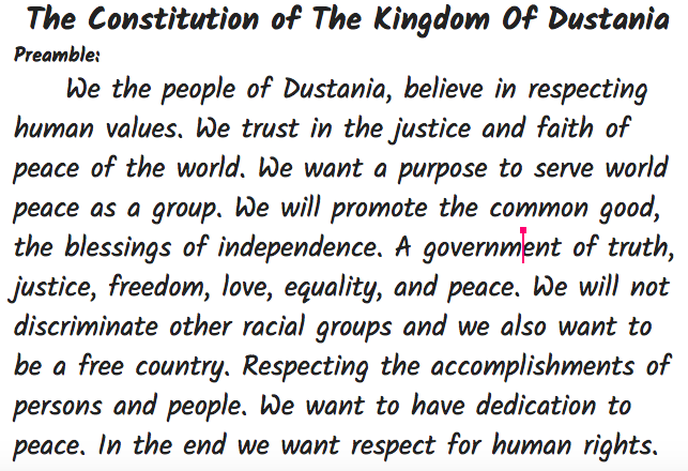
The Constitution of the Kingdom of Dustania

3/21/2018

0 Comments

 
Picture
Picture
Picture

Reflection Questions

Answers

  1. What was the hardest part of writing your preamble? Explain how you overcame that challenge.
  2. What is your favorite part of your preamble? Why is that part powerful and important?
  3. What is the purpose of a preamble in a constitution? What does it do?
  1. The hardest part was turning it into our own words.
  2. My favorite part was finding parts that we liked to add to our preamble.
  3. It introduces the constitution. 
0 Comments

Student Led Conference - Spring, 2018

3/20/2018

0 Comments

 
Picture
0 Comments
<<Previous

    Author
    ​


    Archives

    May 2018
    April 2018
    March 2018
    February 2018
    January 2018
    December 2017
    November 2017
    October 2017
    September 2017

    Categories

    All

    RSS Feed

    Picture
Powered by Create your own unique website with customizable templates.