What's going on in Mr. Solarz' Class?
What's going on in Mr. Solarz's Class?
  • Parents (Newsletter)
    • Our Online Photo Album >
      • 2018-2019 Photo Album
      • 2017-2018 Photo Album
      • 2016-2017 Daily Photo Journal
      • 2016-2017 Daily Photo Journal - Album 2
      • 2015-2016 Daily Photo Journal
      • 2015-2016 Yearbook
      • 2014-2015 Daily Photo Journal
    • Our YouTube Channels >
      • 2018-2019 YouTube Channel
      • 2017-2018 YouTube Channel
      • 2016-2017 YouTube Channel
      • 2015-2016 YouTube Channel
      • 2014-2015 YouTube Channel
      • 2013-2014 YouTube Channel
      • 2012-2013 YouTube Channel
      • YouTube videos over the years
      • Learn Like a PIRATE videos
    • Calendar
    • Our Weekly Schedule
    • FAQ about our classroom
    • Curriculum Night Presentation
  • Educators
    • Danielson Framework >
      • Domain 1 - Planning & Preparation
      • Domain 2 - Classroom Environment
      • Domain 3 - Instruction
      • Domain 4 - Professional Responsibilities
      • Professional ePortfolio
      • Instructional Coach Evidence
      • Experience Logs
    • FAQ about our Classroom
    • Workshops
    • Our Classroom Library is for Sale
  • Curriculum
    • Science Units >
      • 5th Grade >
        • Human Body Unit >
          • Human Body Links
        • Ecosystems >
          • Ecosystems - Legends of Learning
        • Watery Earth >
          • Watery Earth Links
        • Earth in Space
        • Investigating Matter
      • 4th Grade >
        • Energy >
          • Energy Unit Notes
          • Energy Debates
          • Energy Debate Organizers
        • Our Geosphere
        • Waves
      • Science Fair
      • STEM Investigations!
      • Try Engineering Together
    • Social Studies Units >
      • 5th Grade >
        • Revolutionary War >
          • Liberty's Kids Videos
          • Revolutionary War Hero Project >
            • RWHP Directions
        • U.S. Constitution & Government >
          • Mini Lessons
          • Colonize Mars! >
            • Claiming Mars for Ourselves >
              • 2017-2018 Creating our Country on Mars
              • 2016-2017 Mars Decisions
              • 2015-2016 Claiming Mars for Ourselves
              • 2014-2015 Claiming Mars for Ourselves 2015
            • Solutions to Problems on Mars >
              • 2017-2018 Our Solutions to Problems on Mars
              • 2016-2017 Problems & Solutions
              • 2015-2016 Our Solutions to Problems
              • 2014-2015 Our Solutions to Problems
            • 2014-2015 "Mission: Mars" Video Discussions 2015
          • Project Citizen
        • Westward Expansion >
          • Oregon Trail Simulation
          • Oregon Trail Readings
          • Reflection Rotation >
            • 2017-2018 Reflections >
              • ThingLink Photo Stories
              • Green Screen Tableaux Vivants
              • Fictional Travel Blog
              • Canva Concept Cards
              • YouTube Newscasts
              • Google Slide Show
              • Daily Travel Blog
              • Act-It-Outs
            • 2016-2017 Reflections
            • 2015-2016 Reflections >
              • Voki Reflections >
                • Voki Blog
            • 2014-2015 Reflections >
              • Act-It-Outs
              • Timeline Spreadsheet
              • Newscasts
              • ThingLink >
                • ThingLink Images
                • Sign up for ThingLink
              • Google Slideshow
              • Fictional Travel Log
              • Daily Travel Log
              • Tableaux Vivants
              • Photo Stories
      • 4th Grade >
        • Geography
        • Explorers
        • Native Americans
        • Colonization
        • State of Sustainability
      • Presidential Election Simulation - 2012 >
        • Presidential Election Simulation - 2016
      • Current Events
    • Reading >
      • 5th Grade Units >
        • Literature Circles >
          • Literature Circles >
            • Video Discussions
          • Literature Circles >
            • Video Discussions
            • Activities
        • Schoolwide Launch
        • Schoolwide Fiction
        • Schoolwide Non-Fiction
        • Schoolwide Ecosystems
        • Schoolwide Poetry
        • Wonder >
          • Wonder
        • The Phantom Tollbooth >
          • Phantom Tollbooth Assignments
      • 4th Grade Units >
        • Schoolwide Launch
        • Schoolwide Fiction
        • Schoolwide Non-Fiction
        • Schoolwide Poetry
        • Schoolwide Energy
    • Writing, Spelling & Grammar >
      • Writing >
        • Writing City
        • WEX
        • WriteAbout
        • Reflection Writing
        • JoonBugz
      • Spelling >
        • Words Their Way
      • Grammar >
        • Grammar
    • Math >
      • Money Island
      • Math in Focus
    • Miscellaneous >
      • Activities >
        • Short-Term Projects
        • Challenges!
        • Special Events
        • Projects & Mini Lessons
        • Bonus Activities
        • Miscellaneous >
          • Honor Badges
          • Growing a Growth Mindset
      • Imagination Club >
        • Schedule
        • Daily Ritual
        • Mini-Lessons
        • Photo Journal
        • Student Creations Round 1
      • Mystery Skype
      • Entrepreneurship Unit >
        • Entrepreneurship - Creating Our Own Businesses!
      • Self-Reflection
      • KinderPals
  • Student ePortfolios
    • 2018-2019 ePortfolios >
      • Students 1-7 >
        • 1 - Isabel
        • 2 - Alexis
        • 3 - Oscar
        • 4 - Adrian
        • 5 - Edy
        • 6 - Matthew
        • 7 - Molly
      • Students 8-14 >
        • 8 - Joey
        • 9 - Jeremiah
        • 10 - Emmalina
        • 11 - Sama
        • 12 - Hazel
        • 13 - Nick
        • 14 - Filip
      • Students 15-21 >
        • 15 - Nellie
        • 16 - Landon
        • 17 - Molly
        • 18 - Harrison
        • 19 - Kali
        • 20 - Inti
        • 21 - Ryan
        • 22 - Pavel
      • Blog Assignments
    • 2017-2018 ePortfolios >
      • Students 1-9 >
        • Elle
        • Daniel
        • Tommy
        • Alyssa
        • Gavin
        • Milosz
        • Mikey F
        • Caitlin
        • Brynna
      • Students 10-17 >
        • Kya
        • Olivia
        • Ian
        • Colin
        • Owen
        • Gianna
        • Isabella
        • Carmen P
      • Students 18-25 >
        • Lucy
        • Caleb
        • Mikey S
        • Wes
        • Martin
        • Will
        • Shaun
        • Carmen W
      • Blog Assignments
    • 2016-2017 ePortfolios >
      • Students 1-8 >
        • Hailie
        • Jody
        • Madison
        • Dylan
        • Calvin
        • Connor
        • Louisa
        • Harvey
      • Students 9-16 >
        • Anna
        • Jack
        • Ben
        • Elijah
        • Catelyn
        • Cole
        • Abby
        • Ashley
      • Students 17-23 >
        • Charles
        • Michelle
        • Charlie
        • Daniel
        • Sam
        • Chingoon
        • Kyren
      • Blog Assignments
    • 2015-2016 ePortfolios >
      • Students 1-9 >
        • TJ
        • JJ
        • Bridget
        • Alex
        • Mason
        • Ryan
        • Lucas
        • Shreya
        • Logan
      • Students 10-18 >
        • Charlotte
        • Addie
        • Aidan
        • Andrew
        • Jeremy
        • Rachel
        • Russell
        • Addy
        • Cassidy
      • Students 19-26 >
        • Audrey
        • Regan
        • Giuliana
        • Brady
        • Stephen
        • Matthew
        • Ben
        • Tyler
        • Thomas
      • Blog Assignments
    • 2014-2015 ePortfolios >
      • Students 1-7 >
        • 1 - Michael
        • 2 - Charlie
        • 3 - Nicole
        • 4 - Stacy
        • 5 - Bela
        • 6 - Kendall
        • 7 - Demetri
      • Students 8-14 >
        • 8 - Emily
        • 9 - Nicky
        • 10 - Hanna
        • 11 - Payton
        • 12 - Hasanain
        • 13 - Tucker
        • 14 - Chris
      • Students 15-21 >
        • 15 - Madi
        • 16 - Aidan
        • 17 - Luke
        • 18 - Kaela
        • 19 - Ryan
        • 20 - Alison
        • 21 - Lucas
      • Blog Assignments
  • Passion Time
    • Passion Time Resources >
      • ALL Passion Time Resources
      • Step-By-Step Directions
      • Submit Your Essential Question
      • Our Trello Page
      • Our Passion Projects over the years
      • Our Trello Board
      • SAMPLE Blog Post Format
      • YouTube Upload Page
      • Mini-Lessons
    • 2018-2019 Projects >
      • Round 1
      • Round 2
      • Round 3
      • Round 4
    • 2017-2018 Projects >
      • Round 1
      • Round 2
      • Round 3
      • Round 4
      • Round 5
    • 2016-2017 Projects >
      • Submit Your Essential Question
      • Mini-Lessons
      • Round 1
      • Round 2
      • Round 3
      • Round-4
      • Round 5
      • Round 6
    • 2015-2016 Projects >
      • Round 1
      • Round 2
      • Round 3
      • Round 4
    • 2014-2015 Projects >
      • Round 1
      • Round 2
      • Round 3
      • Round 4
      • Round 5
      • Round 6
  • Student-Led Classroom Info
    • Our Learning Experiences
    • 21st Century Skills
    • Whole Class Goals
    • Individual Goals
    • Classroom Jobs
    • Collaborative Responsibilities
    • Rituals & Routines
    • Uses of "Give Me Five"
    • Student-Led Mini-Lessons
    • Lit Circle Signposts
    • Mystery Skype Jobs

Nature's Waste Master

5/24/2017

0 Comments

 
Answer the following questions in your blog post. Remember to have at least one follow-up sentence for each question, when possible.
  1. Where do you think the items came from originally?
  2. Do you think the items look the same today as they did a month ago?
  3. What happened to the matter in each item over the past month?
  4. Do you think the items will be the same forever? Why or why not?
  5. What do all of the items in the bag have in common?
  6. Do you notice any relationships between the items in the bags? They all...
  7. What evidence do you have that the items were all once part of a living thing?
  8. Another name for "nature's waste" is "organic remains." These are all organisms that are no longer living, or parts of organisms that are discarded, excreted, or no longer needed.  What other examples of organic remains can you think of?
  9. What would happen to each item from your bag if it were left outside? What might it look like in 6 months? What would cause it to change?
  10. What would eventually happen to the waste MATTER in each type of organic remain?
  11. Why isn't the earth just piled up with all the matter from nature's waste?
  12. Why could all of the items in the mystery bags be classified as nature's waste?
  13. Do you think that all living things generate waste? What makes you think that?
Answers:
  1. Trees and different plants. There are leaves, pine cones and pine needles which come from trees, and the flowers and grass come from other plants.
  2. I don't think so. They are most likely dying right now because they aren't getting any more nutrients, and when they were on plants they were most likely growing.
  3. They are decaying and died because they aren't getting any food and nutrients. They can't do photosynthesis anymore.
  4. No, because they can't make anymore food. So they will start to die and they won't be the same forever. 
  5. They are all nature's waste, and came from plants. They all fell off of either a tree or a plant. The grass was just left behind from being cut.
  6. The leaves and the flowers both made food using photosynthesis. The twigs and the leaves both fell off of trees.
  7. They all are called nature's waste, and nature is made up of living things. So they would have all had to come from living things to be called that.
  8. Dog hair, snake skins, bird feathers. They aren't really needed anymore because the animals have made more of it. 
  9. It would keep growing and be bigger. Since it got all the nutrients it needs and the sunlight it can make food for itself, and keep growing.
  10. It would decay and turn into soil. Once something decays and dies it just goes back into the land as soil. 
  11. Because we make different materials out of different things. We make wood chips out of sticks, and other things get recycled and made into other new things.
  12. They can be classified as that because the plant didn't need them anymore so it just dropped down. Then it starts to die and becomes waste.
  13. Yes, because when we don't need nutrients that we eat and we get rid of it and that is called waste. Animals also produce waste when they don't need certain body parts anymore and it just falls off.
0 Comments

Sunlight on the Menu

5/23/2017

1 Comment

 
I was absent for this lesson.
1 Comment

Plants as Producers

5/17/2017

0 Comments

 
Reflection/Synthesis:
Answer the following questions in your blog post. Remember to have at least one follow-up sentence for each question, when possible.
  1. Plants need energy and matter to grow. Where do plants get their ENERGY?
  2. Where do plants get their MATTER?
  3. Where do plants get their FOOD (be careful - this is a trick question)?
  4. Why are plants called Producers?
  5. What would happen if plants didn't have a way to get energy?
  6. What would happen to animals if there were no plants to eat?
  7. What are some of the LIVING components of a plant "system"? (A plant "system" is everything that a plant needs to survive and everything it produces.)
  8. What are some of the NON-LIVING components of a plant "system"?
  9. In what ways do the components of the system interact?
  10. What matter is transported in and out of the plant system?
Answers:
  1. Plants get there energy from the Sun. Then it gets turned into food through photosynthesis, and when the plants eat the food they get energy.
  2. From carbon in the air. The plant is what it's mostly made up of.
  3. The Sun. That's where they get the energy to make food. So the Sun technically is where plants get their food from.
  4. Because they make food for themselves. Then herbivores eat the plants and so on.
  5. Then they wouldn't have any food because they make food off of the energy they get from the Sun. Then they won't get any energy and will most likely die.
  6. Everyone else would die. The herbivores and omnivores eat the plants, and if there were no plants they wouldn't get food. The the carnivores and some omnivores won't get any food.
  7. The sun. It's the only thing in a plant system besides the plant, that the plant needs to survive.
  8. Air (Carbon-dioxide, and oxygen), water and the soil. The air gives the plant matter, and the water and soil give the plant nutriens it needs.
  9. The sun and the water and soil interact in the process of photosynthesis, since they are both parts of the food that the plant creates. The soil and the water interact since the water transports the nutriens inside the soil throughout the plant.
  10. The oxygen. Since it's part of the plant's matter and it's being exhaled it is getting released from the plant system.

​
0 Comments

Food - Matter & Energy

5/11/2017

2 Comments

 
Picture
Answer the following questions while analyzing the Nutrition Labels:
  1. As a result of looking at food labels, what did you learn about food?
  2. Look at the ingredients of one human food label. Write down the food name. What ingredients came from animals?
  3. What ingredients in the above food label came from plants?
  4. What similarities and differences did you notice between the human food and pet food labels you looked at?
  5. Choose an animal/insect from the ecosystem walk. What do you think it eats? Explain what you think it gets from its food.
Reflect & Synthesize:
Answer the following questions in your blog post. Remember to have at least one follow-up sentence for each question, when possible.
  1. What does food provide to animals, including humans?
  2. Do the pet food and human food have the same nutrients? In what ways are they different?
  3. Does a higher calorie count mean a food is better for pets to eat? What makes pet owners think that?
  4. What is it in food that helps us repair our bodies and grow?
  5. What in food helps us move and stay warm?
  6. In what way does energy transfer when animals eat food?
  7. Look at the nutrition label below for milk. How much energy is in the food?
  8. What matter is in the food?
Picture
Answers:
  1. How different foods are a lot better for you than other foods. Also how some foods kind of trick you with the serving size.
  2. Peanut butter. It has no ingredients that comes from an animal.
  3. Tomato puree, and soybean oil.
  4. Both labels have one ingredient that has to do with carrots. The human label has no meat, while the pet food one has lots.
  5. A rolly pollie probably eats leaves other parts of plants. It gets energy and matter from it's food.
Answers:
  1. Matter and energy.
  2. They have some of the same. They both have Vitamin A and calcium. The soup doesn't have any meat though, and the pet food does.
  3. Because then their pets will then have a lot of energy. I think it might be a little better, as long as they burn some of the calories to.
  4. Protein.
  5. Calories (energy).
  6. When animals eat other animals. Then the animals that ate the animal get some of the stored energy that the animal had inside of it.
  7. 160 calories per serving. 
  8. Most likely the fat and the protein. That's what adds weight and muscles to your body.
Picture
2 Comments

Players in an Ecosystem

5/10/2017

0 Comments

 
Picture
Reflect & Synthesize:
Answer the following questions in your blog post. Remember to have at least one follow-up sentence for each question, when possible.
  1. Choose one of your Food Chains that you created and explain how it works.
  2. Can a Food Web be considered a "system"? Why or why not?
  3. What happens if a plant or animal all of a sudden disappears from the food web?
  4. Using this food chain, "sunlight to apple to worm to bird to cat," How do organisms in this food chain get the matter they need for body repair and growth?
  5. Using the same food chain in #4, How do organisms in that food chain get the energy they need for body warmth and motion?
  6. What do you think happens to the matter that is NOT used by the organisms in a food chain or food web? Is it wasted or does something else happen?
Answers:
  1. The way that my food chain above works is the sunlight gives the grass the energy it needs to create food. Then the rabbit eats the grass, and then the eagle eats the rabbit.
  2. Yes, because the parts of a system rely on the other parts of system for things. In a food web it's kind of the same, the animals rely on each other for food.
  3. Then the things that eat that plant or animal go hungry. Like if in my food chain the grass doesn't grow anymore then the rabbit won't have anything to eat. Then the rabbit could die, and then the eagle has no food.
  4. The apple gets it's matter and energy from the sun in order to make it's own food. The worm then gets energy and matter from the apple. The bird gets energy and matter from the bird, and the cat gets matter and energy from the bird.
  5. When they eat the animal, or in some cases the plants or sunlight they get all of the stored energy that was inside of them. 
  6. It might just go into the Earth. Decomposers probably brake it down and it goes into the Earth.
0 Comments

Our Mars Constitution

5/9/2017

0 Comments

 
Our Constitution:
0 Comments

What is an Ecosystem?

5/5/2017

0 Comments

 
Picture
Picture

Lake Ecosystem INTERACTIONS

Within a system of living things
  • Ducks eat plants and bugs.
  • Ducks are interacting or communicating with other ducks.
  • Ducks fertilize the plants.
  • Plants release oxygen for the ducks to breathe.
Between living & non-living things
  • Ducks breathe air (oxygen).
  • Ducks are swimming in the lake.
  • Duck drinks the lake water.
  • Plants are growing in the lake, and taking nutrients from the water.
  • Plants are taking light from the sun, and is converting food from it.


Second image:
Within a system of living things
  • The fish eat bugs.
  • Fish eat smaller fish and frogs.
  • Fish swim through plants.​​
Between living & non-living things
  • ​Fish swim in the water.
  • Plants release oxygen into the water.
  • Plants grow in the ground and the water.


Picture
Picture
Picture
Picture
Picture
Picture
Picture
Picture
Picture
Picture
Reflect & Synthesize:
Answer the following questions in your blog post. Remember to have at least one follow-up sentence for each question, when possible.
  1. What do living things get from their ecosystems?
  2. What evidence do you have to support your answer to Question 1?
  3. What does the term ecosystem mean, based on your experience in this lesson? (Don't use the definition from the BIG IDEA here. Put it into your own words.)
  4. Brainstorm at least one question you have about Ecosystems that you hope you learn from this unit.
  5. Look at the image below that shows a portion of a forest ecosystem. Name at least five components (living or non-living things) of the ecosystem that you can either observe directly or infer. 
  6. What are three (or more) interactions that might occur in this portion of the forest ecosystem?
Answers:
  1. They get soil, oxygen, sunlight and sometimes water. It depends what ecosystem you are in if you can get water or not.
  2. The trees and flowers and plants grow because of the soil, and the sunlight. They get rain water, but sometimes there are ponds in an ecosystem. The oxygen keeps all the animals alive, and the soil helps the insects.
  3. A place where living things and non living things live/are. They also interact with each other.
  4. Why can't some animals live in a certain ecosystem?
  5. Water, deer, grass, flowers, trees, and rocks.
  6. The deer drink the water. The deer might interact with the other deer. The deer will eat the berries and nuts that are in the forest.
Picture
0 Comments

My First Week in Space

5/3/2017

0 Comments

 
Picture
We took of into space about a week ago. Take off was awesome, but it was pretty scary at the same time. The ship started shaking like crazy, and we all started shaking too. Everyone was scared, and was hoping that nothing will go wrong. Some people were crying, and some were celebrating. Living in space is really cool, but it's pretty hard. There is no gravity so we float around everywhere. Brushing our teeth is an example of one of the challenges because the toothpaste sometimes floats off of the toothbrush. We have to do things quickly so everything doesn't float away when we are trying to do something. It is really fun to be floating around on a spaceship all day! The food is pretty gross on the spaceship. We have to eat freeze-dried food that doesn't taste as good as the normal stuff. Some of the stuff tastes pretty good, but then some are pretty gross. A few people brought regular food which tastes really good when we eat it. Sleeping is also a cool but weird aspect of living on the ship. We are kind of half standing half siting in the beds that we have. At least the beds are Velcroed to the walls so we don't go floating around in the ship! It's like we are standing in a sleeping bag, but sleeping at the exact same time. We do get plenty of rest even though we are floating in space. Exercising on the ship is also really cool. Our fitness trainer brought a lot of stuff for us to exercise with. He brought a vacuum treadmill, weights, and lots of other things. In my freetime on the ship I play on my phone, watch videos, play games, talk with my friends that are on the ship. I also really enjoy looking out into space down at Earth, and at the other planets. We also have a lot of work to do. For my job I am constantly sewing clothes, and designing clothes for people, and building spacesuits. I also have to help Sophia Smith cook some food for meals. I like cooking so I really enjoy helping her. I really miss my family and friends back in Berlin, Germany. I do get to facetime them and call and text them, but it isn't the same. Looking down at Earth makes me sad to see what I have left behind, and then I look at Mars and become excited to see what is ahead at Mars. I can't wait for the next 21 weeks before we land on Mars!
0 Comments

Star Patterns

4/7/2017

0 Comments

 
0 Comments

VR Trip to Pakistan

4/7/2017

0 Comments

 
Picture
Picture
Picture
Picture
Picture
Picture
Picture
Picture
Picture
Picture
Picture
Picture
Picture
Picture
Picture
Picture
Picture
0 Comments

What I Think I Know About Mars

4/5/2017

0 Comments

 
What do I already know about Mars?
  • I know that it is made up of sand and rock.
  • I know that water was just recently found on it, so know we can live on it.
  • There are robots on the planet now, but no humans yet. 
  • There are no animals or humans on the planet. But most likely bacteria.
  • The US is planning to send people to Mars to investigate soon.
  • Mars is still a safe distance from the sun so we won't get to warm or cold.
  • Mars is the farthest planet away from the sun that isn't made of some sort of gas.
  • It doesn't rain on Mars.
Answer the following questions WHILE you watch:
  1. What do you know about NASA's plans to visit Mars?
  2. How long will the trip take?
  3. What supplies and equipment will the astronauts need to survive there?
  4. What do you think are the risks of traveling to such a distant planet?
  5. What would you want to bring with you?
  1. They want to send people sometime early in the next century. Before they decide to they want to see what evidence robots find. They want to make sure that it is safe before humans go.
  2. Two and a half years usually. But they want to go at a certain time when it will only take 6 months.The way they would do this is that when Mars and Earth are almost alined with each other so that it wouldn't be as far as a distance.
  3. Food, air, and water. There is a machine that would recycle the air, food, and water to be re-used. Then the source would never get low and there would always be enough to survive. They would also need tons of different types of tools to do different experiments. 
  4. Not enough gravity, that may do things to your body if there isn't enough. Like you might not be able to walk or do things with Earth's gravity and it does things to your bones and muscles. You would have to make sure that you worked out enough. Different germs and bacterias that might affect you or the journey may also be dangerous, as well as unknown parts of space. Mars is also getting dryer and dryer so if they run out of water there might not be enough.
  5. I would want to bring food that I like and would still last on Mars, and bring things to do if I get bored of just doing nothing or the people in my crew. Also something that would still be able to contact my family and my friends from Mars or where ever in space I am. 
0 Comments

Earth's Orbit and Stars

4/5/2017

0 Comments

 
0 Comments

If the World Were a Village

4/4/2017

0 Comments

 
Notes:
​Page 7:
  • In 2012 the world’s population was about 7 billion 50 million
  • China and India have the biggest population
  • If we lived in a world that just has one village with 100 people, each person would represent 70.5 million people in real life.
Summary:   This talks about the population of our Earth, and how it would be different with very little people.

Page 8:
  • People from the village
    • 60 from Asia
    • 15 from Africa
    • 11 from Europe
    • 8 are from South America, Mexico, Central America, and the Caribbean
    • 5 are from Canada and the US
    • 1 is from Oceania
Summary:     Most people in the global village come from places like Asia and the other most populated countries in the world.

Page 10:
  • People in the global village all speak different languages.
    • In the global village there are 6,000 languages more than ½ the people speak these languages:
    • 21 speak Chinese dialect and of these 21, 16 people speak Mandarin dialect.
    • 9 speak Hindi
    • 9 speak English
    • 7 speak Spanish
    • 4 speak Bengali
    • 3 speak Portuguese
    • 3 speak Russian
Summary:   This page shows how many languages are spoken in different places of our world. There are 8 languages that are very popular and there are about 6,000 languages on Earth.

Page 12:
  • ⅕ of the villagers are 9 or younger
  • More than half are under 30
  • 9 are under 5
  • 10 are between 5 and 9
  • 18 are between 10 and 19
  • 17 are between 20 and 29
  • 15 are between 30 and 39
  • 12 are between 40 and 49
  • 9 are between 50 and 59
  • 6 are between 60 and 69
  • 3 are between 70 and 79
  • 1 is over 79
  • The numbers were very different in the village around the 1900’s
  • The village is slowly growing
Summary:     This page talks about the ages in the global village. The number of children went up in the past couple of years and will probably go down soon, and it’s the opposite with the elderly.

Page 15:
  • There are many different religions in the global village
  • 33 are Christian
  • 22 are Muslims
  • 15 don’t have a religion or are athiest
  • 14 are Hindus
  • 9 practice Shamanism, Animism, and other folk religions
  • 5 are Buddhists
  • 2 belong to other religions such as Judaism, Confucianism, Shintoism, Sikhism, Jainism, or Baha’i faith.
  • There are big changes for some of the religions
Summary:    Religions can become more or less popular throughout the years. Also every religion is okay to believe in in this village.

Page 17:
  • The villagers produce different foods.
  • 31 sheep and goats
  • 23 cows, bulls and oxen
  • 15 pigs
  • 3 camels
  • 2 horses
  • 700 chickens - 7x more than the people
  • Not all the food was divided equally.
  • 30 people are hungry either most or all the time
  • 17 people are always hungry
  • That’s 47 people that don’t have any or very little food
  • Then the other 53 are fine and don’t need to worry
Summary:    There is tons of food in this world and about ½ of this world doesn’t get enough, and are always or most of the time starving. Then the other half have enough to survive and thrive with it, and there is plenty of food to go around to everyone.

Page 18:
  • In most of the village the air and water is clean, but some places aren’t so lucky or there isn’t enough.
  • Fresh air and drinkable water is necessary.
  • 87 have clean water either in their home or not far away.
  • The other 13 don’t have clean and safe water and have to travel large distances to get it.
  • 62 have clean sanitation like public or household sewage disposal, the other 38 don’t. They either have to go in outhouses or like the woods, and they are in dangerous situations.
  • 68 people breathe clean air while the other 32 don’t.
Summary:    This page talks about how some people don’t have what is necessary to live (clean air and water, sewage system, etc.) ,and it’s really dangerous.

Page 21:
  • Some children don’t go to school and some just have to say home to help their family.
  • 36 can go to school and only 30 go. There is only 1 teacher for these 30 students.
  • The other 6 children are working instead.
    • Three work for their families around the house, on farms, and small businesses.
    • Three are child laborers. They are forced to work in fields, factories, and mines. They sell things on the streets and might serve as child soldiers in the military.
  • Out of the people that can read 14 of them can’t. Mostly men are taught to read because people thought that they are more likely to get a job.
  • Out of the 63 adults that can have a job only 52 are working. Six people want to find jobs, and five are in school.
Summary:    Education is sometimes not present in some parts of the world and lots of people don’t really work or go to school at all.

Page 22:
  • In this global village money isn’t divided equally. If it was everyone would make about $10,300 a year.
  • The 10 richest people make up nearly 85% of the world’s wealth. Each has $87,500 a year in the global village.
  • The 10 poorest people each have less than $2 a day.
  • The other 80 people make in between. Half the people make an average of about $6 per day.
  • The average cost of necessities is $5,000 per year in the village.
  • The villagers have:
    • 50 radios
    • 45 televisions
    • 103 telephones but more than 86 are cell phones
    • 28 computers
    • 2 trucks
    • 10 automobiles
    • 20 bikes
Summary:    A lot of the world doesn’t make or have enough money to buy the necessities of life or anything extra. Some people just make $2 per day.

Page 25:
  • 76 have electricity
  • 24 don’t
  • Of the 76 that have electricity they really only use it at night
  • 73% of the energy comes from fossil fuels
  • 17% comes from nuclear power
  • 10% comes from wind and water
Summary:    This page talks about how tons of people don’t have electricity and the energy that they need to use. ¼ of the world doesn’t have electricity which means no fridge or anything like that.

Page 27:
  • Today people are expected to live up to 68 on an average.
  • One big problem is malaria.
    • 41 people in the village live in a place where malaria is found.
    • 6 people contract malaria every year.
    • There are shots and 80 people get vaccinations for some diseases.
    • But more vaccinations need to be found.
Summary:    Some people aren’t lucky enough to get the medicine that we have and get the same diseases every year. Some resources have been found but we need to find more and make it more popular in other parts of the world.
Write a blog entry called, "If the World Were a Village" and write about the following in paragraph format. (Don't respond to these questions individually. Incorporate them all into a paragraph.) 
  • Explain what surprised you about the statistics of our world.
  • What upset you?  What do you wish were different?
  • What made you want to do something to improve a situation?
  • Can you do anything to help? If so, what?
The one statistic that surprised me was that only 3/4 of the world has electricity and the other 1/4 doesn't. That's 25% that doesn't have a fridge or and oven or any lights at all. It would be really hard to live like that since we have for our whole lives. Something that upset me was how many people go hungry in the world, and I wish that everyone had enough food like we do. The thing that made me want to improve that situation was about 50% of the world/village doesn't have enough food. Then the other 50% has enough to live or thrive with it, and we throw out so much food everyday it's unbelievable. To help this situation I would give away the good food that my family doesn't eat or still good leftovers that could help the people that are hungry and starving. 
Also, include an appropriate image of some sort that goes with what you are saying (and give credit).:
Picture
Credit:
https://www.consciousalliance.org/project-entries/food-drive/
0 Comments

Seeing Stars from Earth

4/3/2017

0 Comments

 
0 Comments

21st Century Skills Challenge!

3/22/2017

0 Comments

 
Picture
​Reflection/Synthesis Questions:
  1. What was hard about the game? Explain in detail!
  2. Was the game a valuable use of class time? If so, why? If not, why not?
  3. Regardless of your answer to #2 above, if you were marketing this game to teachers, what would you claim this game is good for in the classroom? What skills do students learn from this game?
  1. It was hard because we couldn't really see what the other person was talking about. So if my partner was giving me instructions and it was hard to understand, I couldn't look at his screen and see what he was talking about but had to try and figure it out on my own. 
  2. It was because we learned how to communicate better with each other, and also learned how to solve problems while hitting challanges along the way.
  3. I would say that it's good for problem solving and working well with others. If you and your partner didn't get along you wouldn't accomplish anything in this game and then you would have to start working better with each other.
0 Comments

Reflections from Dubai

3/21/2017

0 Comments

 
My teacher, Mr. Solarz, was fortunate enough to travel to Dubai last week for an education conference and to meet former Top 50 Global Teacher Prize candidates for the Varkey GEMS Global Teacher Prize. He shared his unbelievable experience with us, and here are some things that I learned from our discussion:
  • One thing that I learned was that the head of the program gave away more money than he kept. Let's say he earned about $10 billion a year he would probably give away $8,900,000 that year. He does that every year and donates to different charities or things that he believes in. He keeps giving it away until it hurts.
  • I learned about different cultures and some interesting things about them, and how no matter what culture you are or what lanuage we speak we are more a like than different. 
  • I learned that some people can be really smart and really good at something, and then they have some things that they really need to improve on. 
Picture
0 Comments

World Poetry Day 

3/21/2017

0 Comments

 
Picture
Reflection/Synthesis Questions:
  1. Why did you choose the poem that you chose? Does it have a message that you wish others to learn? Is it playing with language in a fun or original way? Why this poem and not a different one?
  2. What is it that you like about poetry? If you don't know, look through the poems that are being tweeted today to find inspiration!
Answers:
  1. I chose this one because it's really simple and I like it like that. It's really funny when you think about it. It has a message that says to have a creative mind. She could of gotten water from her kitchen but instead she just waited outside for it to rain. It's in a fun original way because the words are repeated over and over again and I couldn't imagine the poem without it that way. I chose this poem because it has a playful tone to it and it makes you laugh how she's just waiting and waiting for it to rain, and she's laying on the ground. 
  2. I like poetry because it really allows anything. You can be creative, funny, and weird. It allows you to express yourself through a different perspective. Like in Lazy Jane ​the character is a little weird but it totally works! It's a very cool and playful way to do literature and it's really fun to read! It also doesn't have to be similar to every other poem. This one is different from all of the other poems that I've read. Some other poems can repeat for ever and ever, like there is one that is in the shape of a circle. It really allows anything to happen! I think it's really cool and I love it.
0 Comments

ChangeMakers ThingLink

3/13/2017

0 Comments

 
Picture
Reflection/Synthesis Questions:
  1. What did you learn while reading this book?
  2. How did the person change the world? / What affect did this person have on other people?
  3. How can this inspire YOU to help others?
  1. I learned that anyone can make a difference in the world. You can help your country, change the stereotypes, and help people in need. It also doesn't have to be the strong people or the smartest, it could be anybody. 
  2. Christopher Ludwig did good things for people no matter who they were, and no matter what struggles they had. He gave tons of money for kids to get a good education, he left lots of money for the poor and sick when he died, and he turned the German Army to the Continental Army's side. 
  3. He made me want to help others that are in need. Donate to charities, help people no matter what they are like, and make a change in the world. He also inspired me to be nice and generous to everyone no matter who they are, or what struggles they have. 
0 Comments

Our Sun is a Star

3/9/2017

0 Comments

 
How can I make a flashlight be the brightest it can be?

  • You can use it in a dark room
  • Put in new batteries
  • Put in a higher wattage bulb
  • Turn it on
  • Use a new bulb
  • Take the lens out
  • Hold it really close to your eye
What makes a star be as bright as it can be?

  • How big the star is (How much light is in the star and how much it can produce)
  • How many other stars are around it
  • How far and close the star is
  • Light pollution
  • Night or day (Darkness of sky)
  • The age of the star
  • If the star has another star orbiting it
  • Type of star that it is (temperature)
Notes:
  • Stars create their own energy
  • The energy is stored inside the star
  • 100,000,000,000 nuclear bombs are created per second by the Sun

0 Comments

Student Led Conference

3/8/2017

0 Comments

 
This is me presenting it to a parent:
Picture
0 Comments

PARCC Test Prep - Math 4

3/6/2017

0 Comments

 
Picture
Picture
Picture
Picture
Picture
Picture
Picture
Picture
Picture
Picture
Picture
Picture
Picture
Picture
Picture
Picture
Picture
0 Comments

My Favorite Book So Far

3/3/2017

0 Comments

 
Picture
0 Comments

Modeling Earth's Revolution

2/21/2017

0 Comments

 
Reflection/Synthesis Questions:
  1. Why is it important to use models when explaining or teaching things?
  2. What are some limitations of models? (What makes them imperfect?)
  3. How did you decide on the model that you chose for this video? What made it the best model for the job? (Why didn't you choose a different model?)

Answers:
  1. It is important because sometimes it's hard to learn difficult concepts with just words. Like for seasons, if I was watching my video I might not have been able to understand it without models.
  2. They aren't up to scale with the real thing, and you might not be able to show something totally. You can't really show how the earth goes around the sun for real, and a globe isn't even close to the size of Earth. You also can't show like mountains if you were using a globe, if you were describing mountains.
  3. I chose a globe, flashlights, a styrofoam  ball, and toothpicks. I chose those because I though that I could show seasons best that way. The flashlight shows the sun the best, a globe is a really small version of Earth, and toothpicks can go into the styrofoam to show places.
0 Comments

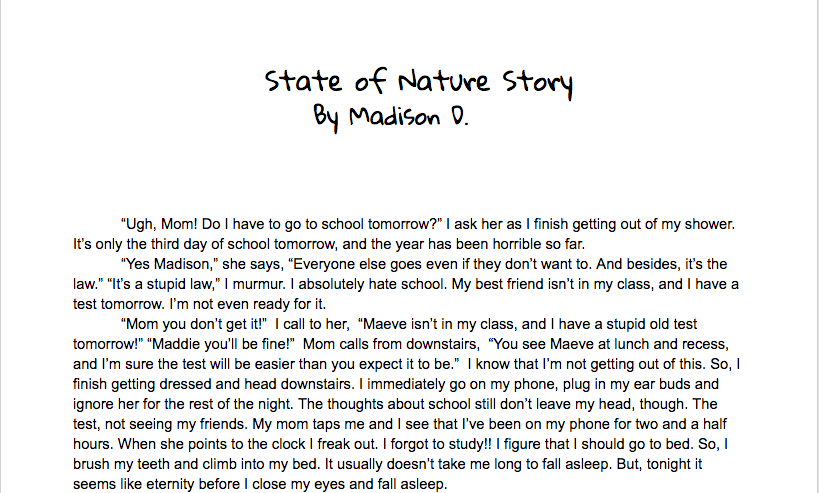
State of Nature Story

2/17/2017

0 Comments

 
Picture
  1. Living in a state of nature would be fun because, you can do fun things whenever you want! Before you are sixteen you can drive a car, and you can play games during school! (Even though in the story I didn't like it.) You can goof around and not be told to stop, well they can but you don't have to listen to them. It would also be fun because you don't have to listen to your parents. But, you might want to.
  2. I'm gald we don't live in a state of nature because it would be hard to live a safe and happy life. People could boss you around if they were bigger and stronger than you. People would be hurt and things can be stolen from you. Your food, things in your house, and a lot of other things. It would be really hard to live in a state of nature everyday of your life.
0 Comments

Models of the Sun and Shadows

2/15/2017

0 Comments

 
Reflection Questions:
Picture
Picture
Picture
Picture
Picture
0 Comments
<<Previous

    Mia Schneider

    I am Mia Schneider, a tailor from Berlin, Germany. It would be very important to have a tailor on the first manned mission to Mars because people need clothes as they grow, and as the clothes get worn out! The astronauts will also need new spacesuits, and I can do that too! I am excited to go on this adventure because we are setting up a new place for people to live, and it will be a once in a lifetime experience!
    ​

    Archives

    May 2017
    April 2017
    March 2017
    February 2017
    January 2017
    December 2016
    November 2016
    October 2016
    September 2016
    August 2016

    Categories

    All

    RSS Feed

Powered by Create your own unique website with customizable templates.