What's going on in Mr. Solarz' Class?
What's going on in Mr. Solarz's Class?
  • Parents (Newsletter)
    • Our Online Photo Album >
      • 2018-2019 Photo Album
      • 2017-2018 Photo Album
      • 2016-2017 Daily Photo Journal
      • 2016-2017 Daily Photo Journal - Album 2
      • 2015-2016 Daily Photo Journal
      • 2015-2016 Yearbook
      • 2014-2015 Daily Photo Journal
    • Our YouTube Channels >
      • 2018-2019 YouTube Channel
      • 2017-2018 YouTube Channel
      • 2016-2017 YouTube Channel
      • 2015-2016 YouTube Channel
      • 2014-2015 YouTube Channel
      • 2013-2014 YouTube Channel
      • 2012-2013 YouTube Channel
      • YouTube videos over the years
      • Learn Like a PIRATE videos
    • Calendar
    • Our Weekly Schedule
    • FAQ about our classroom
    • Curriculum Night Presentation
  • Educators
    • Danielson Framework >
      • Domain 1 - Planning & Preparation
      • Domain 2 - Classroom Environment
      • Domain 3 - Instruction
      • Domain 4 - Professional Responsibilities
      • Professional ePortfolio
      • Instructional Coach Evidence
      • Experience Logs
    • FAQ about our Classroom
    • Workshops
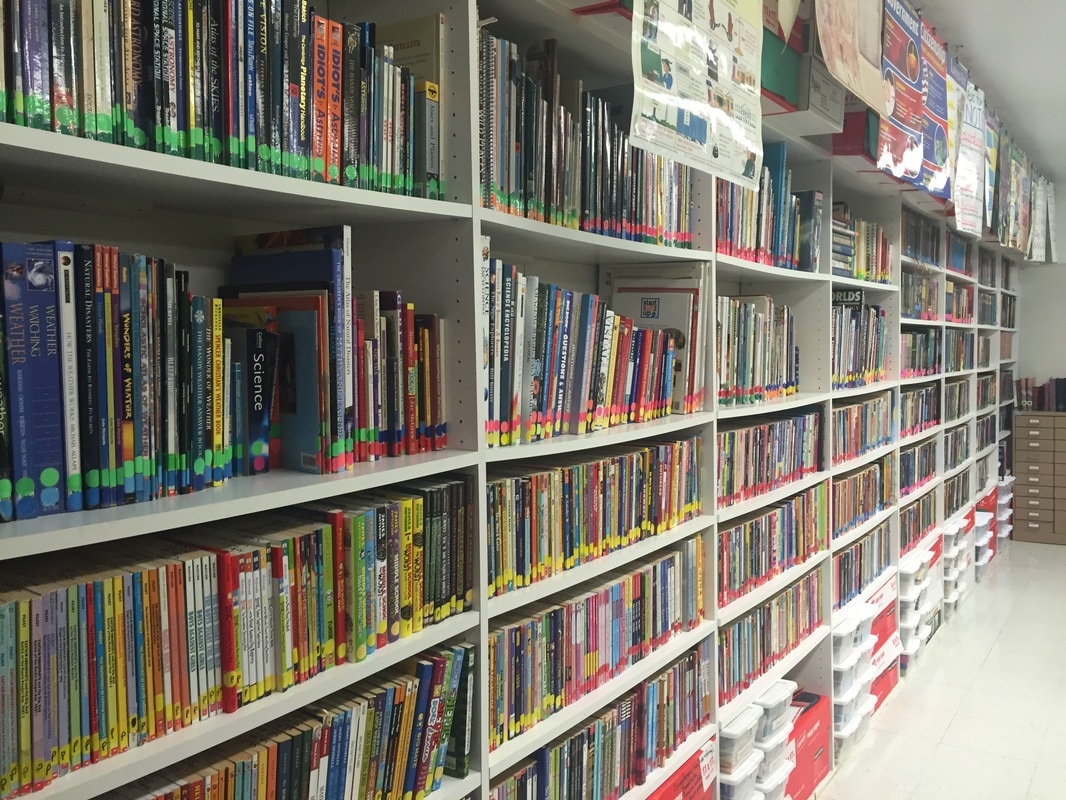
    • Our Classroom Library is for Sale
  • Curriculum
    • Science Units >
      • 5th Grade >
        • Human Body Unit >
          • Human Body Links
        • Ecosystems >
          • Ecosystems - Legends of Learning
        • Watery Earth >
          • Watery Earth Links
        • Earth in Space
        • Investigating Matter
      • 4th Grade >
        • Energy >
          • Energy Unit Notes
          • Energy Debates
          • Energy Debate Organizers
        • Our Geosphere
        • Waves
      • Science Fair
      • STEM Investigations!
      • Try Engineering Together
    • Social Studies Units >
      • 5th Grade >
        • Revolutionary War >
          • Liberty's Kids Videos
          • Revolutionary War Hero Project >
            • RWHP Directions
        • U.S. Constitution & Government >
          • Mini Lessons
          • Colonize Mars! >
            • Claiming Mars for Ourselves >
              • 2017-2018 Creating our Country on Mars
              • 2016-2017 Mars Decisions
              • 2015-2016 Claiming Mars for Ourselves
              • 2014-2015 Claiming Mars for Ourselves 2015
            • Solutions to Problems on Mars >
              • 2017-2018 Our Solutions to Problems on Mars
              • 2016-2017 Problems & Solutions
              • 2015-2016 Our Solutions to Problems
              • 2014-2015 Our Solutions to Problems
            • 2014-2015 "Mission: Mars" Video Discussions 2015
          • Project Citizen
        • Westward Expansion >
          • Oregon Trail Simulation
          • Oregon Trail Readings
          • Reflection Rotation >
            • 2017-2018 Reflections >
              • ThingLink Photo Stories
              • Green Screen Tableaux Vivants
              • Fictional Travel Blog
              • Canva Concept Cards
              • YouTube Newscasts
              • Google Slide Show
              • Daily Travel Blog
              • Act-It-Outs
            • 2016-2017 Reflections
            • 2015-2016 Reflections >
              • Voki Reflections >
                • Voki Blog
            • 2014-2015 Reflections >
              • Act-It-Outs
              • Timeline Spreadsheet
              • Newscasts
              • ThingLink >
                • ThingLink Images
                • Sign up for ThingLink
              • Google Slideshow
              • Fictional Travel Log
              • Daily Travel Log
              • Tableaux Vivants
              • Photo Stories
      • 4th Grade >
        • Geography
        • Explorers
        • Native Americans
        • Colonization
        • State of Sustainability
      • Presidential Election Simulation - 2012 >
        • Presidential Election Simulation - 2016
      • Current Events
    • Reading >
      • 5th Grade Units >
        • Literature Circles >
          • Literature Circles >
            • Video Discussions
          • Literature Circles >
            • Video Discussions
            • Activities
        • Schoolwide Launch
        • Schoolwide Fiction
        • Schoolwide Non-Fiction
        • Schoolwide Ecosystems
        • Schoolwide Poetry
        • Wonder >
          • Wonder
        • The Phantom Tollbooth >
          • Phantom Tollbooth Assignments
      • 4th Grade Units >
        • Schoolwide Launch
        • Schoolwide Fiction
        • Schoolwide Non-Fiction
        • Schoolwide Poetry
        • Schoolwide Energy
    • Writing, Spelling & Grammar >
      • Writing >
        • Writing City
        • WEX
        • WriteAbout
        • Reflection Writing
        • JoonBugz
      • Spelling >
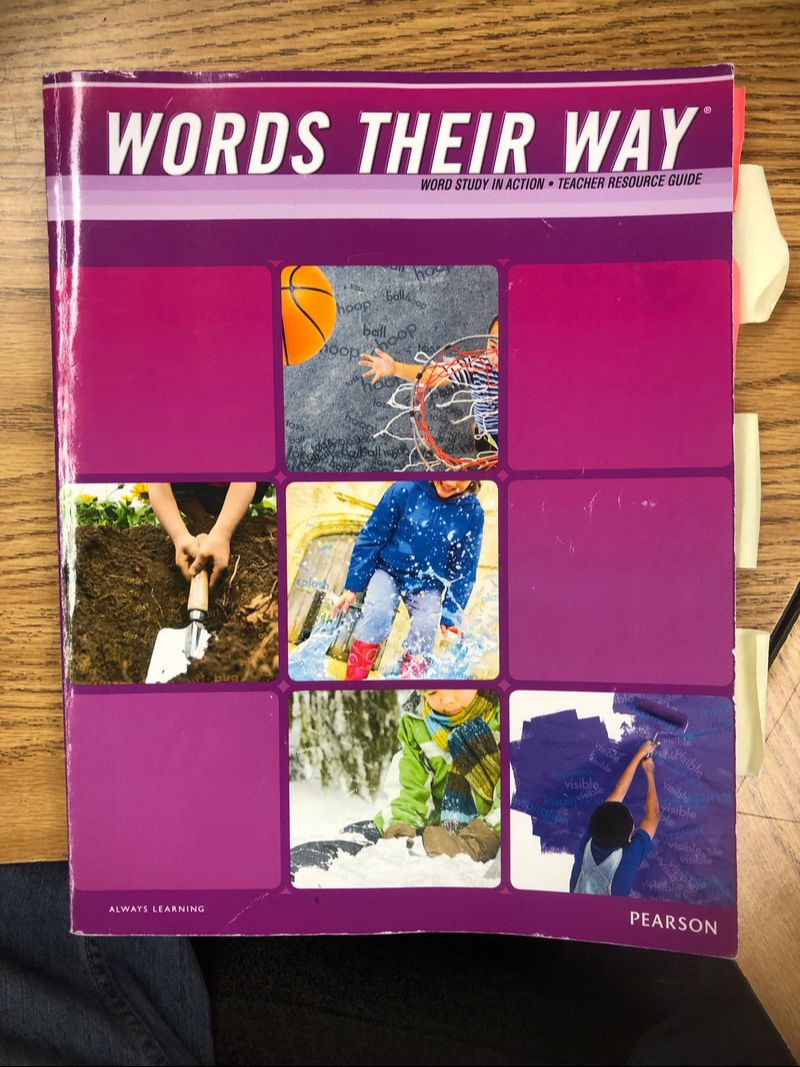
        • Words Their Way
      • Grammar >
        • Grammar
    • Math >
      • Money Island
      • Math in Focus
    • Miscellaneous >
      • Activities >
        • Short-Term Projects
        • Challenges!
        • Special Events
        • Projects & Mini Lessons
        • Bonus Activities
        • Miscellaneous >
          • Honor Badges
          • Growing a Growth Mindset
      • Imagination Club >
        • Schedule
        • Daily Ritual
        • Mini-Lessons
        • Photo Journal
        • Student Creations Round 1
      • Mystery Skype
      • Entrepreneurship Unit >
        • Entrepreneurship - Creating Our Own Businesses!
      • Self-Reflection
      • KinderPals
  • Student ePortfolios
    • 2018-2019 ePortfolios >
      • Students 1-7 >
        • 1 - Isabel
        • 2 - Alexis
        • 3 - Oscar
        • 4 - Adrian
        • 5 - Edy
        • 6 - Matthew
        • 7 - Molly
      • Students 8-14 >
        • 8 - Joey
        • 9 - Jeremiah
        • 10 - Emmalina
        • 11 - Sama
        • 12 - Hazel
        • 13 - Nick
        • 14 - Filip
      • Students 15-21 >
        • 15 - Nellie
        • 16 - Landon
        • 17 - Molly
        • 18 - Harrison
        • 19 - Kali
        • 20 - Inti
        • 21 - Ryan
        • 22 - Pavel
      • Blog Assignments
    • 2017-2018 ePortfolios >
      • Students 1-9 >
        • Elle
        • Daniel
        • Tommy
        • Alyssa
        • Gavin
        • Milosz
        • Mikey F
        • Caitlin
        • Brynna
      • Students 10-17 >
        • Kya
        • Olivia
        • Ian
        • Colin
        • Owen
        • Gianna
        • Isabella
        • Carmen P
      • Students 18-25 >
        • Lucy
        • Caleb
        • Mikey S
        • Wes
        • Martin
        • Will
        • Shaun
        • Carmen W
      • Blog Assignments
    • 2016-2017 ePortfolios >
      • Students 1-8 >
        • Hailie
        • Jody
        • Madison
        • Dylan
        • Calvin
        • Connor
        • Louisa
        • Harvey
      • Students 9-16 >
        • Anna
        • Jack
        • Ben
        • Elijah
        • Catelyn
        • Cole
        • Abby
        • Ashley
      • Students 17-23 >
        • Charles
        • Michelle
        • Charlie
        • Daniel
        • Sam
        • Chingoon
        • Kyren
      • Blog Assignments
    • 2015-2016 ePortfolios >
      • Students 1-9 >
        • TJ
        • JJ
        • Bridget
        • Alex
        • Mason
        • Ryan
        • Lucas
        • Shreya
        • Logan
      • Students 10-18 >
        • Charlotte
        • Addie
        • Aidan
        • Andrew
        • Jeremy
        • Rachel
        • Russell
        • Addy
        • Cassidy
      • Students 19-26 >
        • Audrey
        • Regan
        • Giuliana
        • Brady
        • Stephen
        • Matthew
        • Ben
        • Tyler
        • Thomas
      • Blog Assignments
    • 2014-2015 ePortfolios >
      • Students 1-7 >
        • 1 - Michael
        • 2 - Charlie
        • 3 - Nicole
        • 4 - Stacy
        • 5 - Bela
        • 6 - Kendall
        • 7 - Demetri
      • Students 8-14 >
        • 8 - Emily
        • 9 - Nicky
        • 10 - Hanna
        • 11 - Payton
        • 12 - Hasanain
        • 13 - Tucker
        • 14 - Chris
      • Students 15-21 >
        • 15 - Madi
        • 16 - Aidan
        • 17 - Luke
        • 18 - Kaela
        • 19 - Ryan
        • 20 - Alison
        • 21 - Lucas
      • Blog Assignments
  • Passion Time
    • Passion Time Resources >
      • ALL Passion Time Resources
      • Step-By-Step Directions
      • Submit Your Essential Question
      • Our Trello Page
      • Our Passion Projects over the years
      • Our Trello Board
      • SAMPLE Blog Post Format
      • YouTube Upload Page
      • Mini-Lessons
    • 2018-2019 Projects >
      • Round 1
      • Round 2
      • Round 3
      • Round 4
    • 2017-2018 Projects >
      • Round 1
      • Round 2
      • Round 3
      • Round 4
      • Round 5
    • 2016-2017 Projects >
      • Submit Your Essential Question
      • Mini-Lessons
      • Round 1
      • Round 2
      • Round 3
      • Round-4
      • Round 5
      • Round 6
    • 2015-2016 Projects >
      • Round 1
      • Round 2
      • Round 3
      • Round 4
    • 2014-2015 Projects >
      • Round 1
      • Round 2
      • Round 3
      • Round 4
      • Round 5
      • Round 6
  • Student-Led Classroom Info
    • Our Learning Experiences
    • 21st Century Skills
    • Whole Class Goals
    • Individual Goals
    • Classroom Jobs
    • Collaborative Responsibilities
    • Rituals & Routines
    • Uses of "Give Me Five"
    • Student-Led Mini-Lessons
    • Lit Circle Signposts
    • Mystery Skype Jobs

1a - Demonstrating Knowledge of Content and Pedagogy

3/31/2019

3 Comments

 
Picture
Examples from Charlotte Danielson:
Picture

2017-2018 and 2018-2019 School Years:

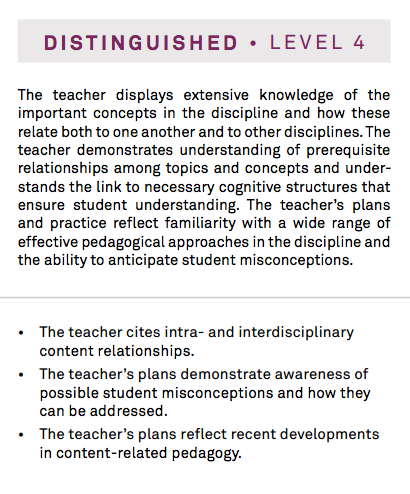
The teacher displays extensive knowledge of the important concepts in the discipline and how these relate both to one another and to other disciplines:

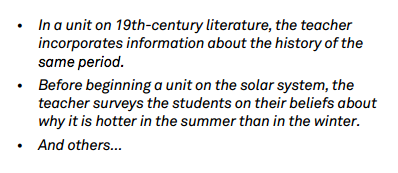
Examples of Lessons & Units that Integrate Subjects:
  • Energy (Science Unit):
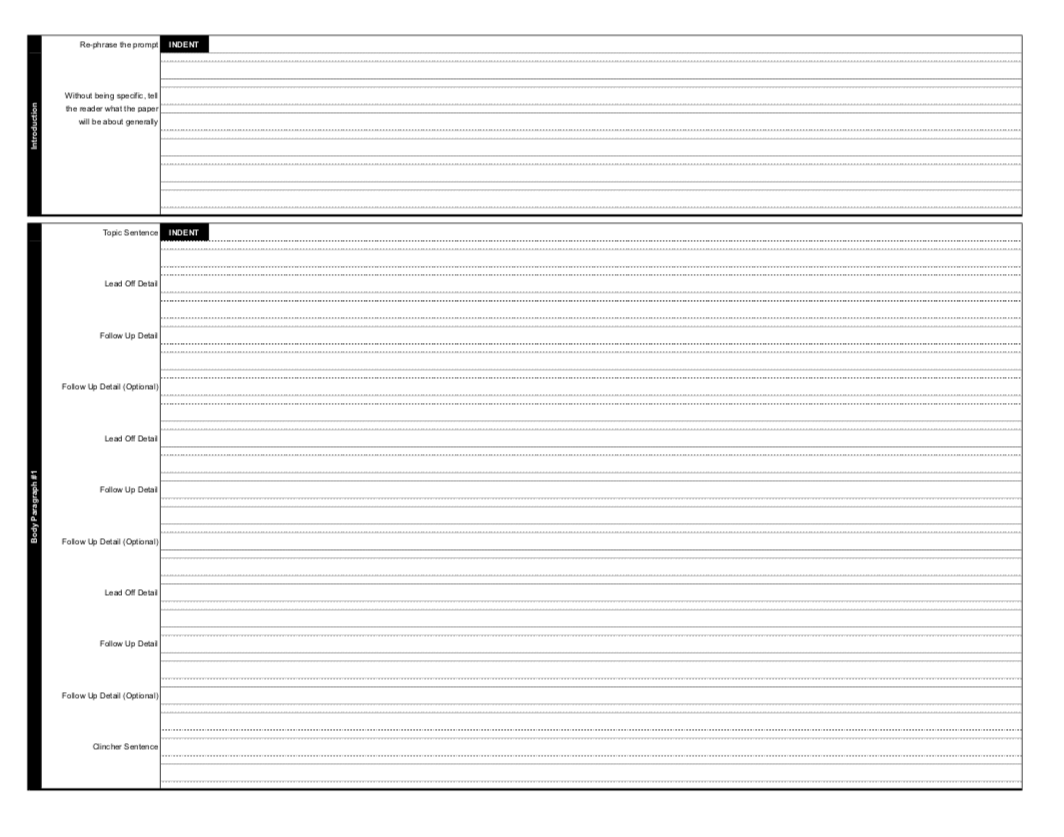
    • I integrated Persuasive Writing into the unit. As students begin their Energy Debate, they read their Persuasive essay on why their energy source is the best. Students use the organizer on the right to follow our organization structure as taught in class.
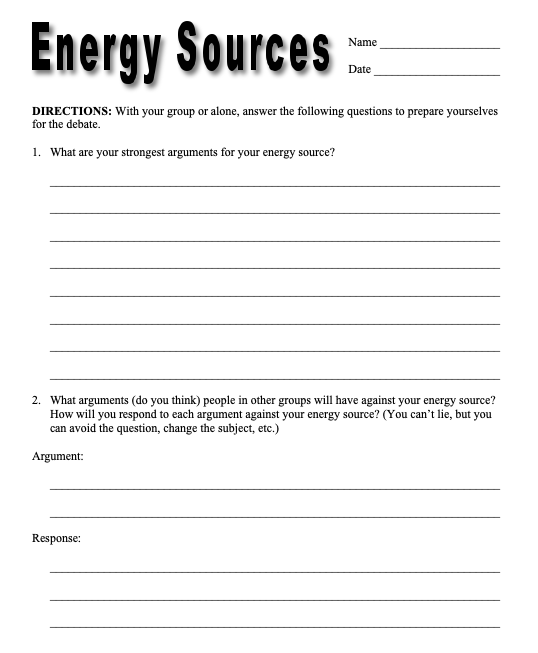
    • I integrated Research Writing into the unit. As students find arguments against their opponents and defenses to refute their opponents' arguments, they use online sources to get their information and show their evidence.
    • Nonfiction reading skills are integrated into the research aspect of this unit. 
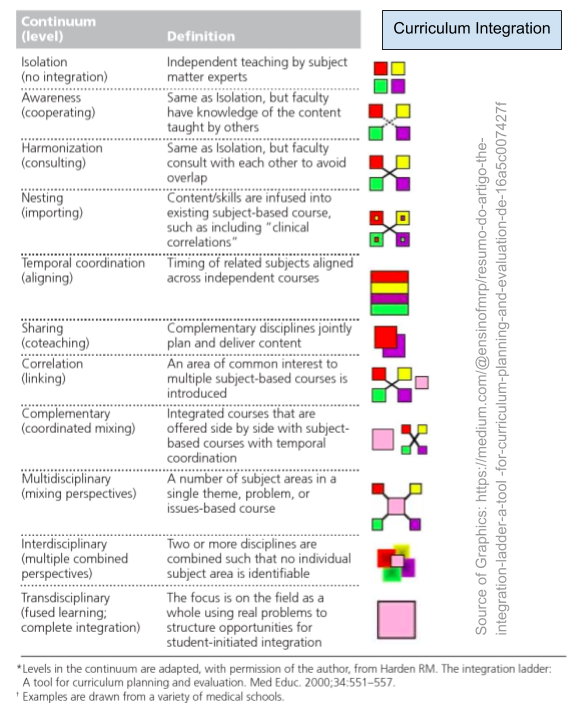
    • Co-hosted a Twitter chat on integrating subjects during curricular planning & made this graphic:
Picture
Picture
Picture
  • Our Geosphere (Science Unit):
    • This unit was a perfect opportunity to integrate the Geography lessons from social studies (History Alive 1).
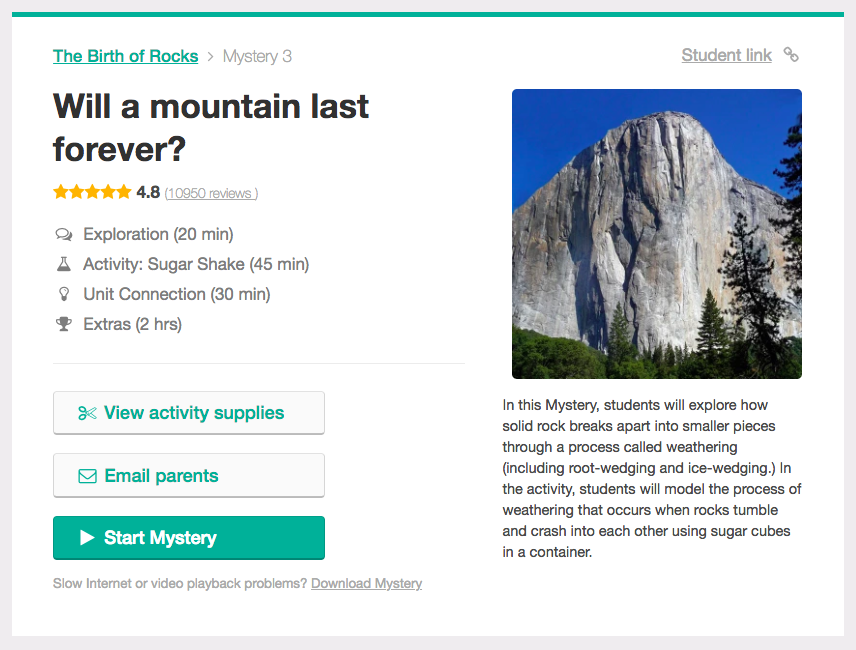
    • I also integrated Mystery Science lessons and various tech tools into my instruction.
    • I would have also included Mystery Skype, but planned to keep that for 5th grade if I moved back.


​

​


​
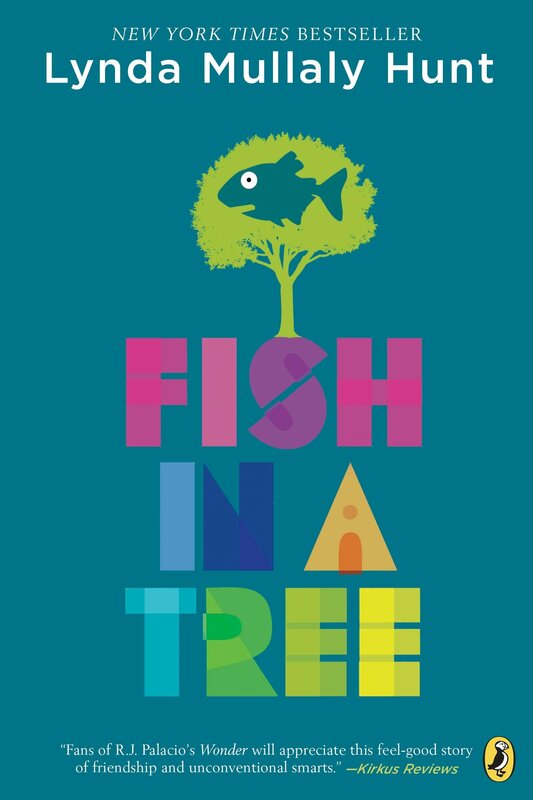
  • "Fish in a Tree" (Shared Reading to start the new school year):
    • In order to teach my students our procedures for reading, and basic literary elements, I started the year with a book that would help build our classroom community, "Fish in a Tree." 
Picture
Picture
Picture
Picture

The teacher's plans and practice reflect familiarity with a wide range of effective pedagogical approaches in the discipline and the ability to anticipate student misconceptions:

​How my plans demonstrate awareness of possible student misconceptions and how they can be addressed:
  • In math, students often have trouble dividing shapes into thirds or fifths because it requires estimation skills that they haven't yet perfected. Since that's the case, I give them two pieces of paper instead of just one. This allows them to mess up on the first page. Then, we talk about how common it is to struggle with this skill at this age, and talk about growth mindset. Then, I ask them to fold the paper before dividing into how ever many sections we need.


​
  • In the energy unit, when we are classifying examples of energy as either kinetic or potential, students often assume that if it's not in motion, it is automatically potential energy. They don't realize that not everything has energy in it. So I allow my students to make this common mistake, and then ask them, "Does a rock that's sitting on the ground have energy?" And we discuss that many things in our world don't have energy and can't be classified as potential or kinetic.


​
​
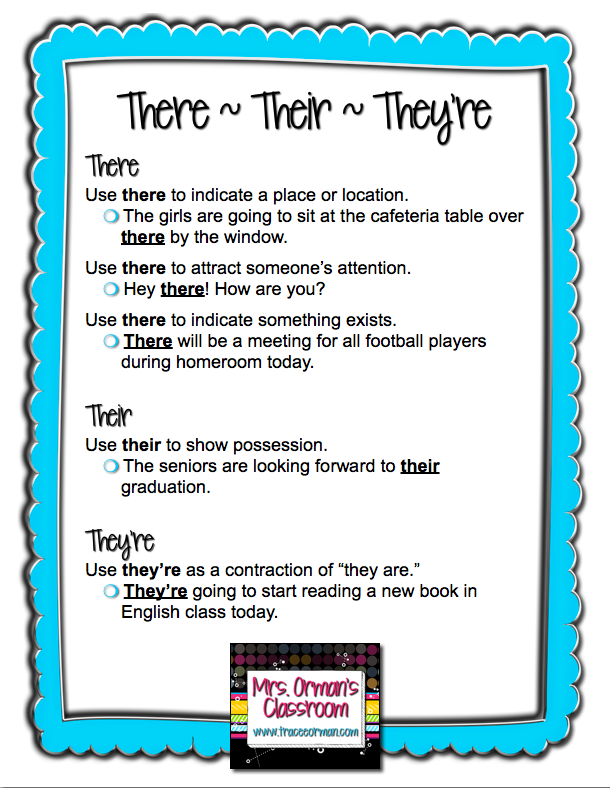
  • Homonyms can be tough for 4th graders. They mix up there/they're/their and our/are and many others all the time! Since I know this can be a challenge for students, we do a lesson at the beginning of the year to address these common homonyms and we make an anchor chart together. This anchor chart hangs up in the classroom and any time a student mixes these up, I ask them to go over to the poster and find their mistake in their writing. By the end of the year, students are making fewer mistakes with these words!
  • We continue to monitor these commonly misspelled words in our writing. Students help each other to find mistakes and fix them!
Picture
Picture
Picture

The teacher demonstrates understanding of prerequisite relationships among topics and concepts and understands the link to necessary cognitive structures that ensure student understanding:

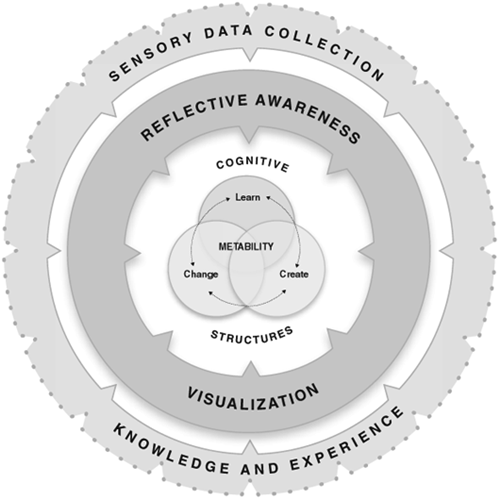
  • Students use various cognitive structures to process information and create meaning in our classroom. Some of these ways include:
    1. making connections/synthesizing,
    2. finding patterns & relationships,
    3. identifying or developing rules, and
    4. transfer learning to new situations.
  • In our classroom, we mainly do this through constant reflection of our learning.


​Recent development of content-related pedagogy:​
  • Worked with my 4th grade team and Sharon Nelles to learn new ways of leading Guided Reading in the intermediate classroom. Explored the concept further by reading through the book and testing things out in our classroom. Planning on implementing these ideas further next school year. (I've led Guided Reading groups in the past, but some of the new ideas that I learned will make Guided Reading groups more effective and efficient.)


​
  • Learned about Math Workshop from Amy Kuehl and others on the fifth grade team. Implemented those ideas this year in 4th grade during WIN Time. It was VERY effective in meeting the needs of each of my students and allowing personalized learning to also take place.


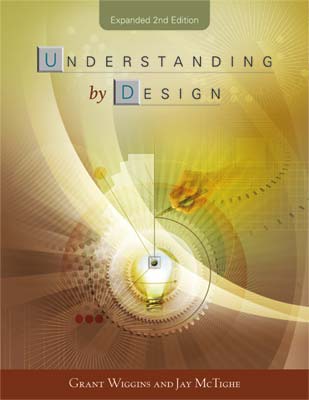
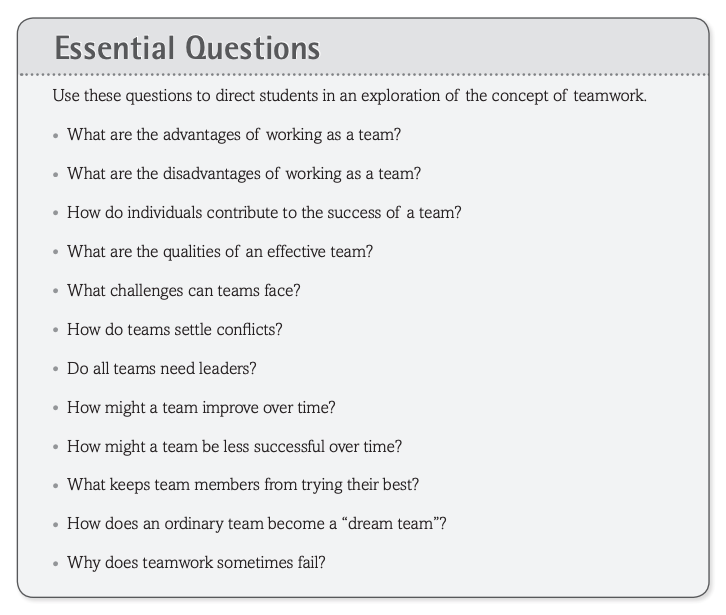
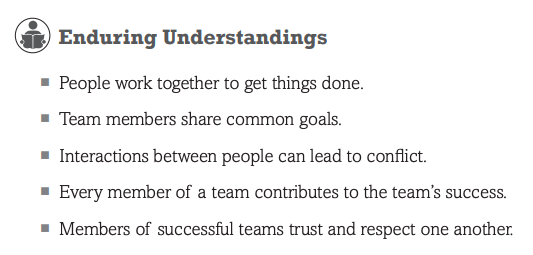
  • I use the concepts from "Understanding by Design" (UbD) from Grant Wiggins and Jay McTighe to design units effectively (using backwards design). To the right are some essential questions and enduring understandings that I recently used to design a KinderPals lesson:
Picture
Picture
Picture
Picture
Picture
Picture

School Years prior to 2017-2018:

Dominant structures & content-related pedagogy for each discipline in our classroom (2015-2017):
  • Math:
    • Daily check-in of class work and homework (one-on-one feedback and re-teach). Independent practice while waiting. (20-25)
    • Direct instruction of new skill with note-taking and constant checks for understanding. (15-30)
    • Collaborative practice with check-in after each side of work. (Remainder of period)
    • Homework to practice skill without support.
    • (Math requires many prerequisite relationships that I've come to learn over the years. In order to ensure the proper order of skills, I have shuffled a few units around and combined a few units for maximum learning potential).
  • Reading:
    • Novel study (a.k.a. Literature Circles) - students select novels based on interest & I partner students with similar interests. Students read aloud in partnerships/groups of three while discussing the book, asking and answering questions, using Signposts from Notice and Note and those that we created.
    • Daily Mini-lessons that incorporate topics from Schoolwide and other reading skills (both teacher-led and student-led).
    • Homework is to write a summary of the day's reading (students take turns completing this on a shared Google Doc).
    • Interactive Read Aloud lessons taught on occasional Tuesdays & Thursdays with student ePortfolio components.
  • Writing:
    • Integrated into other subjects as much as possible.
    • Non-Fiction Writing:
      • Argumentative essays in Energy Debates
      • Human Body Research Papers
      • Reflective Writing on ePortfolio posts
      • State of Nature Stories in Social Studies
      • Summary writing in Reading
    • Fiction Writing:
      • Personal Narratives from other people's points of view (including personas they take on in Social Studies)
      • JoonBugz Screenplay (integrating Schoolwide skills)
  • Science:
    • Lessons are posted online.
    • Direct instruction from the teacher to get students started on inquiry and exploration.
    • Students record video and pictures of their process and products and then post everything on their ePortfolios.
    • Students answer Reflection & Synthesis questions to confirm understanding of material.
  • Social Studies:
    • "History Alive" combines focused & concise content-area reading with fun, collaborative explorations of historical concepts and events (tug-of-war, act-it-outs, debates, etc.).
    • "We the People" teaches textbook, note-taking, study, and test-taking skills while also combining focused & concise content-area reading with fun, collaborative explorations of historical concepts and events (just like History Alive).
    • Simulations allow students to "experience" history as they colonize Mars in order to create a government and constitution for their fledgling country. They also move west during the Oregon Trail to learn about our country's westward expansion efforts in the 1800's.

I attended a 2-day Advanced UbD Workshop led by both authors and, as a result, discovered the importance of "transfer" and eliminating unnecessary lessons.

Examples:
  • Schoolwide - Launch
  • Schoolwide - Fiction
  • Schoolwide - Non Fiction
  • Wonder
  • Human Body Systems
  • Presidential Election Simulation
  • Earth in Space
  • Constitution & Government
  • Westward Expansion
  • Energy
  • Fictional Narrative Writing

Picture
I helped organize EdCamps & attend other voluntary Professional Development opportunities (2015-2017):
  • EdCamp Chicago
  • EdCamp Illinois
  • NICE Mini-Conference
  • ICE
  • Dubai - Global Education & Skills Forum
  • Dubai - Varkey Teacher Ambassadors Forum
  • New York - Asia Society Global Conference
  • Boston - Building Leadership Communities
Picture

Inter- and Intradisciplinary Content Relationships for 5th Grade:

Examples of Lessons & Units that Integrate Subjects:
  • PenPal Schools (Writing & Social Studies)
  • World Poetry Day (Reading & Writing)
  • Passion Time (Content, Writing, Reading)
  • Environmental Challenges (Science & Reading)
  • Inventor's Challenge (Science & Reading)
  • 3M Young Scientist Challenge (Science & Reading)
  • Global Invent-It Challenge (Science & Reading)
  • JoonBugz (Writing & Reading)
  • Colonize Mars (Science & Social Studies)
  • Human Body Research Paper (Writing & Science)

Examples of Skills Lessons & Units:
  • 21st Century Collaboration Challenge
  • Global School Play Day
  • Entrepreneurship
  • Mystery Skype
​Professional Books that I've read:
  • The Innovator's Mindset
  • Pure Genius
  • Ditch that Textbook
  • The Zen Teacher
  • Explore Like a Pirate
  • Play Like a Pirate
  • Your School Rocks... So Tell People
  • How Much Water Do You Have?
  • The Classroom Chef
  • Launch
  • Kids Deserve It!
  • The Writing on the Classroom Wall
  • Instant Relevance
  • Escaping The School Leader’s Dunk Tank
  • The HyperDoc Handbook
  • Setting the Standard for Project Based Learning
  • Teaching Students to Self-Assess
  • The Reading Strategies Book
  • If They Can Argue Well, They Can Write Well
  • Discovering the 5 Love Languages at School
  • What Connected Educators Do Differently
  • Hacking Education
  • Teach Like Finland
  • Growing a Growth Mindset
  • Dozens more! Many of them are featured in Domain 4.
Read More
3 Comments

1b - Demonstrating Knowledge of Students

3/30/2019

1 Comment

 
Picture
Examples from Charlotte Danielson:
Picture

Evidence from 2017-2018 and 2018-2019 School Years:

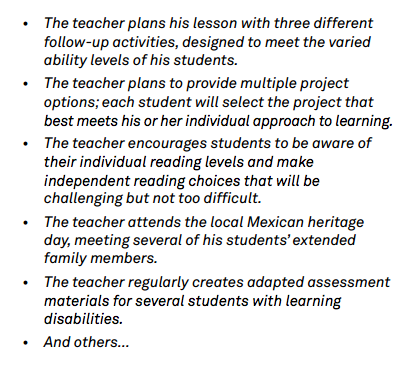
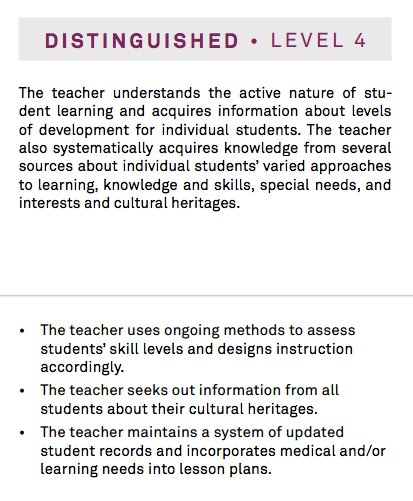
In a collaborative, student-led classroom, this is one of the areas that looks very different than in a traditional classroom. Since my students work together on most activities and lessons are typically very open-ended, differentiation becomes a natural extension of the students' work ethic and the classroom climate that the teacher nurtures. Since I believe in hard work, time-on-task, and a strong focus is important in our classroom, students generally provide a high level of effort on their assignments, leading to their highest achievement possible. I can then use that as a baseline for each student in order to provide individualized support and enrichment.
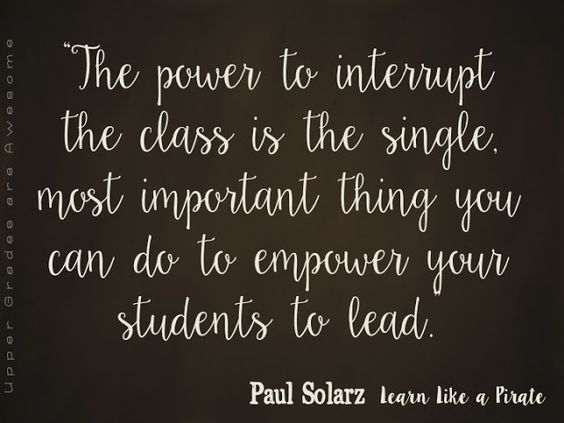
Because I have my students working in assigned partnerships throughout much of my day, I am free to observe and give feedback more immediately than in a traditional classroom. I walk around the room, seeing what each group is doing, often interrupting the class to make announcements that further refine what they are doing, with a strong effort not to impede their creativity.

In addition, I have access to the following formal assessment data:
  • Reading:
    • Fountas & Pinnell Reading Levels (Comprehension)
    • MAP Test Scores (Comprehension)
    • AIMSWeb Scores (Oral Reading Fluency)
    • IXL Diagnostic Reports (Continuous Monitoring, Adjusting & Reporting on Levels)
  • Math:
    • MAP Test Scores (Math Skills)
    • MComp Scores (Computation)
    • Unit Test Scores (Concepts & Skills)
    • Mad Minutes (Math Fact Fluency)
    • IXL Diagnostic Reports (Continuous Monitoring, Adjusting & Reporting on Levels)
Picture
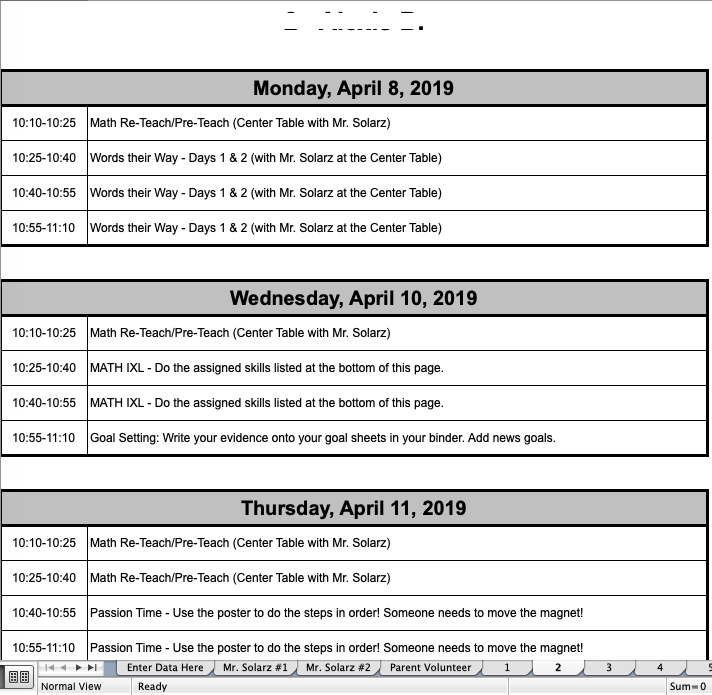
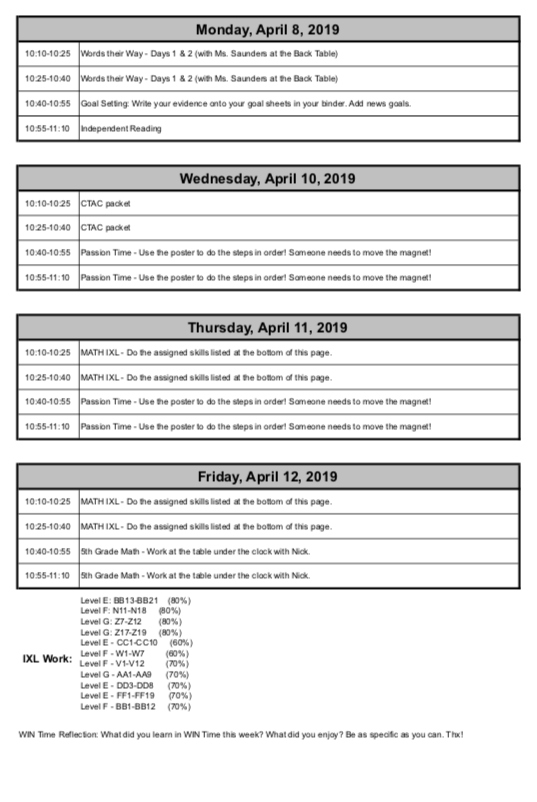
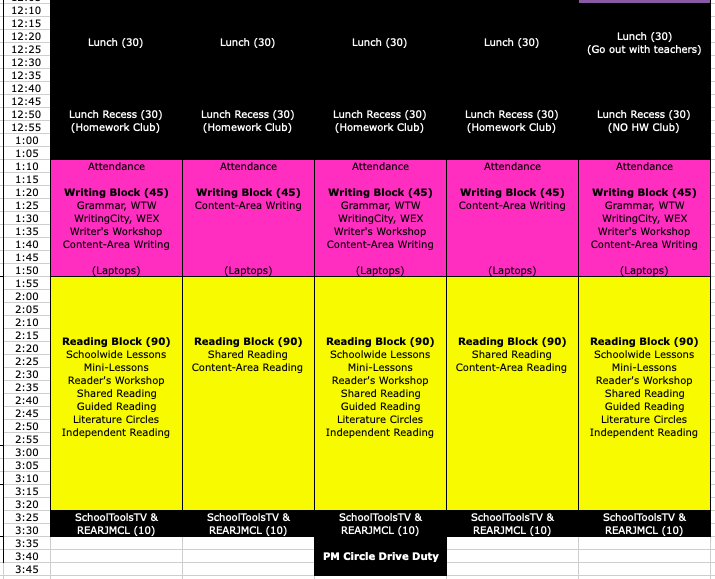
  • I use all of this data on a weekly basis to form flexible groups during WIN Time. I created a spreadsheet that allows me to enter their stations in on one page and it jumps all of the information to separate pages for each student. This allows me to print off their schedule each week without much additional work, letting them know what they are doing during WIN Time each day during the week.  
  • I also plan out which IXL skills each student needs to work on in class and at home (if they choose to do so). These are printed at the bottom of their schedules each week.


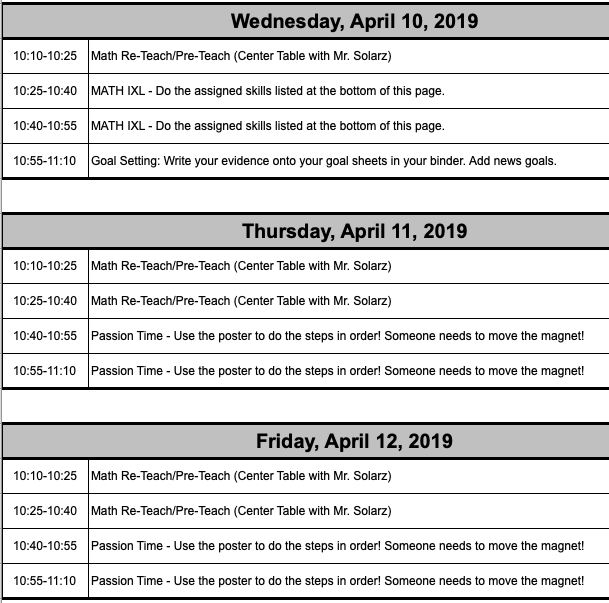
I meet with several students four days per week to re-teach/pre-teach math concepts.
Picture
Picture
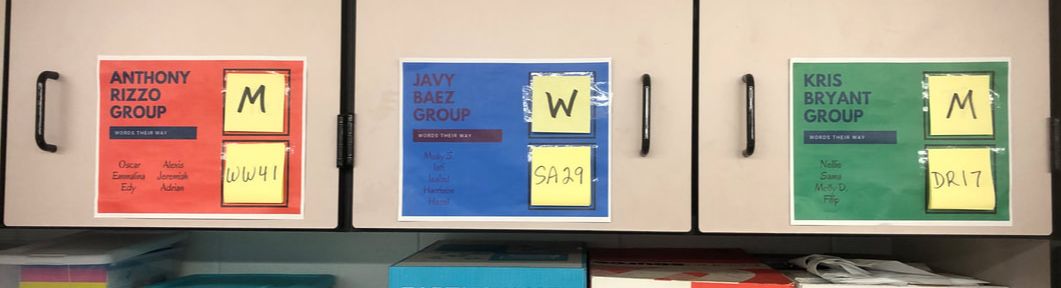
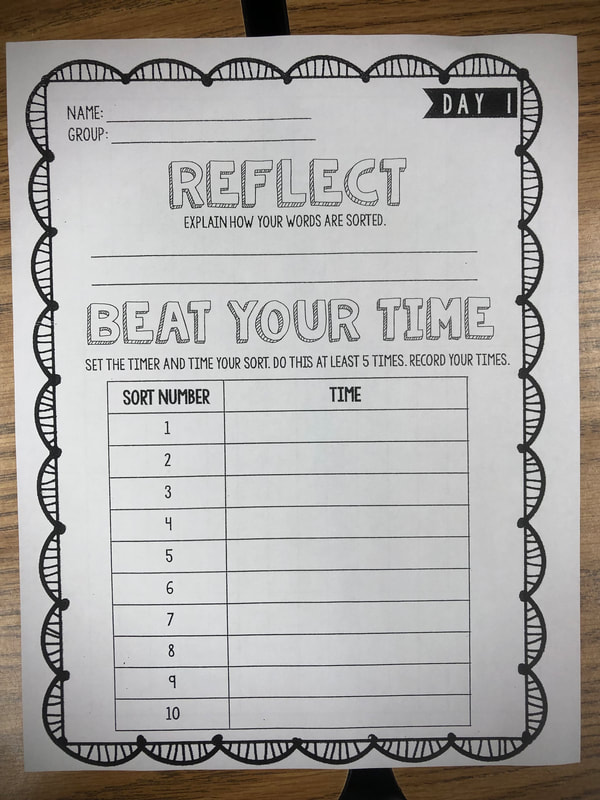
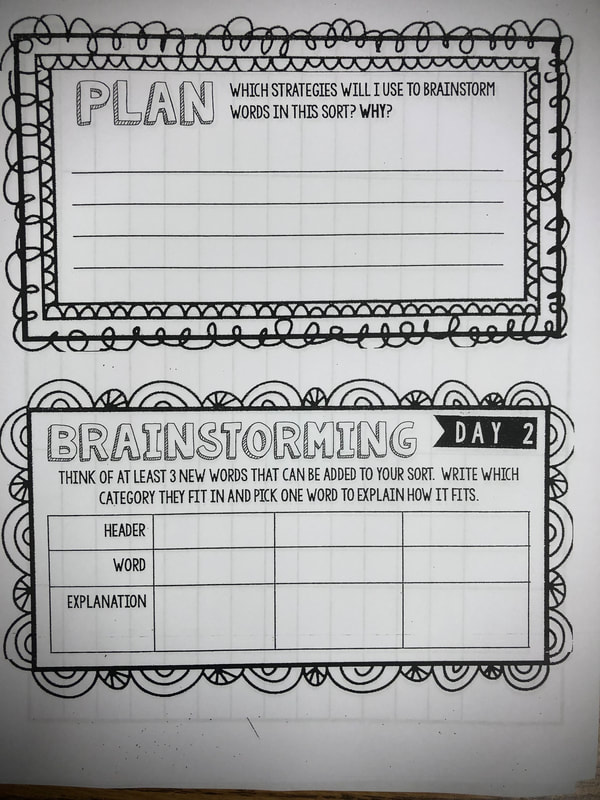
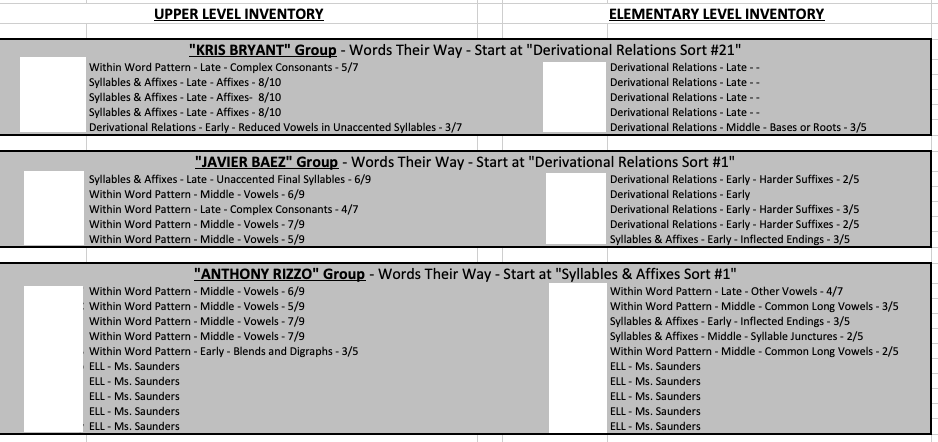
  • I meet with three leveled groups each week for Words their Way, and provide enrichment work for students who are excelling at Words their Way.
Picture
Picture
Picture
Picture
  • Sometimes, in order to meet the needs of all of my students, it requires me to have students check in or get help during Homework Club before school or during lunch recess.


​
  • I am a National Board Certified Teacher (Middle Childhood Generalist). Completing the work for this certification helped me focus in on how children learn differently at different stages of their lives, how to be a reflective practitioner, and taught me to focus on purposeful planning. I also use Understanding by Design principles to eliminate unnecessary lessons, integrate subjects effectively, teach with the end in mind, and focus on Big Ideas and Enduring Understandings.


​
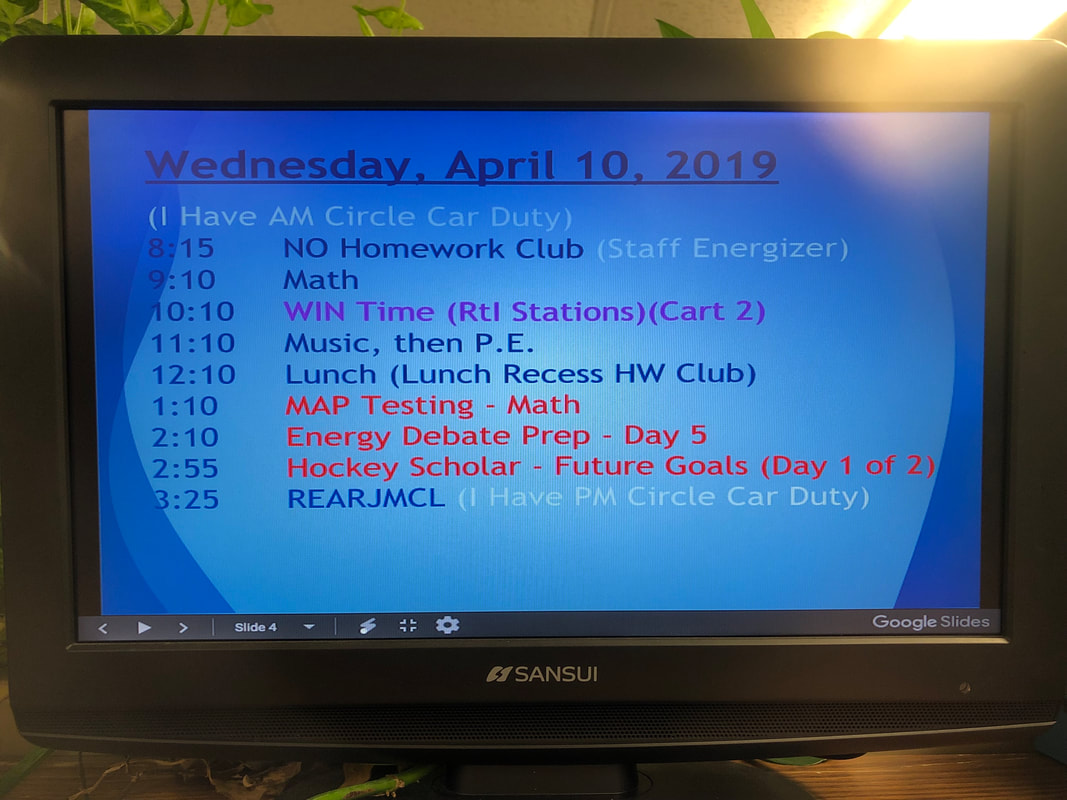
  • In order to engage my students intellectually in my lessons, I display our daily schedule on a TV in the room (which builds anticipation), I have (nearly) everything online for students to read while I go over it (our version of blended learning), or they can watch on the board as I project it. Finally, I add in engaging components to most lessons including, short video clips, demonstrations, and hands-on activities.


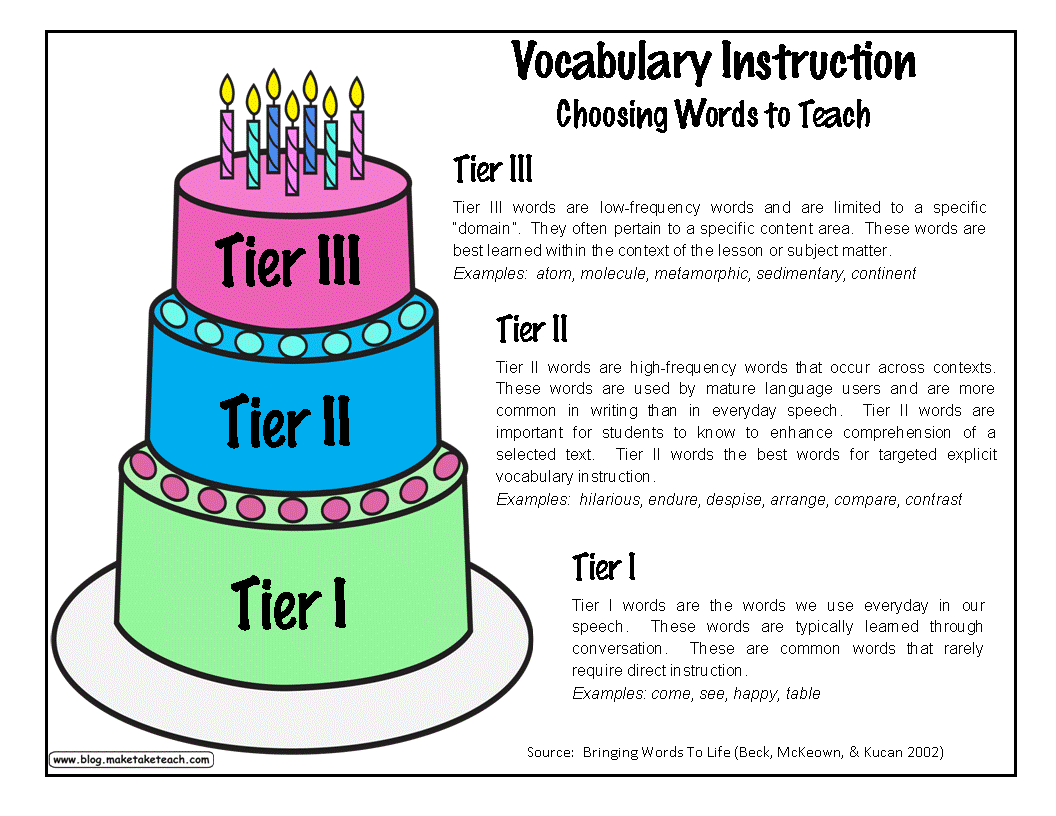
  • Building background knowledge can be an important component of some lessons (and it can also actually detract from other lessons). I try to front-load necessary vocabulary and concepts before beginning complicated lessons to ensure that students are prepared for the new information. And with other lessons, I like to see the students use context clues or problem-solving strategies to infer meaning. I use the Tier 1, 2, and 3 model to help me plan my instruction with regards to vocabulary.


​
  • Depending on the academic and language needs of my students, I work closely with special education teachers and assistants (as well as EL teachers) to ensure that concepts are learned in the most effective way.

​
  • Student interests are accounted for within lessons (i.e. choice with web tools, letting kids choose from lists of options) and more specifically through Passion Time. Each week, students spend 60-90 minutes working on projects of personal interest to themselves.


​
  • Although our classroom is generally fairly homogeneous with regard to cultures, we do spend a lot of time learning about other cultures around the world through Mystery Skype, Global projects, and many more activities! (5th grade only)
  • Lots of time this year has already been spent learning about the muslim culture, Polish & Romanian cultures, and about Japan. All of this was to seek out information about each of my students' cultural heritage & to learn about where they were living.
Picture
Picture
Picture
Picture
Picture
Picture
Picture

Read More
1 Comment

1c - Setting Instructional Outcomes

3/29/2019

0 Comments

 
Picture
Examples from Charlotte Danielson:
Picture

Evidence from the 2017-2018 and 2018-2019 School Years:

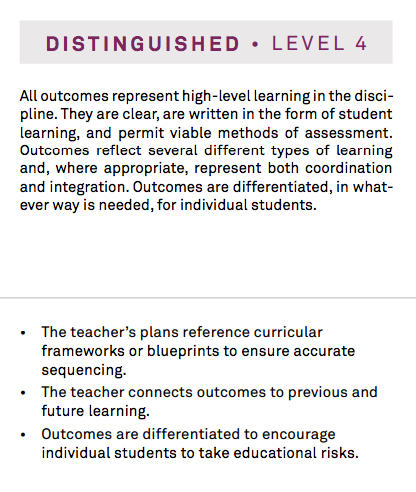
All outcomes represent high-level learning in the discipline. They are clear, are written in the form of student learning, and permit viable methods of assessment:

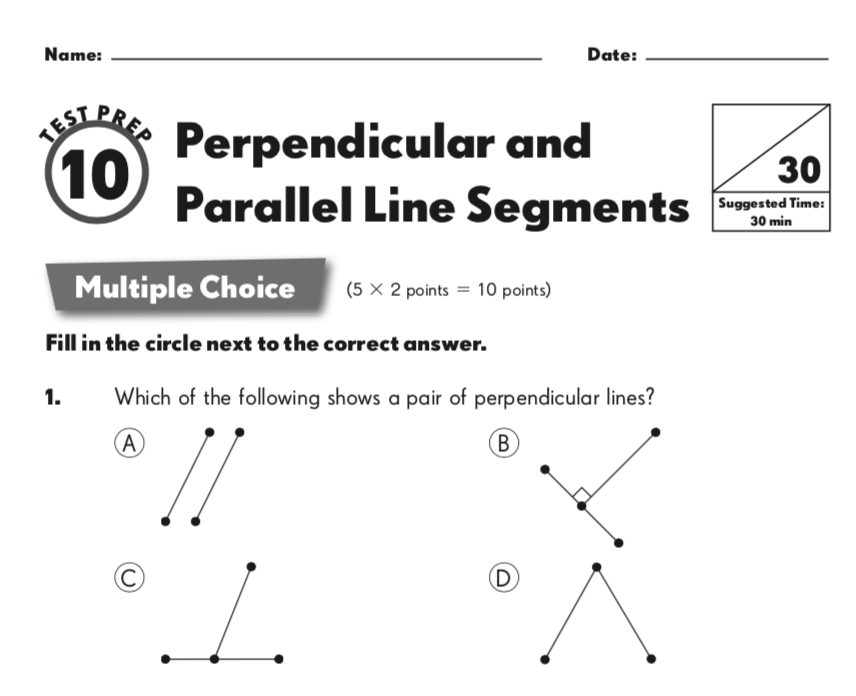
  • Since we have moved towards common assessments throughout the grade level, I pretty much use the assessments from Math in Focus, Schoolwide, History Alive, and Science Companion, as is.
  • Nearly all learning objectives are now based on standards (from our standards-based report card, our grading sheets from the district, and the objectives provided to us from each program that we've adopted). Teachers rarely have to write curricular outcomes anymore. 


​
  • I have added an assessment to Words their Way in order to get more information on each child's progress towards learning their spelling patterns.​
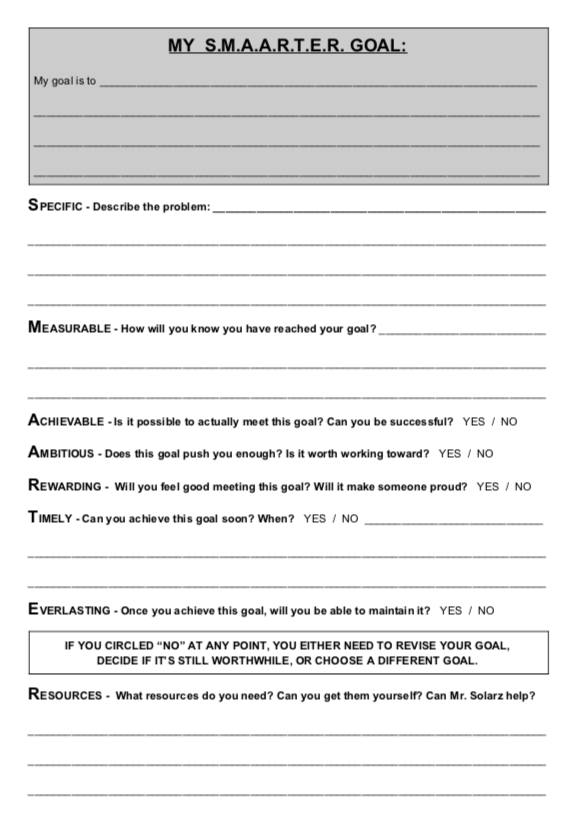
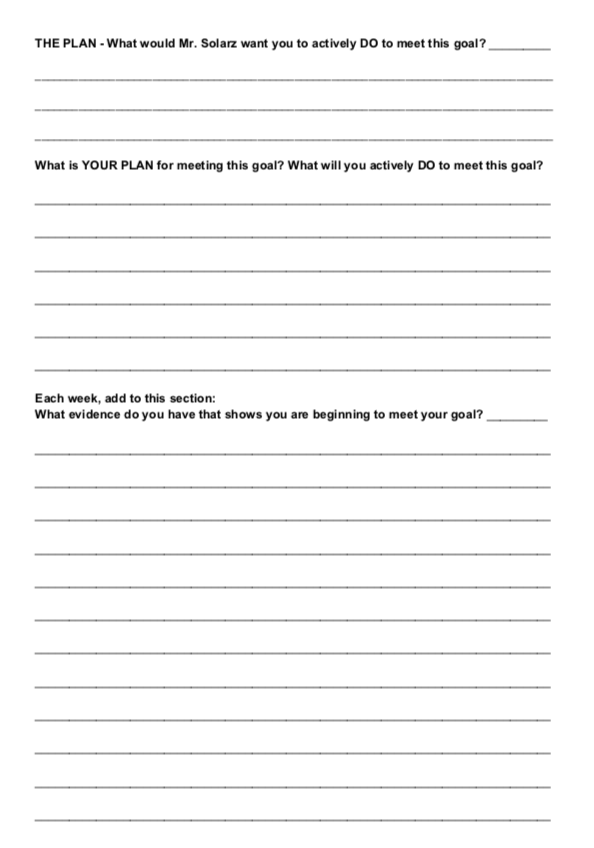
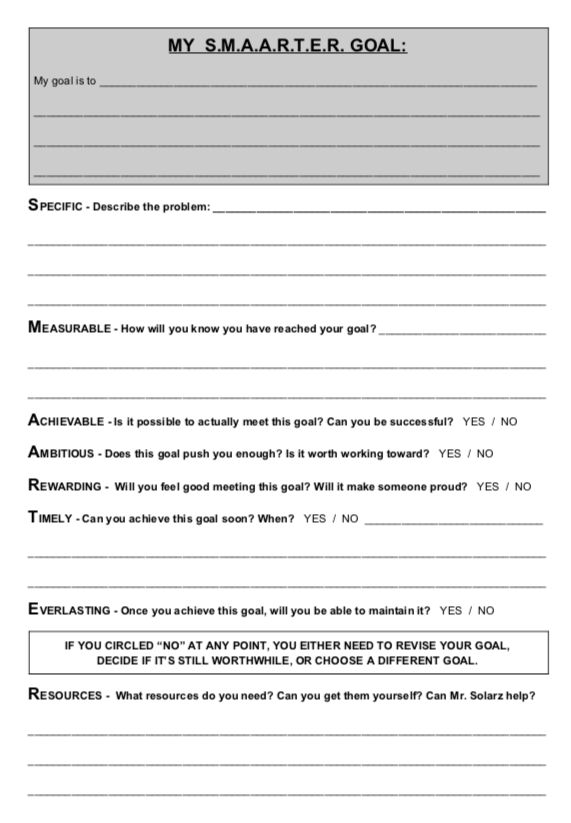
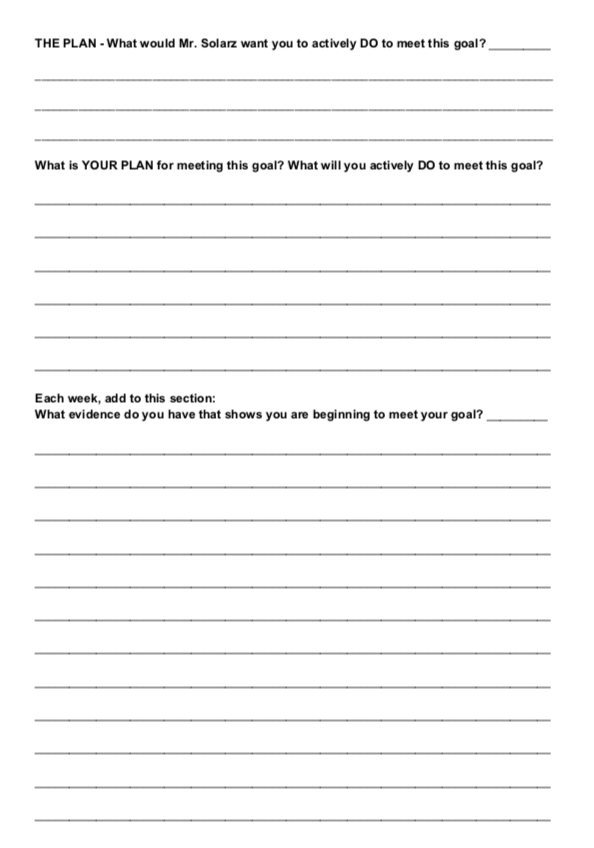
  • My students are constantly writing personal goals, reflecting on their progress towards those goals, collecting evidence towards meeting those goals, and deciding when goals have been met using a structure I created called SMAARTER Goals.
  • I write the first few for them to use as a guide, and then they use 15 minutes during WIN Time to address each goal.
Picture
Picture
Picture
Picture

Outcomes reflect several different types of learning, and where appropriate, represent both coordination and integration:

Teacher's Plans reference curricular frameworks or blueprints to ensure accurate sequencing and plans connect outcomes to previous and future learning:​
  • Math in Focus - I teach the lessons in the order that was given to us by the district office. I understand the prerequisite skills my students need to be successful in each unit and also know where they are "headed" in fifth grade. I assign IXL skills for each chapter that align with the skills being taught in Math in Focus. These skills act as a preview of lessons to come, extra practice, extensions of the lessons' skills, and review. Lessons are in the Singapore Math format.


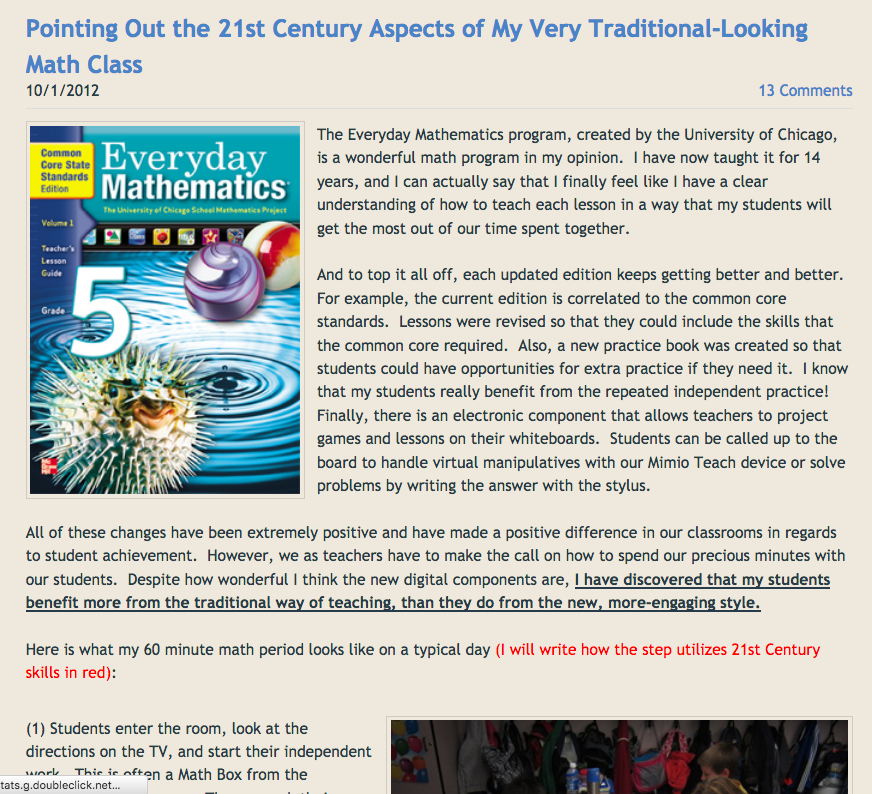
  • Schoolwide Reading - The district gave us the sequence of the five units. I went through each unit and replaced some lessons with ones that I've taught in the past that have the same objective. Ideally, I'd like to integrate non-fiction Schoolwide with non-fiction writing (i.e. Expository/Informative/Research and Persuasive writing). Common core standards were met with some of the lessons, while some standards were met during the independent reading portion of the lesson. Common Core standards play an important role in my Reading mini-lessons and my students' Lit Circle videos.​
  • Writing - This year, I used a combination of WEX, WritingCity, and Writer's Workshop to meet the needs of my students. Rather than just focus on the three units that WEX provides, I also had my students complete units in Persuasive writing, Explanatory writing, and Research writing. These non-fiction writing units integrate nicely with science, social studies, Passion Time, and more. With WEX, students focused on personal narratives, fictional narratives, and responding to literature.
  • Science Companion - I taught the three science units in the order that the district mandated and planned each unit in the order Science Companion suggested. I utilized my fourth grade team for LOTS of help with supplies, preparation, and suggestions. Since I had taught one of the units in the past, I was able to jump right in and get started. A few lessons were changed since I taught it, but the Big Ideas mostly remained the same. I integrated a debate into the Energy unit, complete with Persuasive writing, Research writing, Listening & Speaking skills and a slew of 21st Century skills. 
  • History Alive - I taught all nine units as suggested by History Alive and the district. I had taught these lessons in previous years, so I had lots of supplemental materials to support the units and integrated a few projects into the experience as well. Since I've taught 5th grade for 19 years, I also understand what follows these nine units, so I was able to give my students a "sneak peak" into what's to come in order to pique their interests!


​
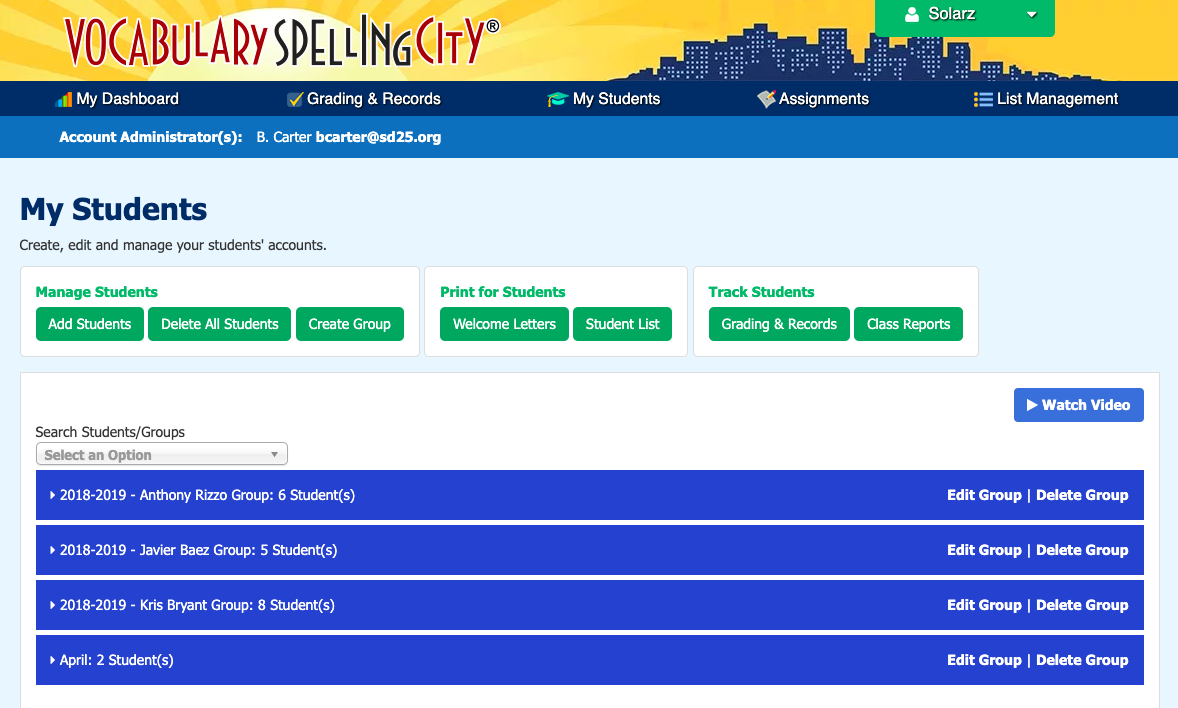
  • Words their Way - Students learned word study at their current level, with peers learning the same words, with teacher support each week. I assessed them twice during the year to ensure that groups were meeting their needs. I gave students additional practice using SpellingCity, so they could learn vocabulary and spelling as well. I supplemented this program with commonly misspelled words, grammar, spelling feedback during writing, and editing lessons.
Picture
Picture
Picture
Picture
Picture
Picture

​Examples of "lessons" that challenge a student's cognitive level:

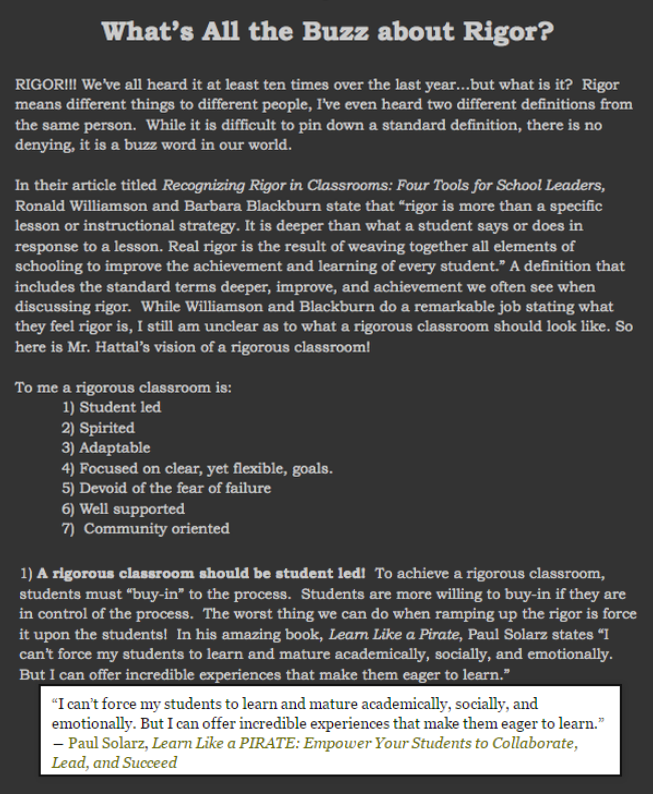
  • Since "rigor" or "challenge" is different for every child and is really a byproduct of differentiation, here is a blog post I wrote that focuses in on how I create challenging lessons for each of my students.
  • Just by being in a student-led classroom, students are finding "rigor" within everything they do. Since this is a collaborative task, it is the teacher's responsibility to encourage strong effort, constant improvement, and the desire to seek out challenges in their everyday work.
  • One task I had my students complete that was particularly challenging for all was our Human Body Research Paper. Students had to research each of the 6 main systems of the body, paraphrase their learning, and organize it all into a cohesive paper.
  • I had my students complete challenges that were actually global contests with prizes. I helped them meet all the requirements for entry, and they did all the work for winning the prize!
  • Passion Time is always an opportunity for personal rigor, and it's been my way of differentiating various skills and understandings for several years now.
Picture

Examples of lessons that focus on student learning and not on student activities:

  • I personally find this question odd, because the goal of all of my lessons are for student learning and not completing activities, so I have to say that all of my lessons and units are acceptable examples. That being said, not every student learns every objective of every lesson every time, so although my goal is always student learning, I also appreciate knowing that each of my students are making incremental improvements every day (even if they don't achieve mastery).
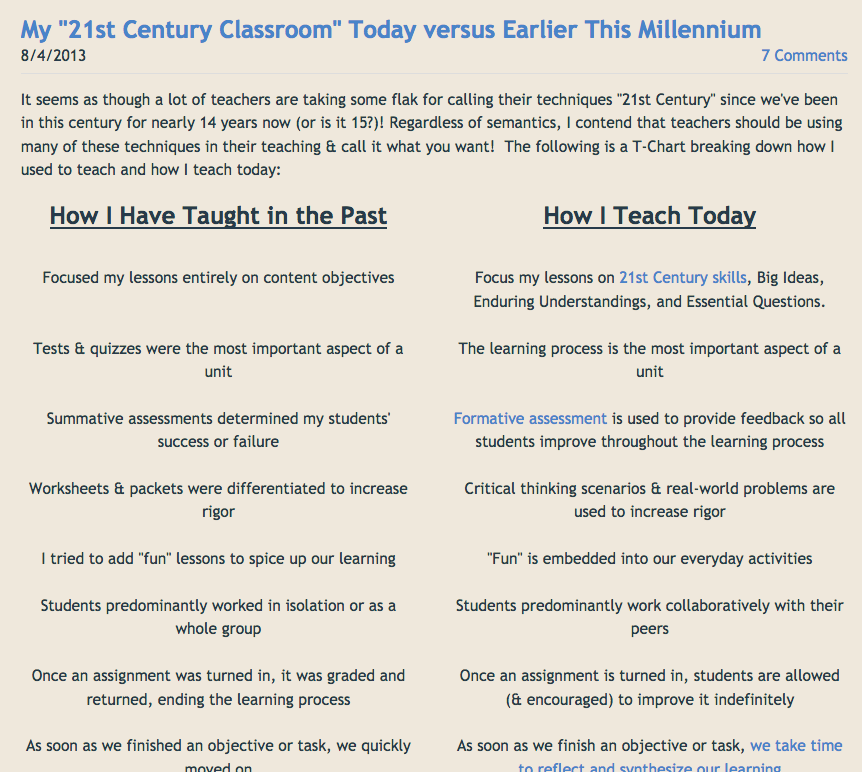
  • Here is an explanation of some of the ways I've changed my perspective on my purpose as an educator.
​
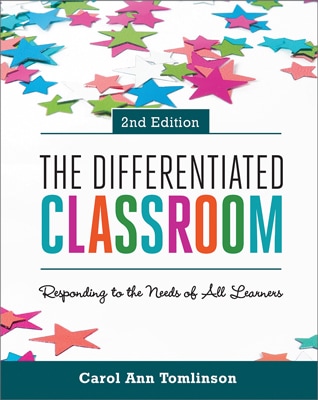
  • Differentiation has been an important area of focus for me since my 2nd year of teaching (my first year was all about survival!). I completed a hefty master's thesis called, "Differentiated Instruction in the Intermediate Classroom" and utilized the research and expertise of Carol Ann Tomlinson for many of my claims. It is my belief that differentiation in the 5th grade classroom is much more effective when it's related to differentiated expectations and feedback, rather than differentiated work that groups students by apparent need and creates animosity amongst students. We all have areas of strength and areas of weakness, but those who are deemed weaker than average on numerous activities each day are often perceived differently by their peers and not appreciated for the things they can do well. Therefore, my entire curriculum is set up for built-in differentiation. Students challenge themselves and others (with my support) to constantly improve and grow.  
​
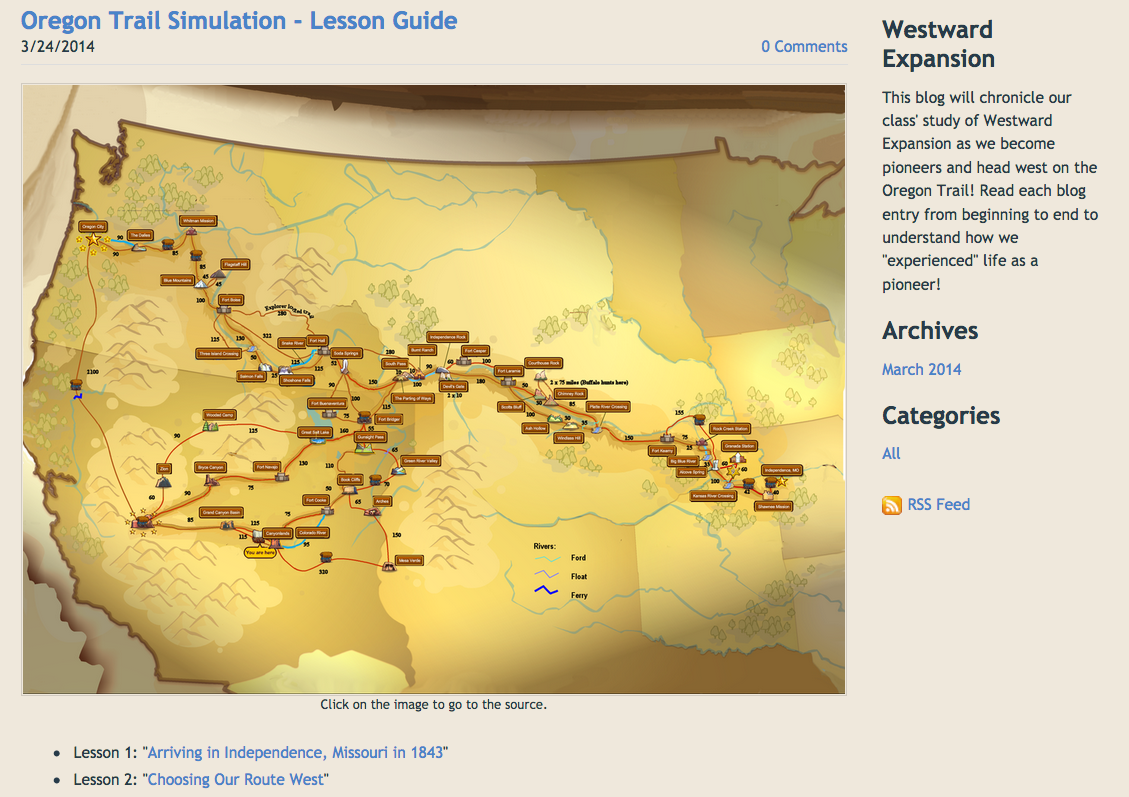
  • Examples of lessons where student learning outcomes represent a range of factual, conceptual understanding, reasoning, social, management, and communication. Facts vs. Concepts is a huge part of our Human Body Research Paper unit. I try to get students to understand that the "cool information" is really just a fact and that they need to explain how each system works and what it does before worrying about the neat facts! Reasoning is a big focus during our Westward Expansion simulation where students make decisions collaboratively as a whole class based on information presented by the teacher. They research, synthesize that information with what they already know, and make decisions based on what the outcomes might be. Social, management, and communication lessons are constantly being done throughout the year via mini-lessons or classroom meetings.
​
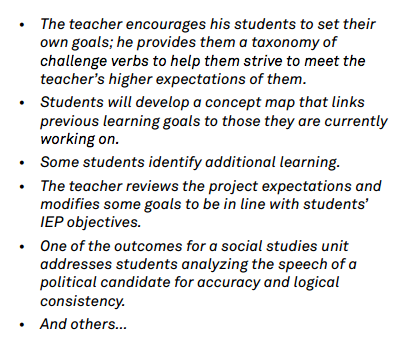
  • In our classroom, Goal-Setting is a vital part of what we do each and every day. During our end-of-the-day routine, students evaluate our day and describe what we did well and what we need to improve on. Through that discussion, the student who has taken on the role of Evaluator for the day, chooses the most important weakness from the day to make a whole-class goal for the next day. We write it down and students remind each other of the goal throughout the next day. Students also create individual goals by identifying relative weak areas, creating a plan for achieving the goal, and recording evidence that supports progress towards the goal. I add personal goals, as necessary.
​
  • I believe in the single point rubric style of assessment. Therefore, I explain the minimum expectations for each student to complete the assignment, but ask students to exceed those baselines as much as they can. This allows students to know what is required and gives them the creative flexibility to make it their own & try to exceed standards. Throughout the work process, I observe, answer questions, give feedback, and help each student improve. When we run out of classtime, students who haven't met minimum requirements finish at home or at Homework Club. Peers help each other every step of the way.
 
  • Outcomes are posted on the board for Math and Reading for most lessons. Students know where these are posted, and know that these are the Big Ideas that they are responsible for.
Picture
Picture
Picture
Picture
Picture

Read More
0 Comments

1d - Demonstrating Knowledge of Resources

3/28/2019

0 Comments

 
Picture
Examples from Charlotte Danielson:
Picture

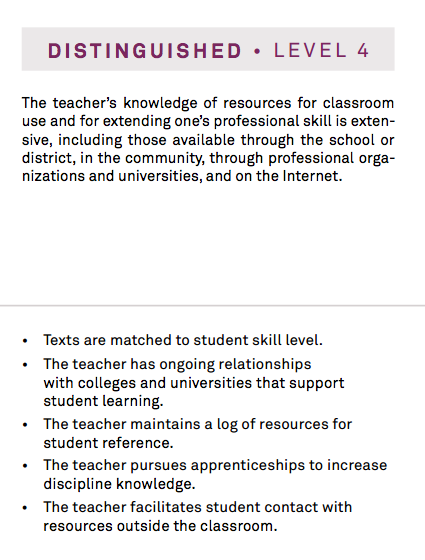
The teacher's knowledge of resources for classroom use and for extending one's professional skill is extensive, including those available through the school or district, in the community through professional organizations and universities, and on the internet:

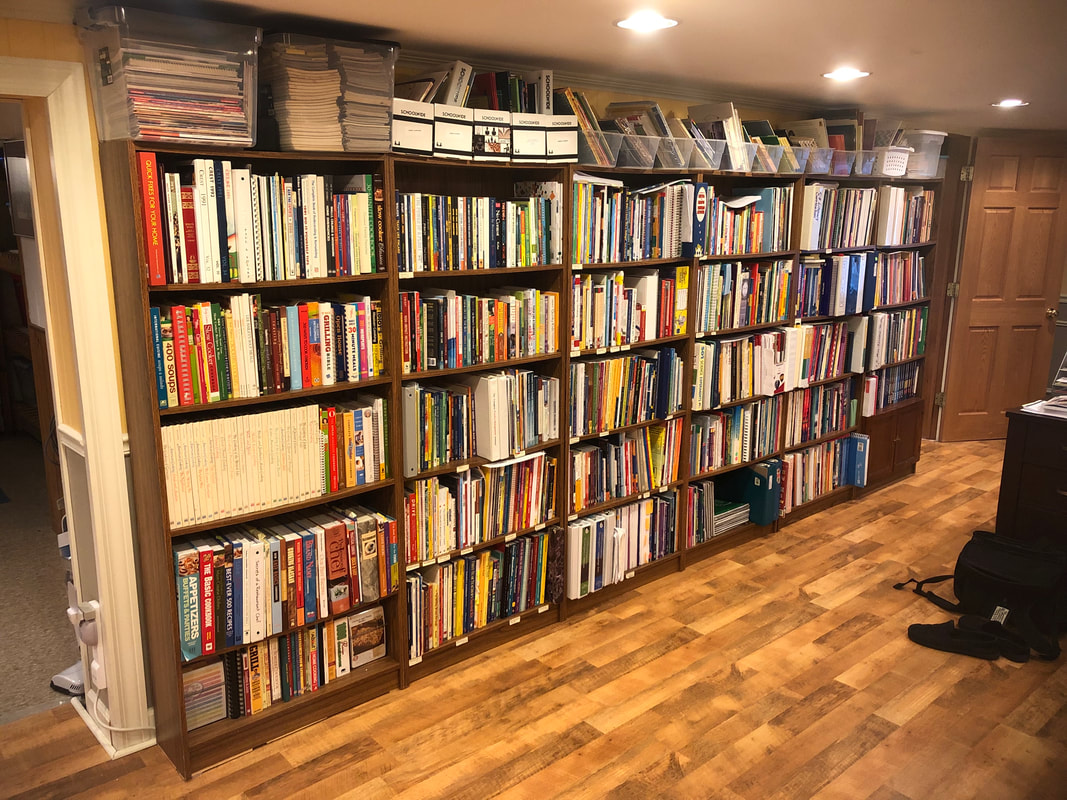
  • I maintain an extensive professional library in my basement, referring to books on a regular basis in order to meet the needs of my students. 
  • I scour Amazon on a weekly basis to find the newest professional books that are being printed.
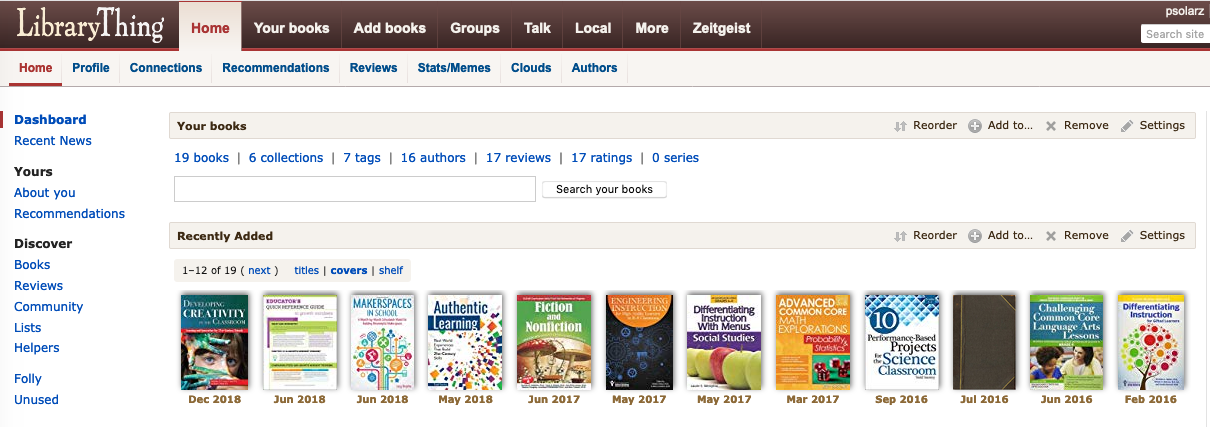
  • I participate LIbraryThing's advanced copy program where I read a book each month, provide a rating and review, and the books are given to me for free. Each of these books that I choose happen to be education-related.
  • Dave Burgess Consulting and many other publishers send me copies of their manuscripts to review and write endorsements for, allowing me a sneak peak into the newest ideas and free professional development!
Picture
Picture
​I integrate the following resources into lessons throughout the year:
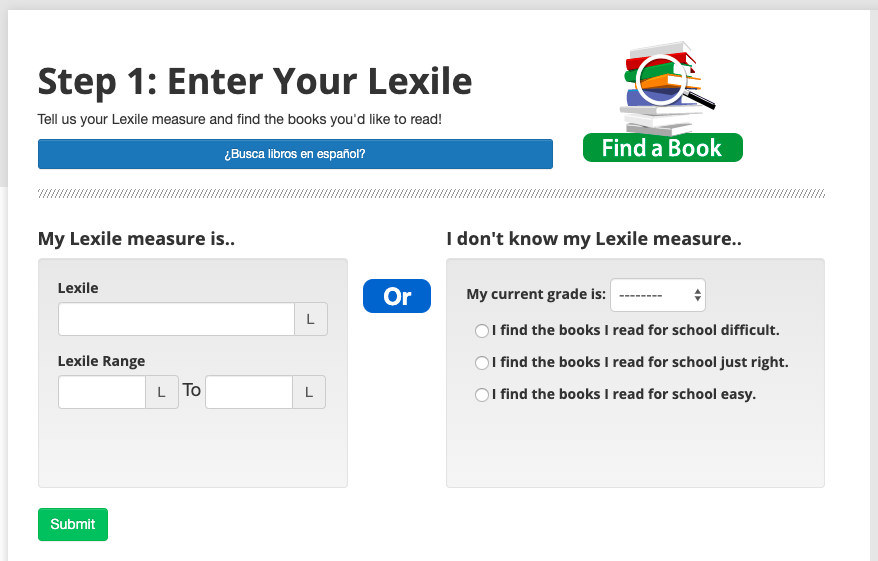
  • Range of Text: We start the year by reading a whole class novel (Wonder or Fish in a Tree) to build our classroom community, set up routines & procedures, and to have common language to use for the rest of the year. As the year progresses, we read books from Schoolwide and student-selected Literature Circle novels (out of 10 choices) that vary from genre to genre and ranges in reading levels. As students finish Lit Circle novels each round, they choose books from our classroom library that meet their interests. Books that I choose to offer range from my lowest student's LEXILE to my highest student's LEXILE. I let them know the LEXILE's of the books but don't require them to choose books at their level (but most students generally enjoy the books at their level better after experiencing "too easy" & "too hard" books!).


​
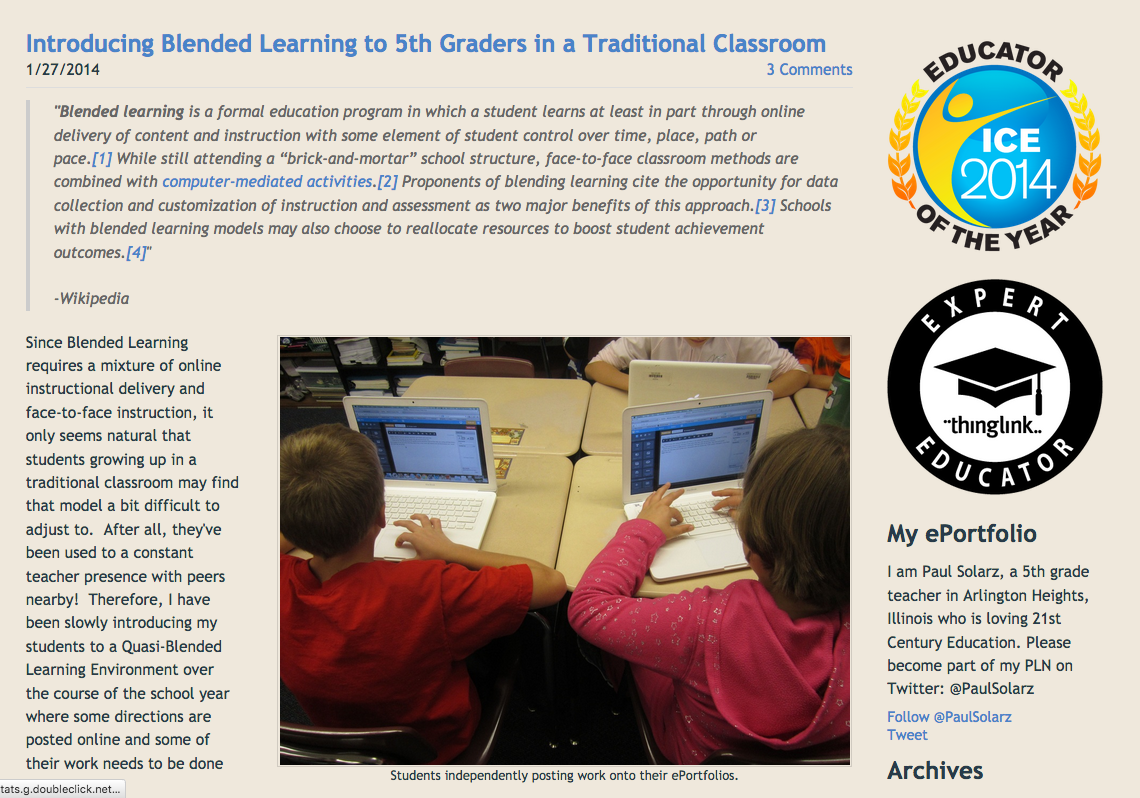
  • Internet Resources: Since I teach in what is called a "Blended Learning" style, internet resources are a daily component of many of our lessons. Blended Learning implies that some learning is being done in person and some is done online. I try to put as much of the material online as I can so directions can be easily found, and I try to get most student work to be uploaded to each student's ePortfolio for sharing and revision purposes. 
 
​
​
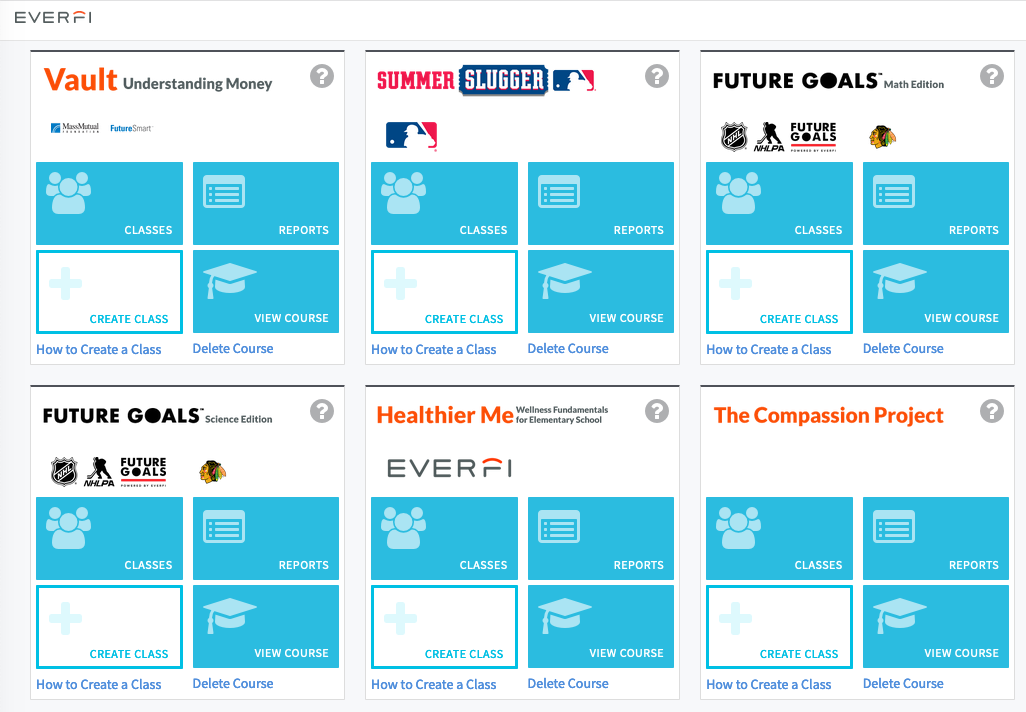
  • Material provided by professional organizations: Nowadays, I have a tendency to integrate lots of games-based education into my curriculum. And this means that I'm using several third-party websites to teach my students the material that they need to learn. For example, I love iCivics for their games that teach students about the various aspects of our government. I also enjoy using EverFi for financial literacy and entrepreneurial skills. This year, Everfi provided my 4th graders with four different game-based learning modules for free that the kids loved!
  • PD or professional groups: I use Twitter for most of my PD, but I also read blogs, attend online group chats, collaborate on Voxer, etc. I use the information that I learn from my PLN to improve the quality of instruction in our classroom and the integrate the best instructional aides available. I host many Twitter chats in order to learn new things about various subjects like Math Workshop or new web tools.


​
  • During Passion Time, my students often need supplies in order to complete their project or creation. I just ask them to write what they need on a Post-It with their name on it & put it on my laptop, and I'll bring it in to school the next day! Over the years, I've bought Legos, arts & crafts supplies, and collected toilet paper tubes & newspaper. I'm thankful to Amazon Prime for quick shipments of modeling clay and glue! Love seeing my kiddos' excited about learning and creating!


Picture
Picture
Picture
Picture
Picture
Picture

Evidence from Previous Years:

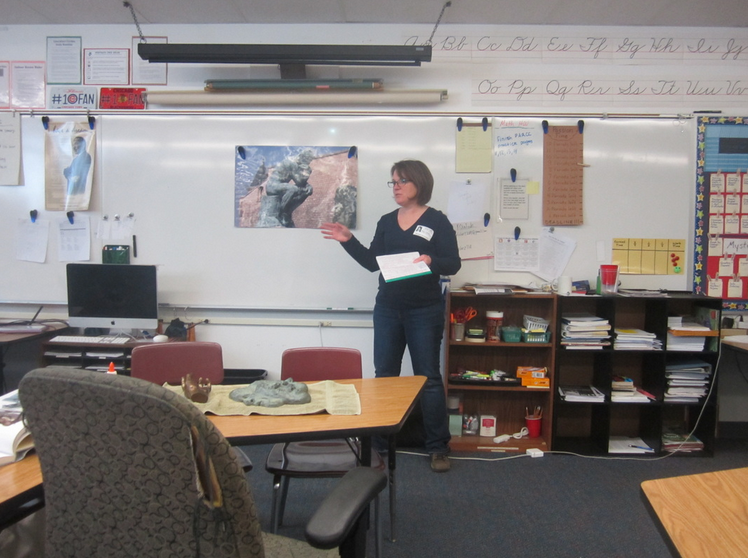
  • Guest Speakers: I invite experts to Skype with us or actually come into our classroom to teach us! We've had Judges, Olympians, Authors, Scientists, Park Rangers, Nature experts, Historians, Older student experts, etc. I plan with each speaker to ensure that the time we spend together is valuable for both parties. I ask my students to take notes online, prepare questions ahead of time and during the presentation, and then interact with each speaker. These have been extremely effective at disseminating information, increasing passion for the topic, and wowing my students! I also continue to encourage parents to do Art Appreciation in our classroom (see image to the right).​


  • Community Resources: In the past, we've worked with our mayor to enact new rules that protected youngsters who wanted to hang out downtown. We've gone to a Teen Council Meeting at the Teen Center to learn and share our perspective on certain issues. We've led an Arbor Day Celebration (complete with a song and a collaborative student-written play) at Pioneer Park for community members and the Park District. We've visited and toured the village police department (and taken mug shots of ourselves in jail). We've interviewed local businesses in an attempt to help make our city safer for all of its residents. 
Picture
Picture
Picture

Read More
0 Comments

1e - Designing Coherent Instruction

3/27/2019

0 Comments

 
Picture
Examples from Charlotte Danielson:
Picture

Evidence from 2017-2018 and 2018-2019 School Years:

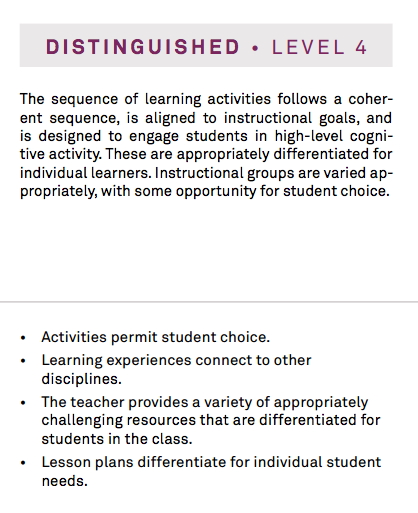
The sequence of learning activities follows a coherent sequence, is aligned to instructional goals, and is designed to engage students in high-level cognitive activity:

Coherent sequence aligned to instructional goals:

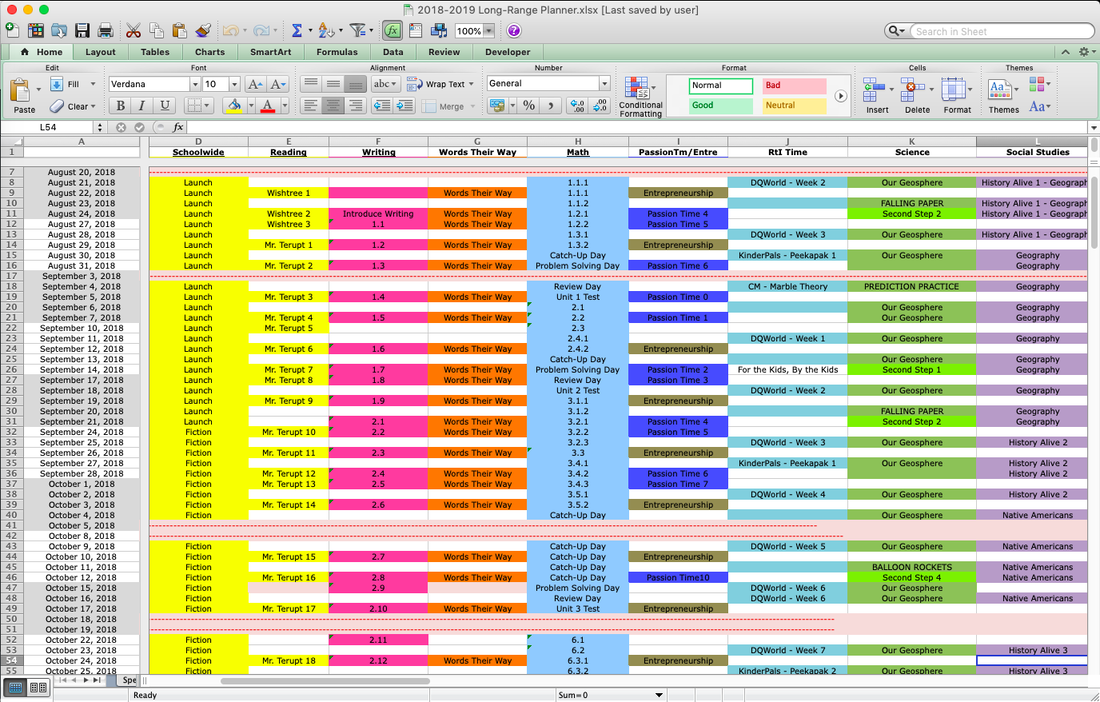
  • Link to my Year-Long Planner: drive.google.com/file/d/1w6c-je0jsdpy0-V-PkmbIMsOqIEKjKEp/view?usp=sharing


​

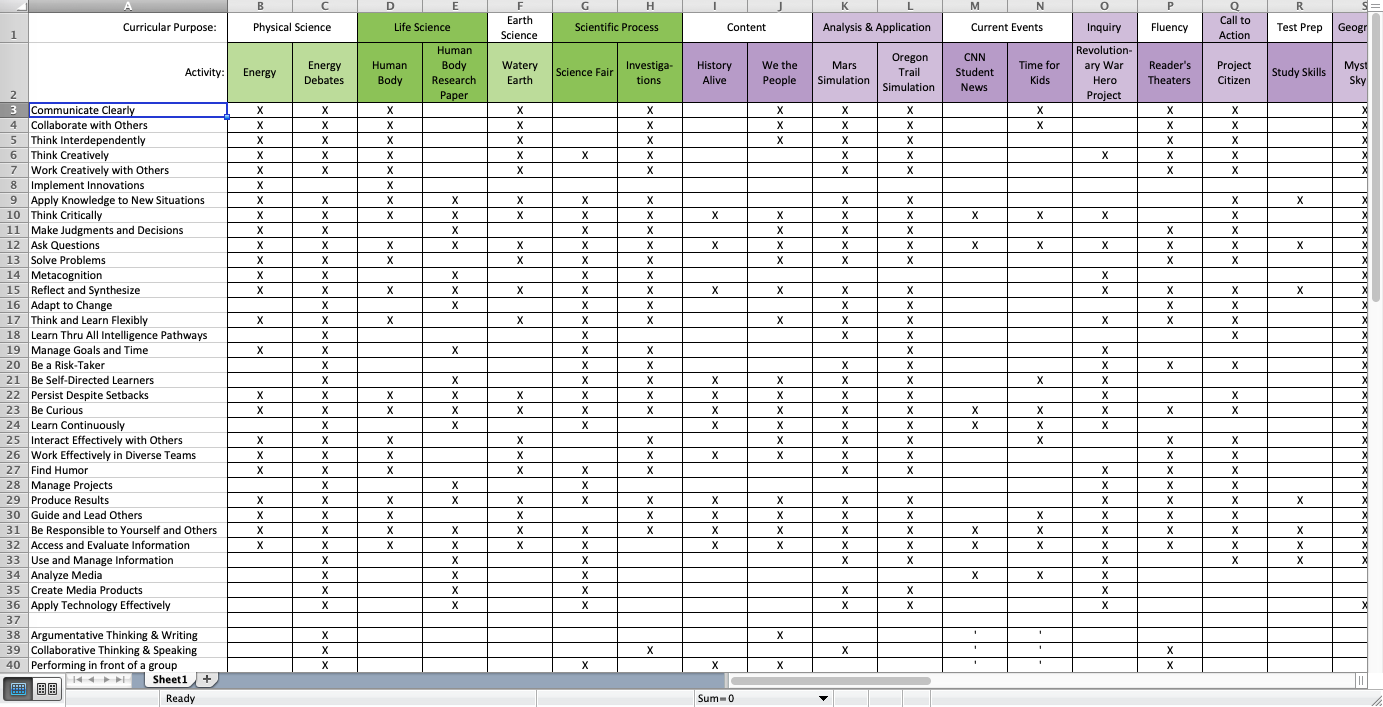
  • Link to my 21st Century Skills Grid: drive.google.com/file/d/1Pss24feW-u1hsH_58X00z2vzhIbEJnV6/view?usp=sharing 


​
​
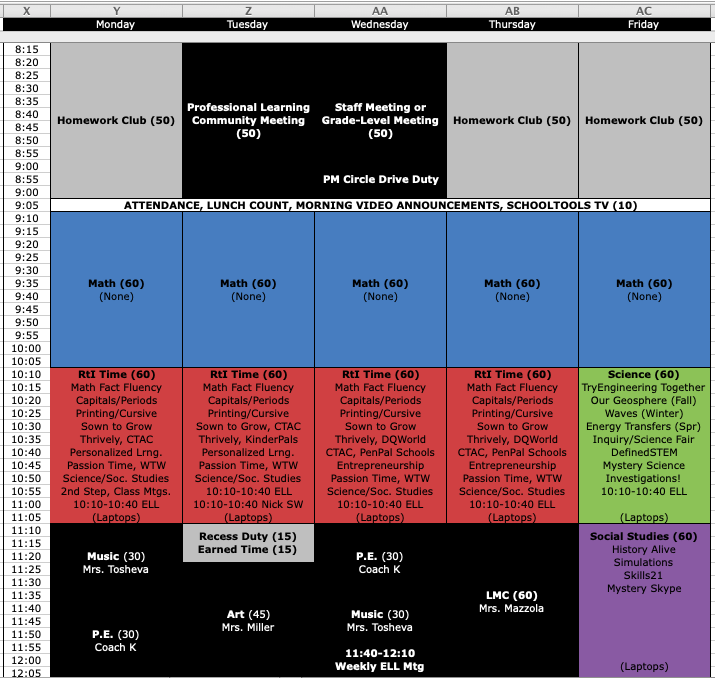
  • Screen shots of my Weekly Planner (click on each image to see a larger version):


​
​
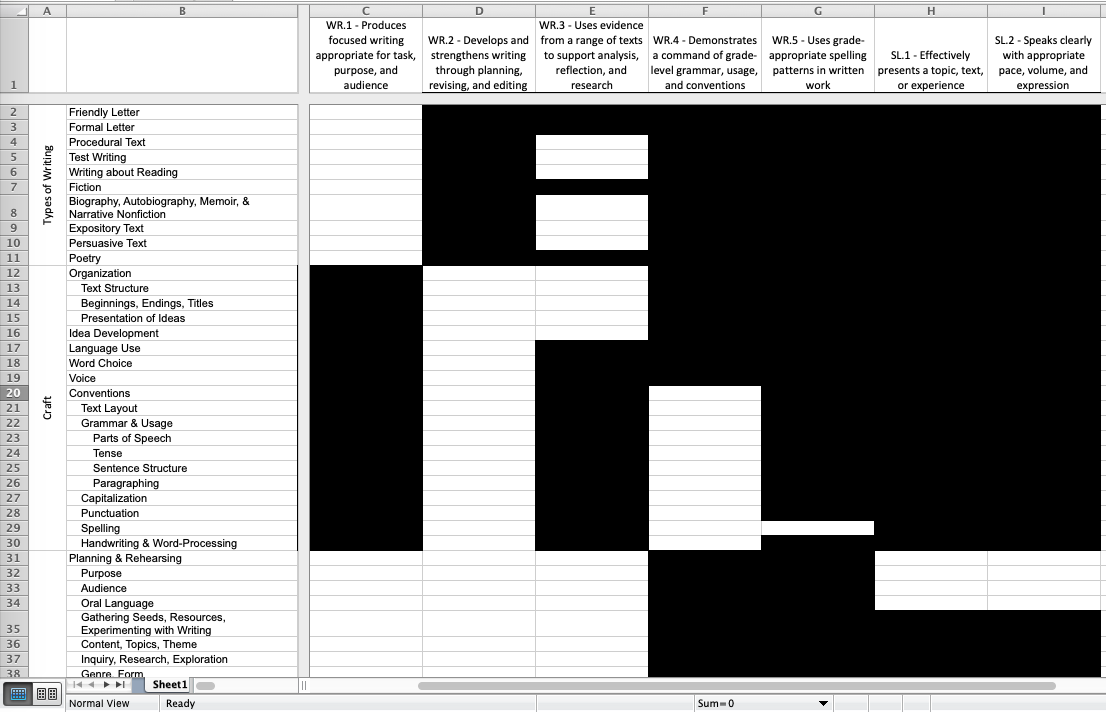
  • Writing Instructional Goals (click to see a larger image):


​

​
  • Words their Way groupings (names have been deleted):


​


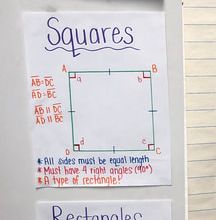
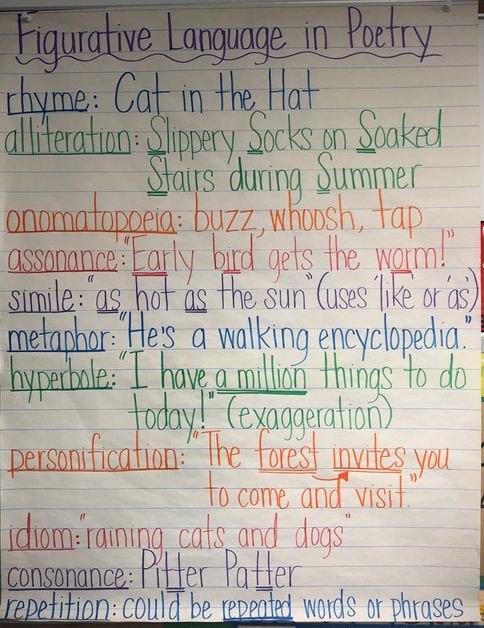
  • Anchor charts are used to help students learn new information over a period of time.
Picture
Picture
Picture
Picture
Picture
Picture
Picture
Picture
Picture

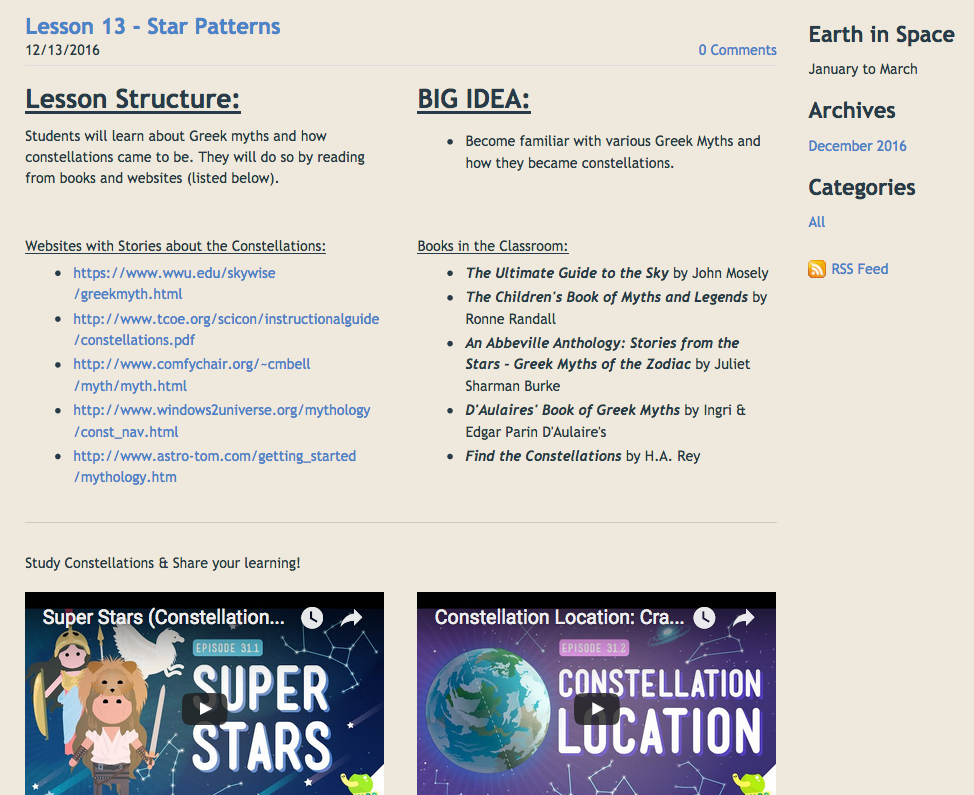
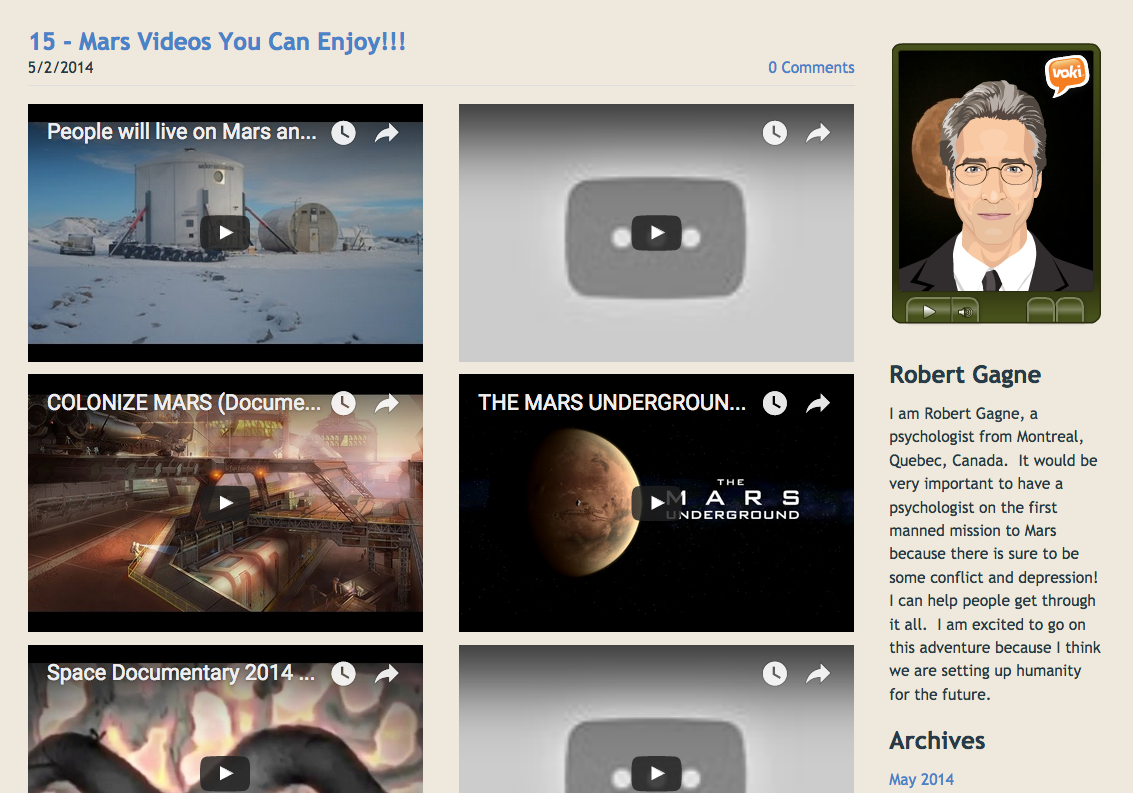
  • Lessons connect to prior learning because I spend time on each unit, developing it, improving it, and publishing it for others to use. Lessons proceed in the order given by the publisher when a program is being used, and goes in the order I feel makes the most sense when I develop the unit. On the right is one from a publisher (Earth in Space) and one that I developed (Colonize Mars).
  • Each lesson builds on the last. Many lessons take several periods to complete and by the end, students see how each lesson connected to form a cohesive unit.
  • Lessons have a definite "Beginning, Middle, and End" because I plan instruction, practice, and reflection as a typical pattern in most lessons.
  • Because every group of students is different from year to year, I generally plan much more for each lesson than I plan to use, providing me opportunities for re-teach or enrichment. I usually post my teacher instructions in the lesson itself so others can follow my general plan as well.
  • Because I believe that students should be spending their time in school building skills and not memorizing information, each lesson typically requires students to practice one of the 34 twenty-first century skills that we focus on throughout the year. Higher-level thinking, problem solving, questioning, finding creative solutions to problems, etc. are often the focus while learning content. I report on these skills each grading period and submit a copy with each student's report card. See a sample copy on the right.
  • Many examples of lessons with higher order thinking and student questioning are found in each unit on our website: paulsolarz.weebly.com and psolarz.weebly.com.
  • In order to ensure that each skill is taught and practiced throughout the school year, I create a grid with the units that I teach each year and identify which 21st Century skills can easily be used within each unit. Because of this, I'm able to identify some skills that don't have lots of opportunities for practice, and make them a focus during a particular unit. See the grid to the right for an example. Unfortunately, some units that I teach don't allow for many 21st Century skills to be taught and practiced, and these are the units that I try to isolate important skills from and integrate them into other units.


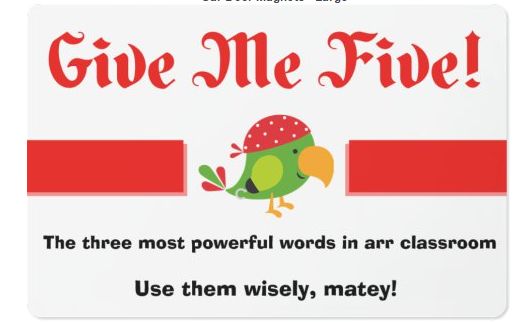
  • Our classroom is built on student choice and students actively leading in the classroom. Therefore, students can often be found making decisions free of teacher permission or interrupting work time to make important announcements ("Give me Five!") that is more traditionally done by the teacher.
  • Students get to choose their Passion Project topics, countries they're from in "Colonize Mars", and where they sit during class, to name just a few. Students help me explain things that I'm unsure of by researching the topic while I continue with the lesson. When they find the answer, they do a "Give me five!" and announce what they've discovered. Student autonomy is extremely important to me.


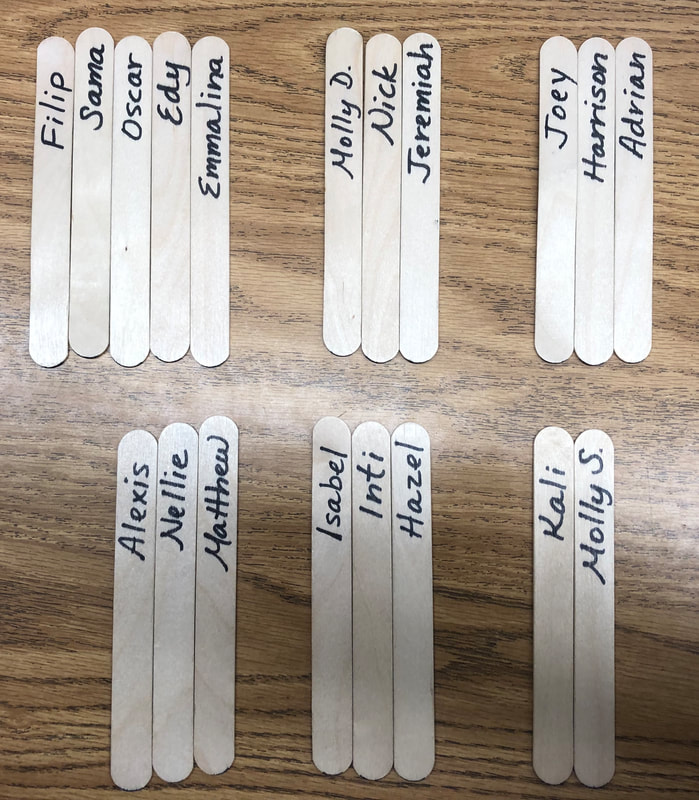
  • Learning groups are often created by choosing sticks (randomly) in order to ensure that each student builds a relationship with everyone in class. However, when creating groups that may last longer than a day or two, or when it would help to have certain types of thinkers in each group, I will choose groups ahead of time (example at right).
Picture
Picture
Picture
Picture
Picture
Here is my application for the Global Teacher Prize. I think it represents some of the instructional activities that I am most proud of very well.

These are appropriately differentiated for individual learners. Instructional groups are varied appropriately, with some opportunity for student choice:

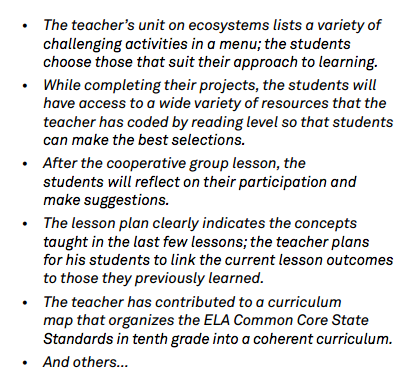
Student Choice:

  • Students choose between ten novels each round of Lit Circles. They give me their top 5 choices and I try to give them their first or second choice. Students may ask the Lexile or student rating of each book & I share these with them while they're choosing books.
  • Independent reading is completely student choice.
  • When assigning "final writing assessments" for each unit, I give students their choice between 5-10 prompts.
  • Although jobs are assigned in our classroom, students are not expected to do their job, only to ensure that their job gets done each day. Therefore, students do any jobs that they want to, any time that they want to.
  • There are many times when I will create a Google Sheet and project it on the board. I will choose sticks, and students will choose which group they'd like to be in. The last child chosen knows not to complain because it was as fair as possible!
  • In our Try Engineering Together units, students select between 6-9 articles to read. They get placed into groups based on the article they select. Then, their pen pal reads the same article and they discuss it.

Learning experiences connect to other disciplines:

  • I've chosen to incorporate several programs or units that integrate subjects effectively and efficiently. For example, Try Engineering Together is a program where each of my students have been partnered up with a science or engineering professional who reads the same articles as my students, write back and forth with each other, and ask & answer questions. This incorporates writing, reading, science, and 21st Century skills.
  • In science, we have expanded our Energy unit to include a debate! Students learn persuasive/argumentative writing techniques, research skills, and presentation skills. In addition, they learn how to listen in order to evaluation and judge to make a vote on which team had a stronger debate. The technology integrations into this unit have really made it a fun experience!
  • In order to make measurement, unit conversions & finding the mean more authentic to my kiddos, I've integrated science investigations into our weekly schedule. These investigations include measuring distances using meter sticks, using timers on iPads, calculating averages, and interpreting data. Lots of math skills in our science lessons!

Differentiated Instruction:

  • Students are put into Words their Way groups based on a pre-test score at the beginning of the year and at least one other time during the year. This ensures that students are learning spelling patterns, rules, and affixes at their readiness level.
  • In math, students are given a packet with "Reteach," "Extra Practice," and "Enrichment" pages. Students have been taught to work on the reteach pages when they are struggling, the extra practice pages when they get the material but don't feel like an expert yet, and the enrichment pages when they completely understand the material and want a challenge. This is done whenever they have a free minute in math class.
  • During WIN Time, I pull students to work on "Reteach" math pages, skills that they're struggling with, and I also pre-teach upcoming lessons. We do IXL together and the goal is to give direction, feedback, and support to ensure that each student is academically successful.
  • In Passion Time, students choose topics of interest and do activities that are at their grade level. I modify my expectations for each child based on their abilities & challenges. I spend time giving feedback and asking students to make improvements over time.

Read More
0 Comments

1f - Designing Student Assessments

3/26/2019

0 Comments

 
Picture
Examples from Charlotte Danielson:
Picture

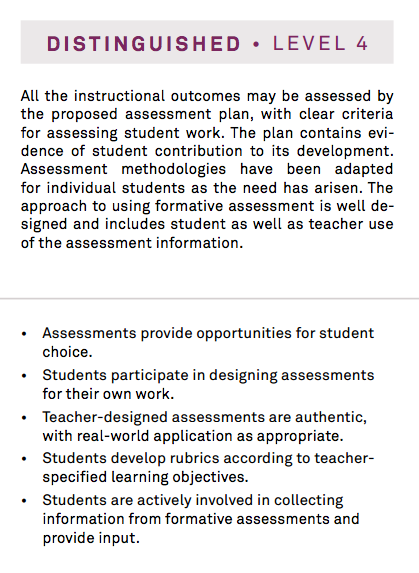
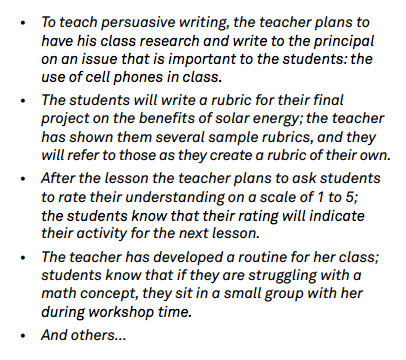
All of the instructional outcomes may be assessed by the proposed assessment plan, with clear criteria for assessing student work. The plan contains evidence of student contribution to its development. Assessment methodologies have been adapted for individual students as the need has arisen. ​The approach to using formative assessment is well designed and includes student as well as teacher use of the assessment information:

  • In our classroom, students set goals for themselves, write plans for achieving those goals, and cite evidence as they close in on achieving their goals. The plan they create and the evidence they choose to collect is completely up to them. In addition, they get to decide when they've accomplished their goal and what criteria need to be met in order to feel that a goal has been met. These are THEIR goals, not mine. These are things they feel they need to improve on in order to become a stronger student, peer, or leader.
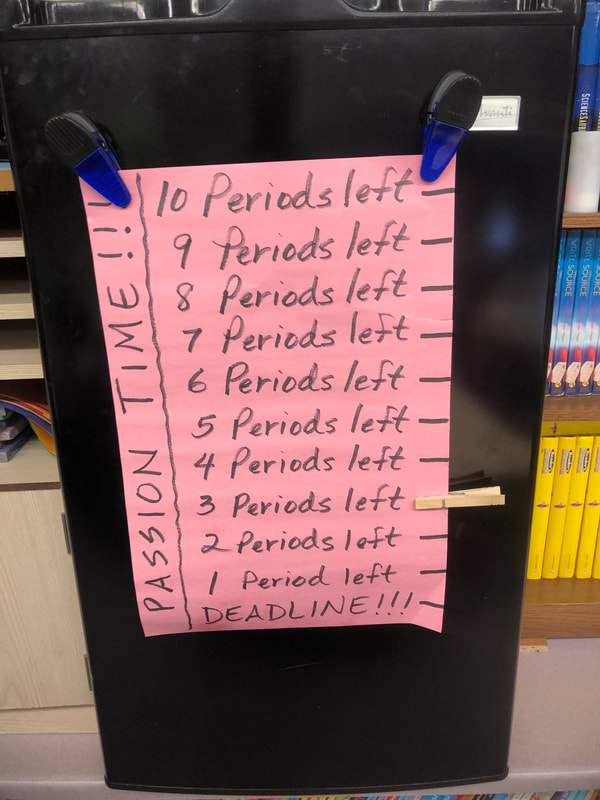
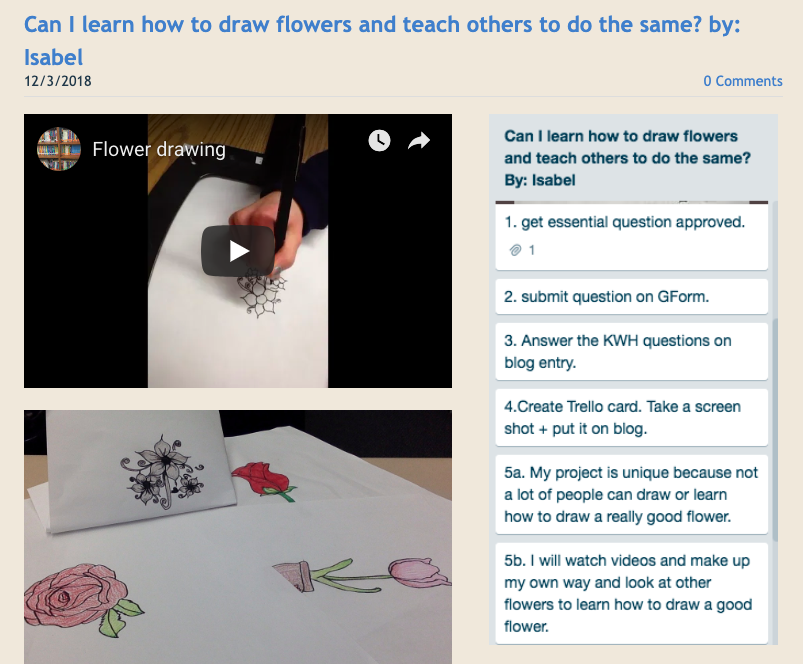
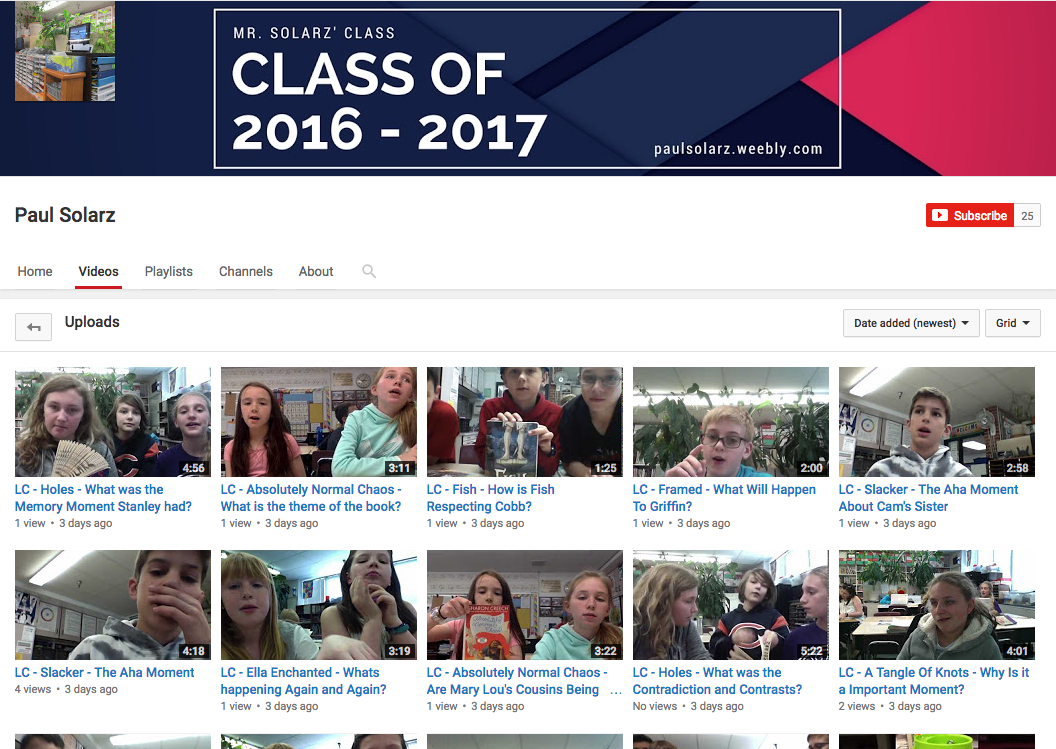
  • During Passion Time, students write an essential question that takes them on a journey through ten class periods of 30 minutes where they explore a topic of personal interest to them. I help them revise the essential question so that it focuses their work carefully, but students determine the process by which they learn their new skill. At the end of the learning process, students complete a reflection and make a video describing their learning. They determine their level of achievement and make adjustments for the next round. Students listen to each others' videos, typing "Quality Boosters" that help their peers improve their work for the next round. 
​
  • Once again, students set individual goals based on feedback from me and their own observations. They set the criteria for evaluation and determine when they've met their goals. I assist with the process to ensure that it is meaningful for all students.
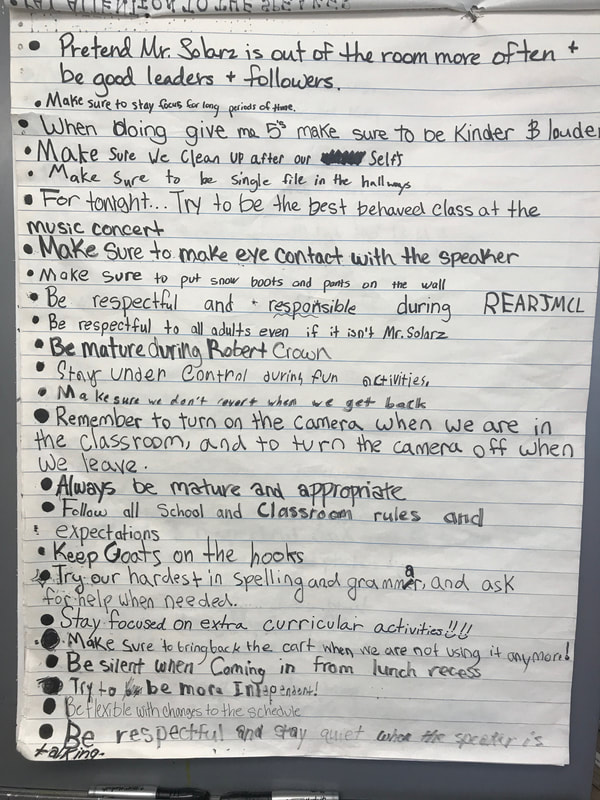
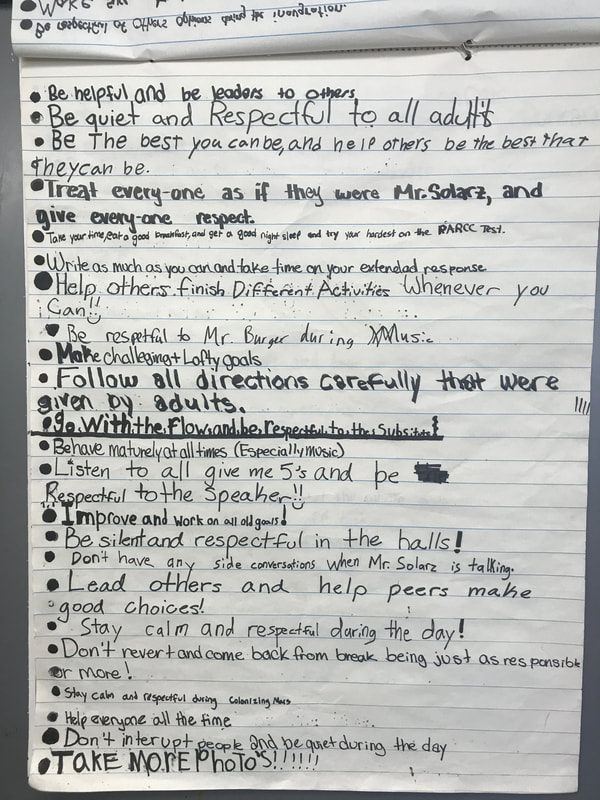
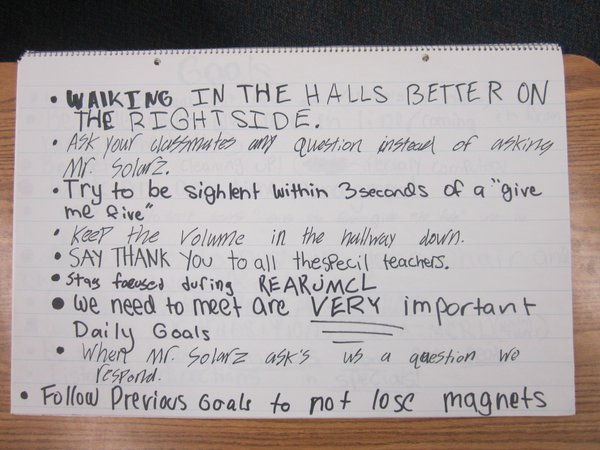
  • In addition to individual goals, students also form whole-class goals each day during Evaluate in REARJMCL:
Picture
Picture
Picture
Picture
Picture
Picture
Picture
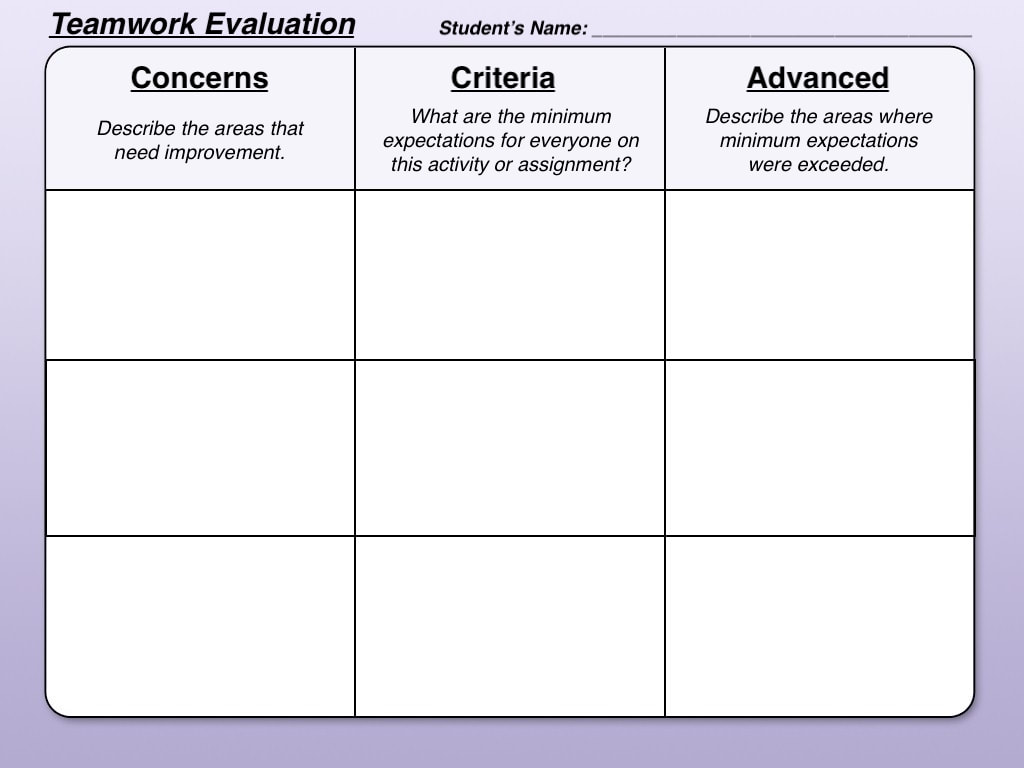
  • Whenever possible, I like to have students develop our rubrics for upcoming projects or activities. Here is an example of one we did for our KinderPals on the topic of TEAMWORK. (I prefer to use a SINGLE-POINT RUBRIC rather than more traditional style rubrics. This matches my improvement-focused philosophy more closely than traditional rubrics which focus on a grade.
  • At the beginning of the year, I had my math class set goals for themselves that would address many of the challenges that are typical in math class. We sat down together on the floor and had a classroom meeting where we worked together to write goals for ourselves that ensured we would have a great year together!
Picture

Evidence from Earlier Years:

Assessment can be tricky for many reasons, and because of this I have chosen to move into an ePortfolio system for much of my assessment.

By using ePortfolios, students have the opportunity to take things as far as they want, to revise blog posts with or without assistance, and to choose web tools that make the most sense for them and for the assignment.

Since ePortfolios are online, I am able to assess their progress on a daily basis from home or school, students can write comments to help with revision & improvement, and it provides a much larger authentic audience than a worksheet or test!

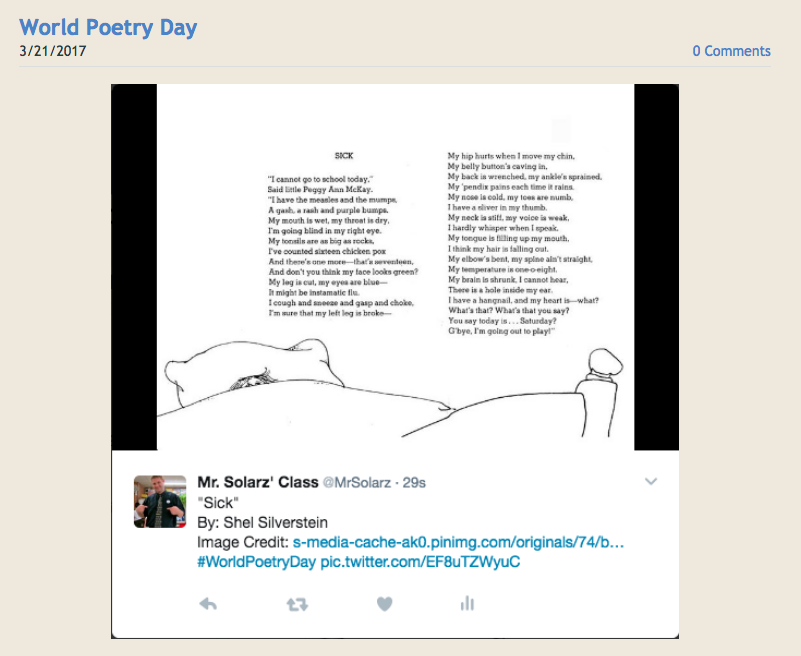
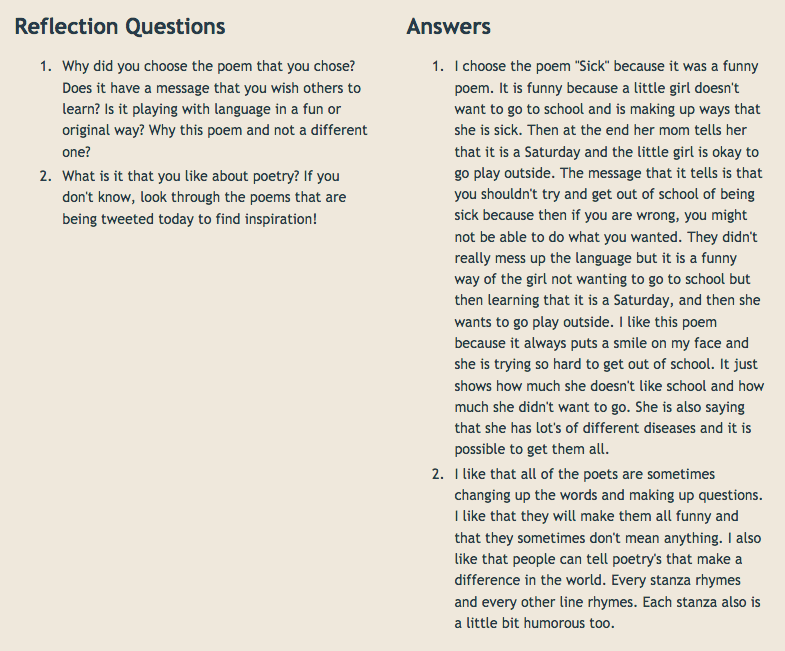
Because students can take each assignment as far as they want or can, differentiation is often natural and only requires some nudges and coaching. On the right, is a sample blog post by Abby. The assignment asked students to find a poem that they enjoyed, share it on Twitter on #WorldPoetryDay and answer a couple questions about it.

As for students who need additional support, I provide lots of feedback both verbal and written to all of my students. I provide time in class and during Homework Club (before school and during lunch recess) for students to make revisions. I encourage parents to help where they can, and I see tremendous growth over the course of the year in all of my students.

On the right is one of our blog feedback sheets that students receive each trimester. Students get a blank version of this sheet when I cut off grades for the trimester. One week later, I grade their blog posts and fill out the sheet. I give it to them and they have 1-2 weeks to make revisions (this is beyond the feedback they receive all trimester). At that point, I grade the ePortfolio entries one more time and students get two grades on the report card:
  1. Blogs BEFORE feedback
  2. Blogs AFTER feedback

This information can also be found on our website all trimester long here.

This system of blog posts also helps me ensure that I assess & document all standards and objectives in at least science and social studies. Other subjects are often done in other ways:
  • Math: I teach a skill, check for understanding, give feedback as students practice their work, and end units with formal assessments that get documented. Students receive daily one-on-one feedback on their class work and homework (if it applies).
  • Reading: I teach lessons (usually as mini-lessons during Literature Circles, but also as independent lessons), have students make final products whenever possible (sometimes reflections or examples), have students record videos during their reading that demonstrates understanding of a standard or objective, and I give them feedback on their work. It gets documented on each report card and comments section.
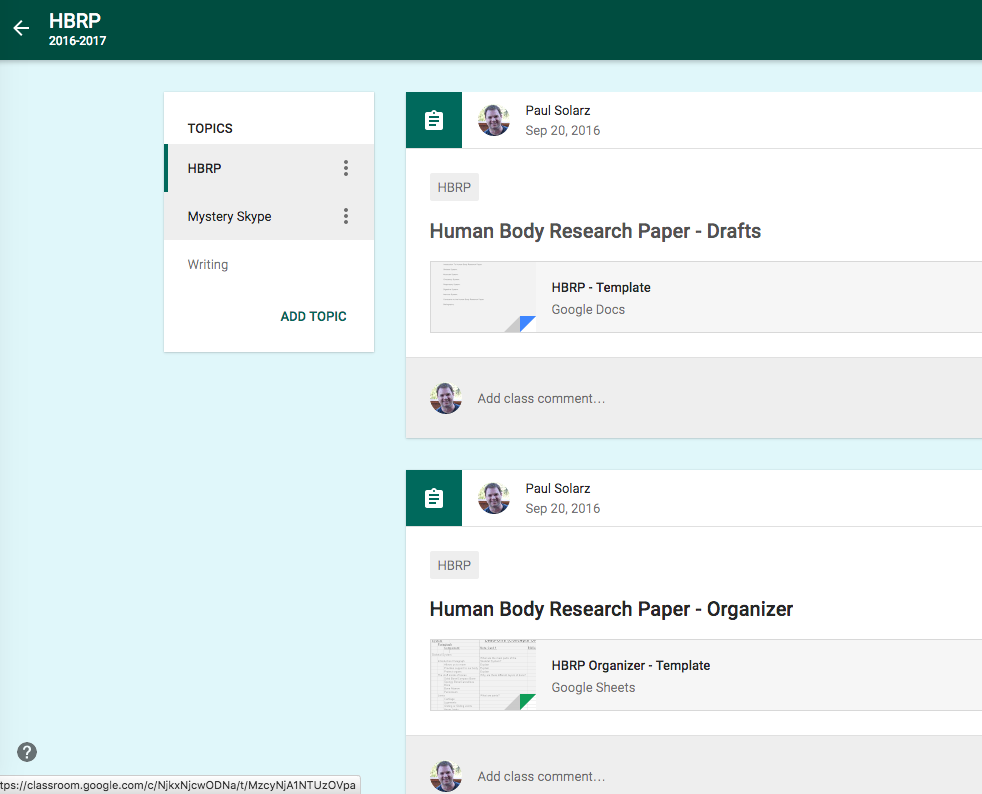
  • Writing: I use Google Classroom or Doctopus to distribute Google Docs to students, occasionally provide organizers to help them structure their writing, teach lessons & provide feedback to students as they write. Each student is given writing goals that meet their own personal needs and everyone is challenged to improve their writing every day!
Formative assessment is being used constantly in our classroom because feedback is my major focus as the teacher, while my students' main focus is improvement.

Formative assessment allows me to get an idea of where my students are as an entire class, helping me make decisions on what to do next in my instructional path. Formative assessment also helps me identify which students will need more support moving forward and which ones need enrichment and encouragement to challenge themselves further!

On the right is one way I conduct formative assessment in my class. It's a Google Sheet created by a Google Form that students fill out. The form has multiple long-answer questions on it that help me determine where students are academically, socially, and behaviorally in class. Based on this data, I make important decisions as I move forward with my teaching.

Of course, the main ways that I use formative assessment in my class is through observation. I sit with my students and walk around the classroom as they work each day. I listen to their words and anticipate misunderstandings and misconceptions. I determine if peer assistance is all that's needed (which is sometimes the case) or if I need to intervene. Many times, I will use this opportunity to do a "Give me five!" and give the feedback to the entire group so various students don't repeat the same mistakes.

My students track goals (some made by me, but many more made by them). We do so on a form at the right and we do this every week for 30 minutes. Students see tremendous growth in academic, social, and behavioral areas throughout the year due to this process!

My students also evaluate each day by discussing what went well and what needed improvement. They set a whole-class goal for the next day and work hard to ensure that goals is met. We do this during REARJMCL, the last 20 minutes of our day. This time includes time to write down any homework, gather our mail and materials, and do our classroom jobs. This time is completely student-led and is a sight to see! An example of some of our daily whole-class goals is on the right.

In addition to creating a whole-class goal, students also evaluate their progress towards goals that have been somewhat elusive! We have a rubric that we use nearly every day where students self-evaluate our class' achievement with regard to each task. Whenever the "Evaluator" disagrees with the majority of students on a grade, they ask for evidence to support their claim. This is an outstanding process that improves students' perspective of reality, self-assessment skills, and metacognition skills. It takes most of the year to make real gains, but it is undeniable when you watch them in the spring! Although the checklist changes every few months, there is one to the right you can check out.

Reflection and Synthesis is a main goal of ours all year long. I teach these skills in many ways, but one great resource I found is on the right.

Students are asked to reflect and self-assess on all assignments they complete either formally or informally. Some of the expectations are given, while others are left up to the student to decide.
Picture
Picture
Picture
Picture
Picture
Picture

Read More
0 Comments

    Domain 1: Planning and Preparation

    Instructional planning includes a deep understanding of content and pedagogy and an understanding and appreciation of the students and what they bring to the educational encounter. But understanding the content is not sufficient; the content must be transformed through instructional design into sequences of activities and exercises that make it accessible to students. All elements of the instructional design – learning activities, materials, and strategies –must be appropriate to both the content and the students, and aligned with larger instructional goals. In their content and process, assessment techniques must also reflect the instructional outcomes and should serve to document student progress during and at the end of a teaching episode. Furthermore, in designing assessment strategies, teachers must consider their use for formative purposes, and how assessments can provide diagnostic opportunities for students to demonstrate their level of understanding during the instructional sequence, while there is still time to make adjustments.

    Archives

    March 2019
    January 2019

    Categories

    All

    RSS Feed

Powered by Create your own unique website with customizable templates.