What's going on in Mr. Solarz' Class?
What's going on in Mr. Solarz's Class?
  • Parents (Newsletter)
    • Our Online Photo Album >
      • 2018-2019 Photo Album
      • 2017-2018 Photo Album
      • 2016-2017 Daily Photo Journal
      • 2016-2017 Daily Photo Journal - Album 2
      • 2015-2016 Daily Photo Journal
      • 2015-2016 Yearbook
      • 2014-2015 Daily Photo Journal
    • Our YouTube Channels >
      • 2018-2019 YouTube Channel
      • 2017-2018 YouTube Channel
      • 2016-2017 YouTube Channel
      • 2015-2016 YouTube Channel
      • 2014-2015 YouTube Channel
      • 2013-2014 YouTube Channel
      • 2012-2013 YouTube Channel
      • YouTube videos over the years
      • Learn Like a PIRATE videos
    • Calendar
    • Our Weekly Schedule
    • FAQ about our classroom
    • Curriculum Night Presentation
  • Educators
    • Danielson Framework >
      • Domain 1 - Planning & Preparation
      • Domain 2 - Classroom Environment
      • Domain 3 - Instruction
      • Domain 4 - Professional Responsibilities
      • Professional ePortfolio
      • Instructional Coach Evidence
      • Experience Logs
    • FAQ about our Classroom
    • Workshops
    • Our Classroom Library is for Sale
  • Curriculum
    • Science Units >
      • 5th Grade >
        • Human Body Unit >
          • Human Body Links
        • Ecosystems >
          • Ecosystems - Legends of Learning
        • Watery Earth >
          • Watery Earth Links
        • Earth in Space
        • Investigating Matter
      • 4th Grade >
        • Energy >
          • Energy Unit Notes
          • Energy Debates
          • Energy Debate Organizers
        • Our Geosphere
        • Waves
      • Science Fair
      • STEM Investigations!
      • Try Engineering Together
    • Social Studies Units >
      • 5th Grade >
        • Revolutionary War >
          • Liberty's Kids Videos
          • Revolutionary War Hero Project >
            • RWHP Directions
        • U.S. Constitution & Government >
          • Mini Lessons
          • Colonize Mars! >
            • Claiming Mars for Ourselves >
              • 2017-2018 Creating our Country on Mars
              • 2016-2017 Mars Decisions
              • 2015-2016 Claiming Mars for Ourselves
              • 2014-2015 Claiming Mars for Ourselves 2015
            • Solutions to Problems on Mars >
              • 2017-2018 Our Solutions to Problems on Mars
              • 2016-2017 Problems & Solutions
              • 2015-2016 Our Solutions to Problems
              • 2014-2015 Our Solutions to Problems
            • 2014-2015 "Mission: Mars" Video Discussions 2015
          • Project Citizen
        • Westward Expansion >
          • Oregon Trail Simulation
          • Oregon Trail Readings
          • Reflection Rotation >
            • 2017-2018 Reflections >
              • ThingLink Photo Stories
              • Green Screen Tableaux Vivants
              • Fictional Travel Blog
              • Canva Concept Cards
              • YouTube Newscasts
              • Google Slide Show
              • Daily Travel Blog
              • Act-It-Outs
            • 2016-2017 Reflections
            • 2015-2016 Reflections >
              • Voki Reflections >
                • Voki Blog
            • 2014-2015 Reflections >
              • Act-It-Outs
              • Timeline Spreadsheet
              • Newscasts
              • ThingLink >
                • ThingLink Images
                • Sign up for ThingLink
              • Google Slideshow
              • Fictional Travel Log
              • Daily Travel Log
              • Tableaux Vivants
              • Photo Stories
      • 4th Grade >
        • Geography
        • Explorers
        • Native Americans
        • Colonization
        • State of Sustainability
      • Presidential Election Simulation - 2012 >
        • Presidential Election Simulation - 2016
      • Current Events
    • Reading >
      • 5th Grade Units >
        • Literature Circles >
          • Literature Circles >
            • Video Discussions
          • Literature Circles >
            • Video Discussions
            • Activities
        • Schoolwide Launch
        • Schoolwide Fiction
        • Schoolwide Non-Fiction
        • Schoolwide Ecosystems
        • Schoolwide Poetry
        • Wonder >
          • Wonder
        • The Phantom Tollbooth >
          • Phantom Tollbooth Assignments
      • 4th Grade Units >
        • Schoolwide Launch
        • Schoolwide Fiction
        • Schoolwide Non-Fiction
        • Schoolwide Poetry
        • Schoolwide Energy
    • Writing, Spelling & Grammar >
      • Writing >
        • Writing City
        • WEX
        • WriteAbout
        • Reflection Writing
        • JoonBugz
      • Spelling >
        • Words Their Way
      • Grammar >
        • Grammar
    • Math >
      • Money Island
      • Math in Focus
    • Miscellaneous >
      • Activities >
        • Short-Term Projects
        • Challenges!
        • Special Events
        • Projects & Mini Lessons
        • Bonus Activities
        • Miscellaneous >
          • Honor Badges
          • Growing a Growth Mindset
      • Imagination Club >
        • Schedule
        • Daily Ritual
        • Mini-Lessons
        • Photo Journal
        • Student Creations Round 1
      • Mystery Skype
      • Entrepreneurship Unit >
        • Entrepreneurship - Creating Our Own Businesses!
      • Self-Reflection
      • KinderPals
  • Student ePortfolios
    • 2018-2019 ePortfolios >
      • Students 1-7 >
        • 1 - Isabel
        • 2 - Alexis
        • 3 - Oscar
        • 4 - Adrian
        • 5 - Edy
        • 6 - Matthew
        • 7 - Molly
      • Students 8-14 >
        • 8 - Joey
        • 9 - Jeremiah
        • 10 - Emmalina
        • 11 - Sama
        • 12 - Hazel
        • 13 - Nick
        • 14 - Filip
      • Students 15-21 >
        • 15 - Nellie
        • 16 - Landon
        • 17 - Molly
        • 18 - Harrison
        • 19 - Kali
        • 20 - Inti
        • 21 - Ryan
        • 22 - Pavel
      • Blog Assignments
    • 2017-2018 ePortfolios >
      • Students 1-9 >
        • Elle
        • Daniel
        • Tommy
        • Alyssa
        • Gavin
        • Milosz
        • Mikey F
        • Caitlin
        • Brynna
      • Students 10-17 >
        • Kya
        • Olivia
        • Ian
        • Colin
        • Owen
        • Gianna
        • Isabella
        • Carmen P
      • Students 18-25 >
        • Lucy
        • Caleb
        • Mikey S
        • Wes
        • Martin
        • Will
        • Shaun
        • Carmen W
      • Blog Assignments
    • 2016-2017 ePortfolios >
      • Students 1-8 >
        • Hailie
        • Jody
        • Madison
        • Dylan
        • Calvin
        • Connor
        • Louisa
        • Harvey
      • Students 9-16 >
        • Anna
        • Jack
        • Ben
        • Elijah
        • Catelyn
        • Cole
        • Abby
        • Ashley
      • Students 17-23 >
        • Charles
        • Michelle
        • Charlie
        • Daniel
        • Sam
        • Chingoon
        • Kyren
      • Blog Assignments
    • 2015-2016 ePortfolios >
      • Students 1-9 >
        • TJ
        • JJ
        • Bridget
        • Alex
        • Mason
        • Ryan
        • Lucas
        • Shreya
        • Logan
      • Students 10-18 >
        • Charlotte
        • Addie
        • Aidan
        • Andrew
        • Jeremy
        • Rachel
        • Russell
        • Addy
        • Cassidy
      • Students 19-26 >
        • Audrey
        • Regan
        • Giuliana
        • Brady
        • Stephen
        • Matthew
        • Ben
        • Tyler
        • Thomas
      • Blog Assignments
    • 2014-2015 ePortfolios >
      • Students 1-7 >
        • 1 - Michael
        • 2 - Charlie
        • 3 - Nicole
        • 4 - Stacy
        • 5 - Bela
        • 6 - Kendall
        • 7 - Demetri
      • Students 8-14 >
        • 8 - Emily
        • 9 - Nicky
        • 10 - Hanna
        • 11 - Payton
        • 12 - Hasanain
        • 13 - Tucker
        • 14 - Chris
      • Students 15-21 >
        • 15 - Madi
        • 16 - Aidan
        • 17 - Luke
        • 18 - Kaela
        • 19 - Ryan
        • 20 - Alison
        • 21 - Lucas
      • Blog Assignments
  • Passion Time
    • Passion Time Resources >
      • ALL Passion Time Resources
      • Step-By-Step Directions
      • Submit Your Essential Question
      • Our Trello Page
      • Our Passion Projects over the years
      • Our Trello Board
      • SAMPLE Blog Post Format
      • YouTube Upload Page
      • Mini-Lessons
    • 2018-2019 Projects >
      • Round 1
      • Round 2
      • Round 3
      • Round 4
    • 2017-2018 Projects >
      • Round 1
      • Round 2
      • Round 3
      • Round 4
      • Round 5
    • 2016-2017 Projects >
      • Submit Your Essential Question
      • Mini-Lessons
      • Round 1
      • Round 2
      • Round 3
      • Round-4
      • Round 5
      • Round 6
    • 2015-2016 Projects >
      • Round 1
      • Round 2
      • Round 3
      • Round 4
    • 2014-2015 Projects >
      • Round 1
      • Round 2
      • Round 3
      • Round 4
      • Round 5
      • Round 6
  • Student-Led Classroom Info
    • Our Learning Experiences
    • 21st Century Skills
    • Whole Class Goals
    • Individual Goals
    • Classroom Jobs
    • Collaborative Responsibilities
    • Rituals & Routines
    • Uses of "Give Me Five"
    • Student-Led Mini-Lessons
    • Lit Circle Signposts
    • Mystery Skype Jobs

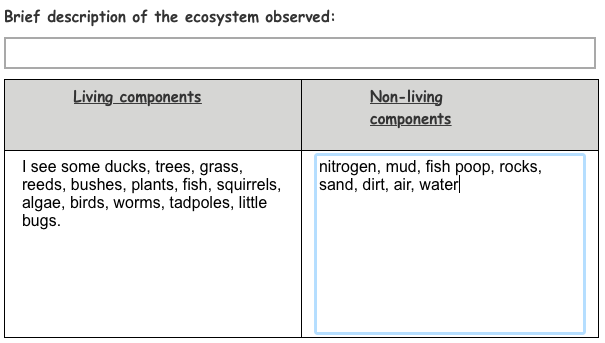
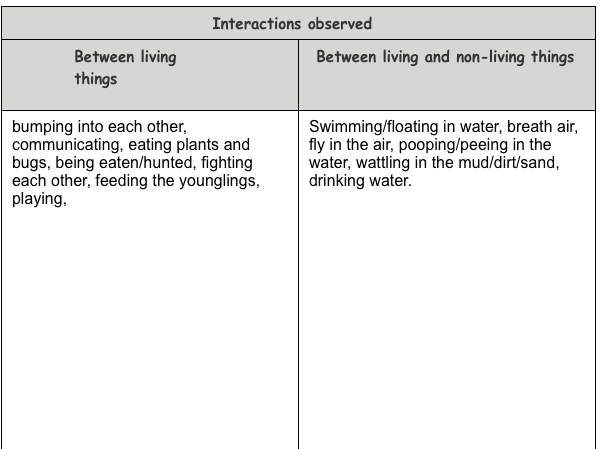
Lesson 1: What is an Ecosystem?

3/30/2016

0 Comments

 
Picture
Picture
Picture
Picture
Picture

Picture
Picture

Picture
Picture
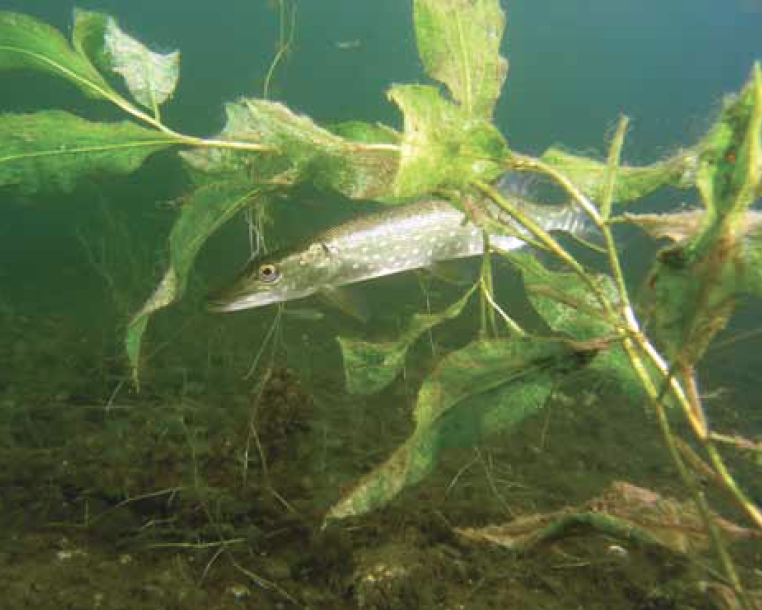
  1. What do living things get from their ecosystems?
  2. What evidence do you have to support your answer to Question 1?
  3. What does the term ecosystem mean, based on your experience in this lesson? (Don't use the definition from the BIG IDEA here. Put it into your own words.)
  4. Brainstorm at least one question you have about Ecosystems that you hope you learn from this unit.
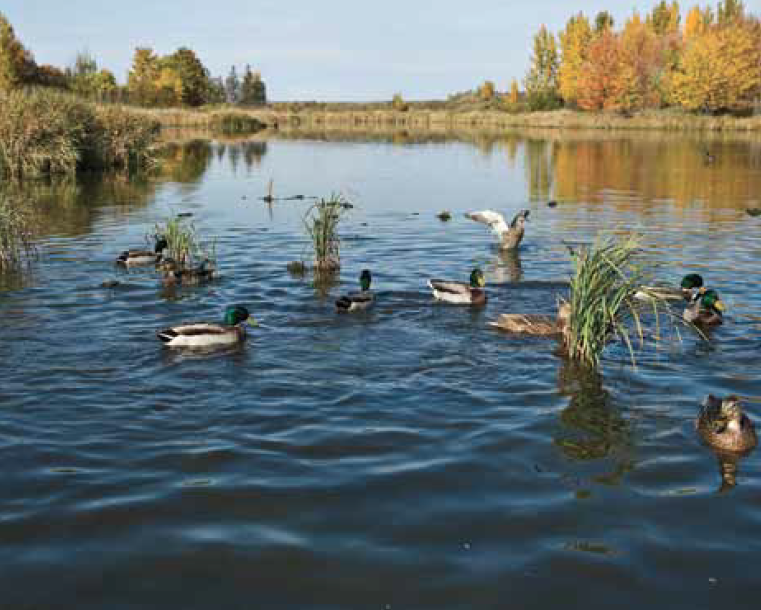
  5. Look at the image below that shows a portion of a forest ecosystem. Name at least five components (living or non-living things) of the ecosystem that you can either observe directly or infer. 
  6. What are three (or more) interactions that might occur in this portion of the forest ecosystem?
  1. Living things get a habitat from there ecosystem, in this habitat is all the things these animals need to survive.
  2. The evidence is that all animals live in a habitat and this is in a ecosystem.
  3. An ecosystem means a arrangement of living things that calibrate with others and the nonliving parts of the environment.
  4. How are ecosystems made and what is done to make one. O have this question because I'm wondering how an ecosystem starts.
  5. Some of the components are 3 deer, maybe fish, grass, rocks, trees, ants, bugs, ducks, etc.
  6. The deer eating together,  ducks flying together, fish swimming.


0 Comments

Gravity may be a problem because you weigh 38% of your weight on mars but you can jump 2.6 times higher: This can Effect transportation speed and the car bouncing., Zhang Jie, Jim Xenos, and Yuki Ito.

3/30/2016

0 Comments

 
The gravity on Mars allows us to jump higher but walk slower, but that is also a bad thing. The low amount of gravity can't be good at some points and the gravity is lower in some canyons. We will need to make chambers with gravity that is the same as Earth. The gravity inside should be around 9.77 m/s2 for it to be like Earth's. We never have been on this type of gravity before, it actually has more gravity then the Moon. Solution - People should stay active in a machine for about forty five minutes a day and transportation vehicles should be a bit heavier then the lunar rover on the moon because then it will travel faster and will not bounce as much. So then the vehicles can go farther and not bounce as much, and we will keep our muscles and bones healthy.
0 Comments

Lesson 1: What Do We Notice About Poetry?

3/29/2016

0 Comments


What is the poem about?
 What is the subject

How does the poem look on the page?

Poem 1 - I think this poem is about a kid and his skateboard riding around the town on the sidewalk. I think it is also about him and how he moves on the skate board and how he moves it. It might be about him controlling the skate board and zooming down his own little ocean and street.

Poem 2 - I think this about a kid and his/her parents playing games and calmly reading before bedtime and having all of the little critters coming and gathering around the porch. I think it is a magical/mystery poem and it is telling a reader how they seem as if there the size of humans and are clinging to the sides of the porch walls.
Poem 3 -

Poem 4 -
Poem 1 - The poem on the page looks kind of like a teardrop or sweat from him skateboarding. Or small skateboard that could be his. It also just looks like a giant blob. It could also be a type of poem format or something else.

Poem 2 - This poem looks like a magical or mystery because it is in a different pattern and looks like a bit quieter of a poem then the skateboard one. I think this.

Poem 3 -

Poem 4 -

0 Comments

Human Body Research Paper.

3/29/2016

0 Comments

 
Introduction To Human Body Research Paper:
Did you know that our bodies create about a gallon of mucus in just two days! I do. In fact, I know a lot of other interesting information about the human body and YOU WILL TOO if you read my paper! Within this document, you will find six different body system essays. These six essays focus on the muscular, skeletal, respiratory, digestive, and nervous systems, which all work together to operate our body. All of these systems have different components, each with their own unique functions that help to keep us alive. However, each system cannot operate alone - They need each other to be successful. For example, the nutrients gathered by the digestive system get distributed throughout the body in the circulatory system! Over the previous 12 weeks, we gathered information, organized our thoughts, and paraphrased what trusted websites taught us about each system. We worked with responsibility partners and our papers definitely benefited from the collaboration. Just like each human body system needs to rely on the other systems, we relied on each other to improve our writing and our process.The following is the result of our hard work...


...Our skeletal system is made up of more than 200 bones! These bones work together to provide our body with support so we can stand and can walk around,and protect our vital organs like are heart and our brain! Our bones even make and store blood cells for our circulatory system! without our bones we would just be nothing but a pile of skin, organ and muscle! we wouldn't be able to move or are muscles wouldn’t be safe.
          Our bones are made up of many layers. These layers are important because we need are bones to be strong,...


Read More
0 Comments

Colonizing Mars Lesson 6: Potential Problems

3/16/2016

1 Comment

 
List potential problems as you read about them in your book. Also be thinking about other problems not mentioned that we should be considering.


Write a journal entry about what you learned from the perspective of your persona.  Be "in character" while writing and express some of your concerns & worries in your writing.

Include some of the other personas in your writing to make it feel more real.  Publish live and then comment on others' writing.


I have learned that mars is not that simple to go to and that our chance of surviving  without without the right stuff is 0%. Also I am wondering how the doctors 

Ingrid Kristiansen and Zuzanna Nowak will learn to fight off martian diseases that could come up. I am looking forward to the trip ahead and hoping our pilots Mert Dogan and Mohamed Farooqui fly well to mars. I am scared because of all of the big dangers on mars, it will never be safe there because of dust storms, water shortages and the freezing temperatures. I will have trouble making cars that are suitable for the mars and the gravity, also the insane shortage of pressure.
  • Problems -
  • Years are twice as long
  • One day on mars is only 37 minutes longer than our day
  • Low gravity, you would weigh about a third of your weight. You could jump 2.6 times higher.
  • All land, no large oceans, the planet is all land. No large water sources for people.
  • Monster land forms - It has giant volcanoes, huge canyons, dried up rivers, and vast dune fields. Lots and lots of craters from asteroids that have crashed into them. Asteroids can crash into the planet while we are there.
  • Invisible water - all of the water is frozen water at the north and south poles also frozen under ground. There is also vapor in the air.
  • Global dust storms - HUGE dust storms, they can last for weeks, can break stuff, and almost kill people with the winds, and can take up the whole planet at times.
  • suffocating air - Mars has an atmosphere but, is made mostly of carbon dioxide.Which is the gas our bodies exhale. We would die if we breath it in, because we can not filter it.
  • Super Low pressure - Mars has very thin air, the air pressure is super low, if you would go on mars without anything protecting your body, you would explode!
  • Freezing temps - coldest temp at the poles is negative 225º! but can get to almost 70º at the equator, but -80º during the winter.
  • Chocking hazard - The red dust is rust, but is dangerous so if you breath it in you could die of chocking. It is red because of all of the dust on the planet.
  • Zapping Rays - The radiation from the waves could cause cancer and death. So we would need something to protect us from them.
  • Are there aliens on mars, will they do stuff to us, how will we react to it, and what will we do to them.
  • MARTIANS/ALIENS!!!


1 Comment

Supplies for Mars - Ben

3/7/2016

0 Comments


Personal Supplies


  • Automotive Engineer
  • Picture O' Fam
  • phone 7s PS4
  • Drone
  • Go-pro Hero 4 Silver
  • Star Wars Battle front
  • Hover board
  • 75" 4k TV


Job Supplies

  • Automotive Engineer
  • Radio
  • 12 tires fit for mars surface
  • Google glasses
  • Blow Torch
  • Four .25 horsepower electric engines
  • Two silver oxide electric motors
  • 30 mile gas tank
  • Level
  • Tape measure
  • Wires
  • 1 speed straight drive gear box
  • Cooling fans in the motor
  • Steering wheel for car

Reflection Questions and Answers -

Reflection Questions -
  1. Choose two personal items to explain why you're bringing them.
  2. Explain how you plan to use the work supplies (in paragraph form.)
Reflection Question Answers -
  1. I am bringing a Go pro hero 4 silver because then I can get good pictures of mars and videos of the martian surface while running on it. It is also important for putting on the car that I will make so it can discover new land. I am also bringing a drone so I can see the area around me and far away without having to go exploring way out there. It is also important for finding new things on the martian surface. I plan too also use my google glasses for work because they can show images inside the lense of the car's blue print so I can make and design the car as I go. I also plan On using the two silver oxide motors that they also used on the moon. I plan on using these for storing the battery for the solar panel energy. So that is the stuff I am bring for my job and other things for mars!


0 Comments

14 - How Our Muscles Know When to Move

3/2/2016

0 Comments

 
Picture
Picture

15 - Dilated and undulated Pupils.

Reflection Questions

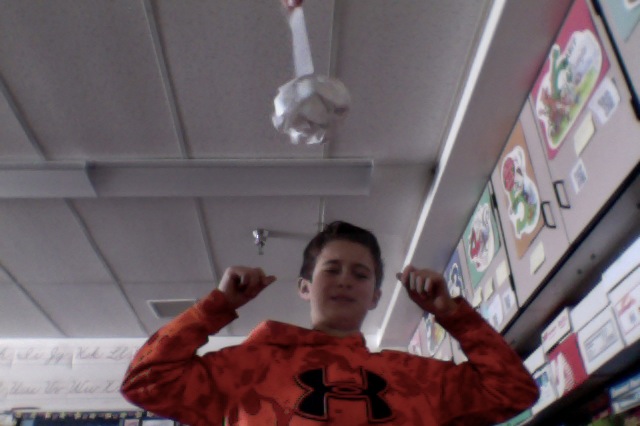
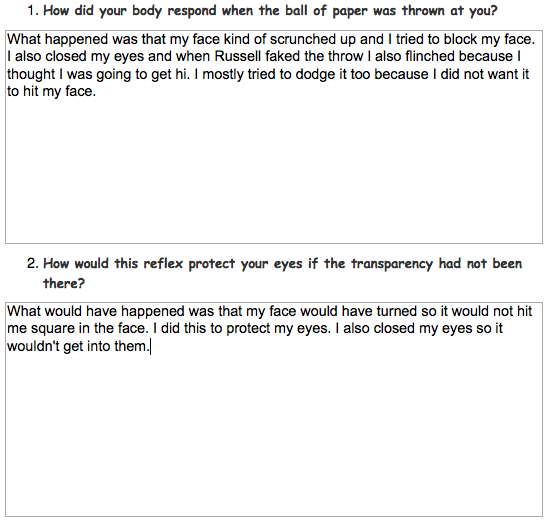
1. Can you feel it when your pupils dilate?

2. Do you have any control over your pupils when they dilate?

3. What do we call this when a reflex happens without our control?

4. Why do our pupils get bigger in the dark and smaller in the light?

5. How does this reflex protect our eyes?

Dilated and Undiluted Eyes

Reflection Question Answers

  1. No I can't because I don't have much control over them and they are very light movements.
  2. Not really because the reaction is not by me, it is just what my brain decides them to do, so I don't really have any control over them.
  3. Involuntary or automatic movement.
  4. They get bigger in the dark because we can't see as well so they open up so we can see more, and they get smaller when there is a lot of light so you don't hurt your eyes.
  5. This protects your eyes because if it is very bright out and you open them it could damage your eyes, if it is very dark and can't see well you might run into something or trip and hurt yourself.


15 - Reaction to Catching Ruler with Senses.

Reflection Questions -
  1. Was it more difficult to catch the ruler using one of the senses as compared to the other? Explain.
  2. How could you use only the sense of smell to catch the ruler? And the sense of taste?
  3. Explain how your senses, nerves, brain, and muscles in your fingers helped you to catch the ruler for one of the senses explored. Use pages 17-23 of your student reference book to help you.
  4. Do you think the nervous system responded to catching the ruler and blinking in the same way? Why or why not? Were the senses used in both? Were muscles used in both? Did you have to think about both actions?
Reflection Questions Answers -
  1. It was the most difficult for the sense of touch because the person was poked in the arm which is farther from the brain then the eyes and ears so it took longer for the person to realize that they were poked then if the saw something with there eyes which were much closer to the brain. So the sense of touch was the hardest because the nerve had farther to travel to feel it.
  2. You could use the sense of smell by spraying something that had a strong smell into the air to tell the person that they should try to catch the ruler before it falls through, the sense of taste could be poring some water into there mouths to also tell them to reach and grab the ruler. The sense of smell could also be done with food but would be much more difficult then doing it with water.
  3. Yes because they both used muscles and it took almost the same amount of time for you eyes to send the brain a message down to your arm to then catch the ruler. You don't have to think as much about the blinking but needed more to catch the ruler. It would take longer for you to catch if you were poked in the arm because the message to your brain would be farther away then your eyes so it would be harder to catch it like that.
  4. No because blinking you can't control unless you think about it but when you see the ruler dropping in front of you, your going to want to try to grab it so you are mainly controlling the reflex of catching the ruler.


0 Comments

2 - What do you already know about Mars?

3/1/2016

0 Comments


Notes and question answers for lesson 2 -

  1. What do you know about NASA's plans to visit Mars?
  2. How long will the trip take?
  3. What supplies and equipment will the astronauts need to survive there?
  4. What do you think are the risks of traveling to such a distant planet?
  5. What would you want to bring with you?
  1. The journey is 250 million miles, it would last 2 and a half years with 18 months on mars, mars is a third of the size of earth, its volcanoes are as wide as the state of Missouri, the tallest mountain is three times taller then Everest, some valleys are as wide as the grand canyon is long, gravity is less then half it is here on earth, days are only a few minutes longer, but a year is twice as long, all of the water is under ground or frozen in the ice caps,
  2. It will be 6 months there, it is 250 million miles away, it would last 2 and a half years with 18 months spent on the surface of mars. 102 days to reach half way point.
  3. the risks are loss of muscle strength and because of the long journey it is hard to even walk. you can lose bone because of sleeping upside down, eating doesn't taste good.
  4. They will need food, water, exercise machines to keep a person in shape, without them they would die very quickly or become very weak.
  5. I know that I would like to bring some stuff for my job (The automotive engineer) such as motors, solar panels, and stuff that I will need to build it like screw drivers, levels, etc. I am also bringing some personal stuff such as some video games, go pro, google glasses, and more.
0 Comments

    Author

    Write something about yourself. No need to be fancy, just an overview.

    Archives

    June 2016
    May 2016
    April 2016
    March 2016
    February 2016
    January 2016
    December 2015
    November 2015
    October 2015
    September 2015
    August 2015

    Categories

    All
    Ecosystems
    Poetry
    Reading
    Science
    Writing

    RSS Feed

Powered by Create your own unique website with customizable templates.