What's going on in Mr. Solarz' Class?
What's going on in Mr. Solarz's Class?
  • Parents (Newsletter)
    • Our Online Photo Album >
      • 2018-2019 Photo Album
      • 2017-2018 Photo Album
      • 2016-2017 Daily Photo Journal
      • 2016-2017 Daily Photo Journal - Album 2
      • 2015-2016 Daily Photo Journal
      • 2015-2016 Yearbook
      • 2014-2015 Daily Photo Journal
    • Our YouTube Channels >
      • 2018-2019 YouTube Channel
      • 2017-2018 YouTube Channel
      • 2016-2017 YouTube Channel
      • 2015-2016 YouTube Channel
      • 2014-2015 YouTube Channel
      • 2013-2014 YouTube Channel
      • 2012-2013 YouTube Channel
      • YouTube videos over the years
      • Learn Like a PIRATE videos
    • Calendar
    • Our Weekly Schedule
    • FAQ about our classroom
    • Curriculum Night Presentation
  • Educators
    • Danielson Framework >
      • Domain 1 - Planning & Preparation
      • Domain 2 - Classroom Environment
      • Domain 3 - Instruction
      • Domain 4 - Professional Responsibilities
      • Professional ePortfolio
      • Instructional Coach Evidence
      • Experience Logs
    • FAQ about our Classroom
    • Workshops
    • Our Classroom Library is for Sale
  • Curriculum
    • Science Units >
      • 5th Grade >
        • Human Body Unit >
          • Human Body Links
        • Ecosystems >
          • Ecosystems - Legends of Learning
        • Watery Earth >
          • Watery Earth Links
        • Earth in Space
        • Investigating Matter
      • 4th Grade >
        • Energy >
          • Energy Unit Notes
          • Energy Debates
          • Energy Debate Organizers
        • Our Geosphere
        • Waves
      • Science Fair
      • STEM Investigations!
      • Try Engineering Together
    • Social Studies Units >
      • 5th Grade >
        • Revolutionary War >
          • Liberty's Kids Videos
          • Revolutionary War Hero Project >
            • RWHP Directions
        • U.S. Constitution & Government >
          • Mini Lessons
          • Colonize Mars! >
            • Claiming Mars for Ourselves >
              • 2017-2018 Creating our Country on Mars
              • 2016-2017 Mars Decisions
              • 2015-2016 Claiming Mars for Ourselves
              • 2014-2015 Claiming Mars for Ourselves 2015
            • Solutions to Problems on Mars >
              • 2017-2018 Our Solutions to Problems on Mars
              • 2016-2017 Problems & Solutions
              • 2015-2016 Our Solutions to Problems
              • 2014-2015 Our Solutions to Problems
            • 2014-2015 "Mission: Mars" Video Discussions 2015
          • Project Citizen
        • Westward Expansion >
          • Oregon Trail Simulation
          • Oregon Trail Readings
          • Reflection Rotation >
            • 2017-2018 Reflections >
              • ThingLink Photo Stories
              • Green Screen Tableaux Vivants
              • Fictional Travel Blog
              • Canva Concept Cards
              • YouTube Newscasts
              • Google Slide Show
              • Daily Travel Blog
              • Act-It-Outs
            • 2016-2017 Reflections
            • 2015-2016 Reflections >
              • Voki Reflections >
                • Voki Blog
            • 2014-2015 Reflections >
              • Act-It-Outs
              • Timeline Spreadsheet
              • Newscasts
              • ThingLink >
                • ThingLink Images
                • Sign up for ThingLink
              • Google Slideshow
              • Fictional Travel Log
              • Daily Travel Log
              • Tableaux Vivants
              • Photo Stories
      • 4th Grade >
        • Geography
        • Explorers
        • Native Americans
        • Colonization
        • State of Sustainability
      • Presidential Election Simulation - 2012 >
        • Presidential Election Simulation - 2016
      • Current Events
    • Reading >
      • 5th Grade Units >
        • Literature Circles >
          • Literature Circles >
            • Video Discussions
          • Literature Circles >
            • Video Discussions
            • Activities
        • Schoolwide Launch
        • Schoolwide Fiction
        • Schoolwide Non-Fiction
        • Schoolwide Ecosystems
        • Schoolwide Poetry
        • Wonder >
          • Wonder
        • The Phantom Tollbooth >
          • Phantom Tollbooth Assignments
      • 4th Grade Units >
        • Schoolwide Launch
        • Schoolwide Fiction
        • Schoolwide Non-Fiction
        • Schoolwide Poetry
        • Schoolwide Energy
    • Writing, Spelling & Grammar >
      • Writing >
        • Writing City
        • WEX
        • WriteAbout
        • Reflection Writing
        • JoonBugz
      • Spelling >
        • Words Their Way
      • Grammar >
        • Grammar
    • Math >
      • Money Island
      • Math in Focus
    • Miscellaneous >
      • Activities >
        • Short-Term Projects
        • Challenges!
        • Special Events
        • Projects & Mini Lessons
        • Bonus Activities
        • Miscellaneous >
          • Honor Badges
          • Growing a Growth Mindset
      • Imagination Club >
        • Schedule
        • Daily Ritual
        • Mini-Lessons
        • Photo Journal
        • Student Creations Round 1
      • Mystery Skype
      • Entrepreneurship Unit >
        • Entrepreneurship - Creating Our Own Businesses!
      • Self-Reflection
      • KinderPals
  • Student ePortfolios
    • 2018-2019 ePortfolios >
      • Students 1-7 >
        • 1 - Isabel
        • 2 - Alexis
        • 3 - Oscar
        • 4 - Adrian
        • 5 - Edy
        • 6 - Matthew
        • 7 - Molly
      • Students 8-14 >
        • 8 - Joey
        • 9 - Jeremiah
        • 10 - Emmalina
        • 11 - Sama
        • 12 - Hazel
        • 13 - Nick
        • 14 - Filip
      • Students 15-21 >
        • 15 - Nellie
        • 16 - Landon
        • 17 - Molly
        • 18 - Harrison
        • 19 - Kali
        • 20 - Inti
        • 21 - Ryan
        • 22 - Pavel
      • Blog Assignments
    • 2017-2018 ePortfolios >
      • Students 1-9 >
        • Elle
        • Daniel
        • Tommy
        • Alyssa
        • Gavin
        • Milosz
        • Mikey F
        • Caitlin
        • Brynna
      • Students 10-17 >
        • Kya
        • Olivia
        • Ian
        • Colin
        • Owen
        • Gianna
        • Isabella
        • Carmen P
      • Students 18-25 >
        • Lucy
        • Caleb
        • Mikey S
        • Wes
        • Martin
        • Will
        • Shaun
        • Carmen W
      • Blog Assignments
    • 2016-2017 ePortfolios >
      • Students 1-8 >
        • Hailie
        • Jody
        • Madison
        • Dylan
        • Calvin
        • Connor
        • Louisa
        • Harvey
      • Students 9-16 >
        • Anna
        • Jack
        • Ben
        • Elijah
        • Catelyn
        • Cole
        • Abby
        • Ashley
      • Students 17-23 >
        • Charles
        • Michelle
        • Charlie
        • Daniel
        • Sam
        • Chingoon
        • Kyren
      • Blog Assignments
    • 2015-2016 ePortfolios >
      • Students 1-9 >
        • TJ
        • JJ
        • Bridget
        • Alex
        • Mason
        • Ryan
        • Lucas
        • Shreya
        • Logan
      • Students 10-18 >
        • Charlotte
        • Addie
        • Aidan
        • Andrew
        • Jeremy
        • Rachel
        • Russell
        • Addy
        • Cassidy
      • Students 19-26 >
        • Audrey
        • Regan
        • Giuliana
        • Brady
        • Stephen
        • Matthew
        • Ben
        • Tyler
        • Thomas
      • Blog Assignments
    • 2014-2015 ePortfolios >
      • Students 1-7 >
        • 1 - Michael
        • 2 - Charlie
        • 3 - Nicole
        • 4 - Stacy
        • 5 - Bela
        • 6 - Kendall
        • 7 - Demetri
      • Students 8-14 >
        • 8 - Emily
        • 9 - Nicky
        • 10 - Hanna
        • 11 - Payton
        • 12 - Hasanain
        • 13 - Tucker
        • 14 - Chris
      • Students 15-21 >
        • 15 - Madi
        • 16 - Aidan
        • 17 - Luke
        • 18 - Kaela
        • 19 - Ryan
        • 20 - Alison
        • 21 - Lucas
      • Blog Assignments
  • Passion Time
    • Passion Time Resources >
      • ALL Passion Time Resources
      • Step-By-Step Directions
      • Submit Your Essential Question
      • Our Trello Page
      • Our Passion Projects over the years
      • Our Trello Board
      • SAMPLE Blog Post Format
      • YouTube Upload Page
      • Mini-Lessons
    • 2018-2019 Projects >
      • Round 1
      • Round 2
      • Round 3
      • Round 4
    • 2017-2018 Projects >
      • Round 1
      • Round 2
      • Round 3
      • Round 4
      • Round 5
    • 2016-2017 Projects >
      • Submit Your Essential Question
      • Mini-Lessons
      • Round 1
      • Round 2
      • Round 3
      • Round-4
      • Round 5
      • Round 6
    • 2015-2016 Projects >
      • Round 1
      • Round 2
      • Round 3
      • Round 4
    • 2014-2015 Projects >
      • Round 1
      • Round 2
      • Round 3
      • Round 4
      • Round 5
      • Round 6
  • Student-Led Classroom Info
    • Our Learning Experiences
    • 21st Century Skills
    • Whole Class Goals
    • Individual Goals
    • Classroom Jobs
    • Collaborative Responsibilities
    • Rituals & Routines
    • Uses of "Give Me Five"
    • Student-Led Mini-Lessons
    • Lit Circle Signposts
    • Mystery Skype Jobs

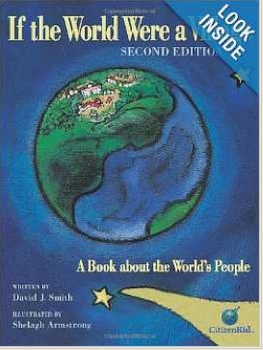
If the World Were a Village

2/24/2016

0 Comments

 
Picture
  • Explain what surprised you about the statistics of our world.
  • What upset you?  What do you wish were different?
  • What made you want to do something to improve a situation?
  • Can you do anything to help? If so, what?
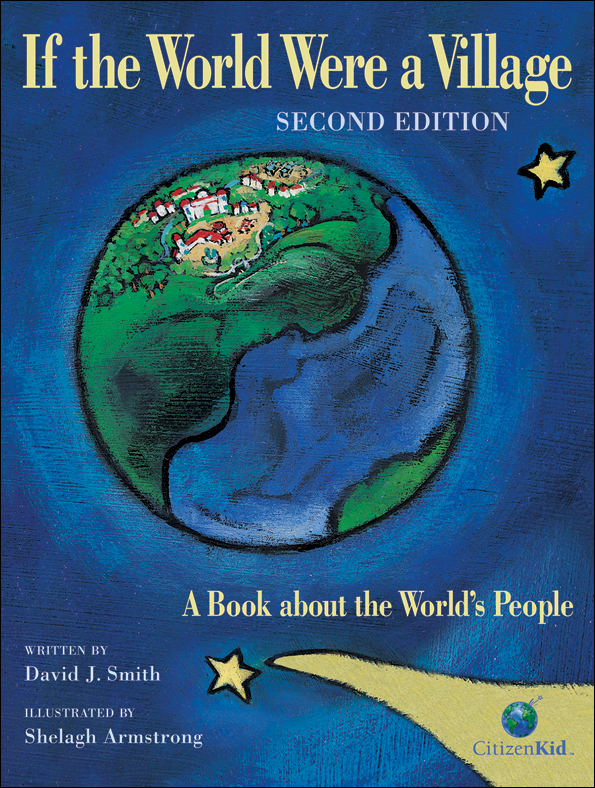
I was really surprised about our world because of how many people did not have the things that most of the people in the world have like food, water or a nice, warm place to live. I was also surprised by how Arlington Heights has more stuff than other countries or states. One thing that did upset me though was that people did not have access to a lot of food and water and that makes me upset because food and water is what we need to be able to live (also shelter). I was upset by how many people in the world don't have food or water or even both. Seeing people in our world live a life without shelter, food, water, electricity, and even other things wanted me to improve people getting water and food because it is not fair if not everyone in the world has food, water, shelter, or electricity. I would do everything I could to help those people who need those supplies. I would start a little business that helps those people and donates clean water, healthy food, gives those people a warm home, and everything that would make those people happy. Then, when they will be happy, the whole world will be happy and everyone will appreciate what you have done to help the world grow and become a better and helpful place!
0 Comments

13 - How Our Muscles Get the Nutrients They Need

2/19/2016

2 Comments

 
Picture
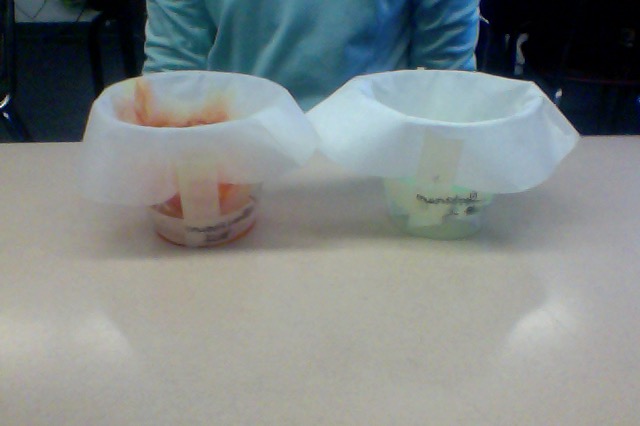
  • I noticed that bloodstream 2 didn't rip at all and nothing changed at all. The liquid didn't drain down all the way to the cup. I noticed that bloodstream 2's coffee filter is dry but bloodstream 1's filter is completely wet. I think that the meat tenderizer did what it did because like in the body, the large intestine took out all the nutrient and vitamins and all the good stuff so the bloodstream 2 looks like paste and is kind of dry. All the liquid from the paste went all the way down at the bottom of the cup. I noticed that in bloodstream 1 all the liquid drained to through the coffee filter and that everything is at the bottom of the cup. I also noticed that inside the coffee filter, it doesn't have as much liquid in blood steam 1. I think that all the liquid is at the bottom of the cup because
Questions:
1. How are the two cups different and why?
2. What process in the human body is demonstrated by the liquid in the bottom of the cup?
3. What process in the human body is demonstrated by the wet coffee filter?
4. How does this lab help us understand digestion?
Answers:
1. The two cups are different because one cup doesn't have liquid at the bottom of the cup and the other cup has liquid at the bottom of the cup. They are also different because one cup's coffee filter is completely wet but the other cup's coffee filter is completely dry. I think why they are different because one cup has been using meat tenderizer but the other cup hasn't used it.
2. The process in which the human body does that represents the liquid at the bottom of the cup is the chyme which is nutrient and all the good stuff from the food we eat. The large intestine picks out all the good stuff from the chyme and whatever the large intestine didn't pick up is waste.
3. The process in which the human body does that represents the wet coffee filter in both cups is the chyme that is spread all around the large intestine. Like  I said in question number 2, the large intestine picks out all the good stuff from the chyme and delivers it to the cells in our body so the cells can have the nutrient the also need.
4. I believe that this lab and the experiment that we today helps us understand digestion better because it shows us exactly what the large and small intestines do. It also shows us about chyme.  
2 Comments

Colonize Mars: If the World Were a Village

2/18/2016

0 Comments

 
Picture
  • In 2012, the population was 7.05 billion people
  • India and China are the most populated countries
  • Of the 100 people in the village:
  • 60 are from Asia or 60%
  • 15 are from Africa 15%
  • 11 are from Europe or 11%
  • 8 are from South America or 8%
  • 5 are from Untied States and Canada combined or 5%
  • 1 from Oceania or 1%
  • In the global village, there are 6000 languages
  • 21 speak Chinese
  • 9 speak Hindi
  • 9 speak English
  • 7 speak Spanish
  • 4 speak Bengali
  • 4 speak Arabic
  • 3 speak Portuguese
  • 3 speak Russian
  • Ages In the global village: The ages were between 5 and 79 years of age.
  • Religions in the global village:
  • 33 are Christine
  • 22 are Muslim
  • 15 are non religious
  • 9 practice other folk religion
  • 5 are Buddhists
  • 2 belong to other global religions
  • 100 years ago there was 12 Muslims compared to 22 today.
  • Food in the global village: There are :
  • 31 sheep and goats
  • 23 cows, bulls and oxen
  • 3 camels
  • 2 horses
  • 30 people in the village are sometimes hungry but have enough food so they will not die and 17 people are not fed that well and always hungry and have a greater chance to die of hunger.
  • For some people in the village, the air and water is polluted and that could put them in the risk of diseases.
  • 87 people in the village have access to a water source but 13 of the people in the village don't have the water, the water is far away from their home and they have to walk far away from home to just get their water.
  • 62 people have the access to sewage disposal but that means 38 of the people don't have that so they also have a greater risk of getting diseases.
  • 68 of the people breathe clean air but 32 of those people in the world breathe air that has dirt and has pollution in the air and when you breathe it you also have a greater risk of diseases.
  • 36 of the people in the village that are school aged but don't go to school but 30 of the people in the village go to school. The 6 other people in the village who are children should be in school but instead work for their families. The remaining 3 of the children are child labors.​
  • Each person in the global village makes/has about $10,300 US Dollars per year. The richest 10 people have nearly 85% of the world's wealth. Each 10 people have at least $87,500. The poorest 10 people each have less than $2 each day. They make less than a $1,000 each year. Half the people in the village average $6 a day or less. The average cost for food, shelter, and other things cost more than $5,000 a year. 50 people have radios, 45 people have television, 103 people have telephones, 28 people have computers. People also have 2 trucks, 10 automobiles, and 20 bicycles.
  • Only 76 people in the global village have electricity but 24 people do not have electricity.
  • The 76 people in the village use the energy for light only at night.
  • 73 percent of the village's energy comes from fossil fuels: coal, oil and gas. 17 percent of the village's energy comes from nuclear power. 10 percent comes from renewable sources such as wind and water.
  • In 1850 a newborn was expected to live to 38 years. But in 1900 a newborn was expected to live to 47.
  • Malaria is the reason that is killing people in the global village. About 80 people in the global village, get vaccination to be protected from deadly diseases.
  • In 1000 BC: 1 people lived in the village.
  • In 500 BC: 2 people lived in the village.
  • In 1 CE: 3 people  lived in the village.
  • In 1000: 5 people lived in the village.
  • In 1500: 8 people lived in the village.
  • In 1650: 10 people lived in the village.
  • in 1800: 17 people lived in the village.
  • in 1900: 32 people lived in the village.
  • in 2012: 100 people lived in the village.
  • If there are 100 people in the year 2012, there will be more than 101 people in 2013 and so on. Around the year 2150, there will be 250 people in the village and most of the scientist believe that 250 is the largest number that our world can sustain.

0 Comments

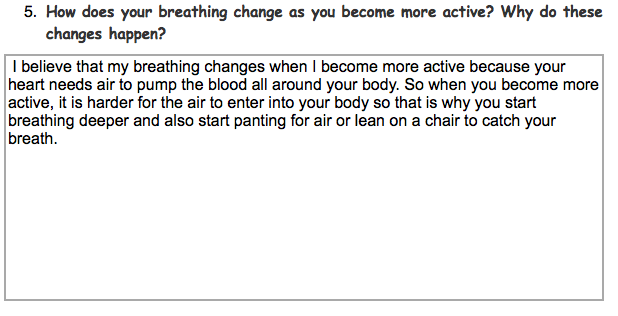
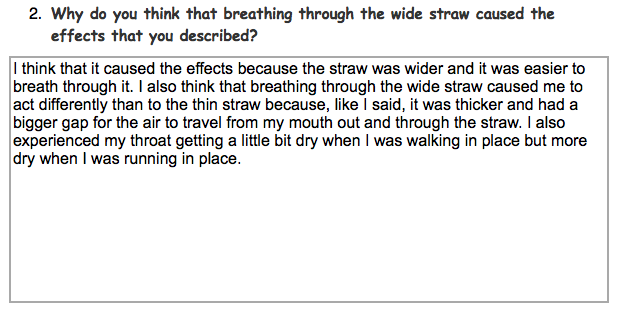
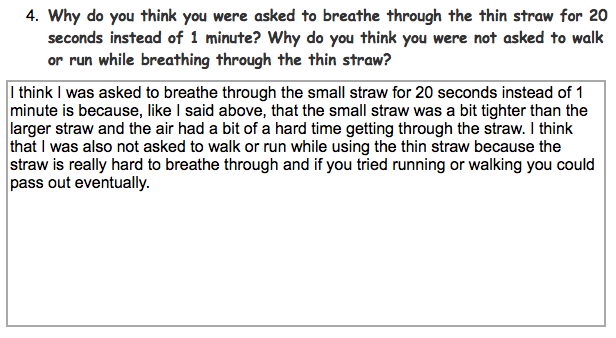
12 - Breathing Hard for Our Muscles

2/8/2016

0 Comments

 
Picture
Picture
Picture

Questions:

Picture
Picture


Answers to Questions:


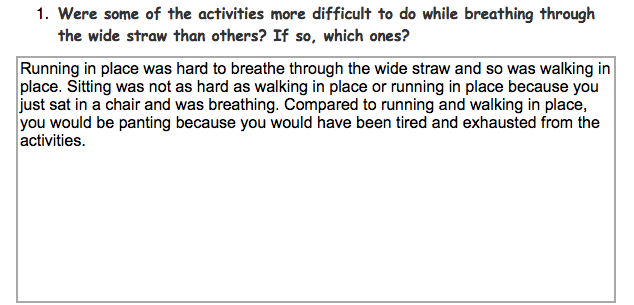
  1. What did breathing through straws represent?
  2. Why should we have this experience?
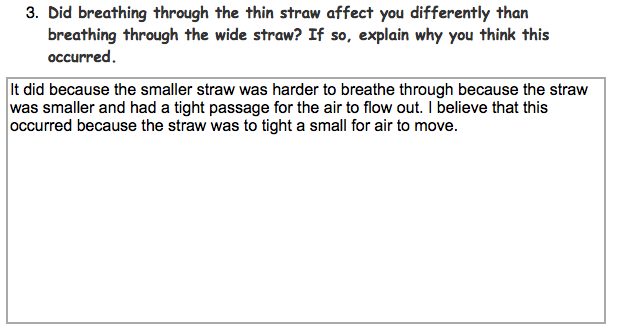
  3. It was difficult to continue moving when you breathed through the straw. Why is that?
  4. What are some things that affect the respiratory system and make it harder to breathe?
  5. How would your daily life be affected if you could only breathe in small amounts of air with each breath?


1. Breathing through straws represented that people who have asthma and other breathing problems have a hard time to breath and that it is hard for them to do physical activities when they can not breathe so well. It also represents that you are able to compare people who don't have the breathing problems (wide straws) with the people who have breathing problems like asthma (thin straw). 
2. You should have this experience with the straws and everything to, like I said, you can easily compare what life is to people who have breathing problems like asthma to people who are perfectly fine with their breathing. You can also learn that breathing is important to our life. 
3. It was difficult to continue moving while I was breathing through the straw because you were thinking about breathing so much that during different periods while doing the experiment, you just stopped moving because you were paying more attention to breathing. It could also go that you were paying more attention to moving and trying not to spit on others that you stopped breathing through the straw.
4. Sometimes you have a stuffy nose and that can affect the respiratory system because the air gets into the body from the nose or the mouth and when you have a stuffy nose, then it is harder for the air to enter the body. 
​5. Your daily life would really be affected because you would only be able to take in deep breaths but what if you like just finished a race and need deep breaths. You would just pass out or die because not enough air entered the body quick enough to save you from the death. Another reason would affect your daily life would be that it would be really hard for you to sleep because you would just be taking quick, small, breaths and you have to be calm and relaxed to sleep. So that would ruin your time to sleep. 
0 Comments

    Author

    Write something about yourself. No need to be fancy, just an overview.

    Archives

    June 2016
    May 2016
    April 2016
    March 2016
    February 2016
    January 2016
    December 2015
    November 2015
    October 2015
    September 2015
    August 2015

    Categories

    All
    Ecosystems
    Oregon
    Poetry
    Reading
    Science
    Writing

    RSS Feed

Powered by Create your own unique website with customizable templates.